
Open-raise sizing is one of the first preflop decisions you learn, and one of the easiest to make too automatically.
You do not need a perfect size for every hand. You do need a default that makes sense, and you need to know when to change it.
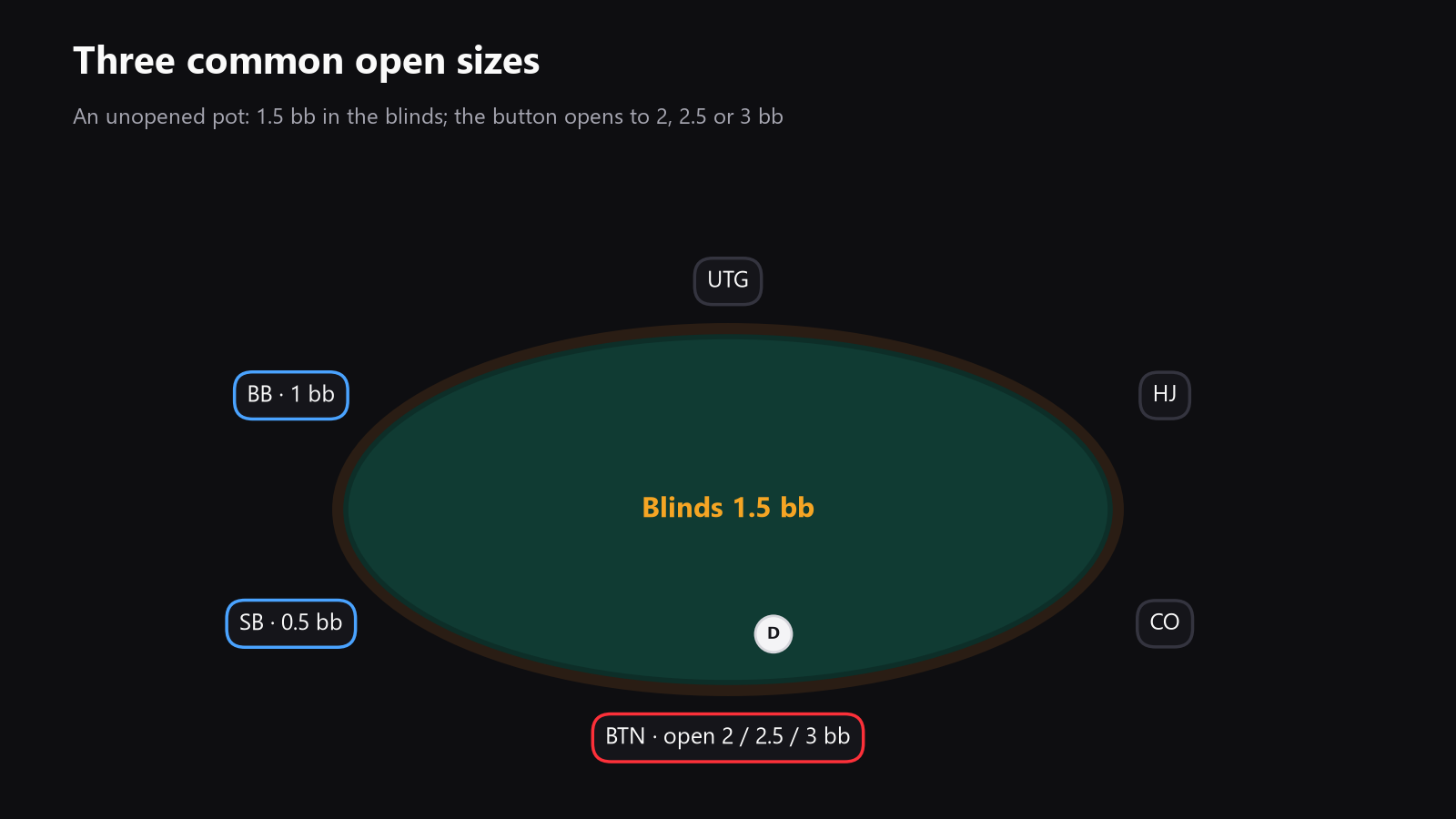
In most online games, a standard open sits somewhere between 2 and 3 big blinds. That range is not random. A smaller open risks less, keeps the pot manageable, and gives the blinds a better price to continue. A bigger open risks more, wins the blinds more often when they fold, and forces tighter continues.
That is the whole subject in one sentence. The details matter, because the right size changes with position, limpers, stack depth, table softness, and antes.
The default open size, and why it exists
If you want a practical default, start here:
| Spot | Common open size | Why it works |
|---|---|---|
| Early position in cash | 2.5 big blinds to 3 big blinds | You are opening into more players, so you want a size that still gets respect |
| Middle and late position in cash | 2 big blinds to 2.5 big blinds | You attack dead money efficiently and keep the pot under control |
| Small blind when folded to you | 2.5 big blinds to 3 big blinds | You are out of position for the rest of the hand, so a larger size helps |
| Tournament spots with antes | Often smaller than cash | The pot is already larger, so you can risk less and still steal well |
The right size is not about looking clever. It is about balancing three things:
- How much money is already in the pot.
- How often the blinds fold.
- How well your hand and range play after the flop.
If the blinds overfold, a bigger size can print more. If they defend too much, a smaller size often keeps your risk in check while still getting action from worse hands.
What a bigger open changes
When you change your open size, you change the pot in four ways.
1. You change the blinds’ price to continue
In an unopened cash game pot, there is 1.5 big blinds in blinds before you act.
If you open to 2 big blinds, the big blind has to put in 1 big blind more.
If you open to 2.5 big blinds, the big blind has to put in 1.5 big blinds more.
If you open to 3 big blinds, the big blind has to put in 2 big blinds more.
That is a real change in price, and it matters.
Here is the raw equity the big blind needs to continue, ignoring postflop skill and future betting:
| Your open size | BB must call | Final pot after call | Raw equity needed |
|---|---|---|---|
| 2 big blinds | 1 big blind | 4.5 big blinds | 22.2% |
| 2.5 big blinds | 1.5 big blinds | 5.5 big blinds | 27.3% |
| 3 big blinds | 2 big blinds | 6.5 big blinds | 30.8% |
A bigger open makes the blind’s continue harder.
That is good when the pool folds too much. It is bad when the pool continues too wide and plays well postflop.
2. You change your own risk
If you open to 2 big blinds and everyone folds, you win 1.5 big blinds.
If you open to 3 big blinds and everyone folds, you win the same 1.5 big blinds, but you risk more to get it.
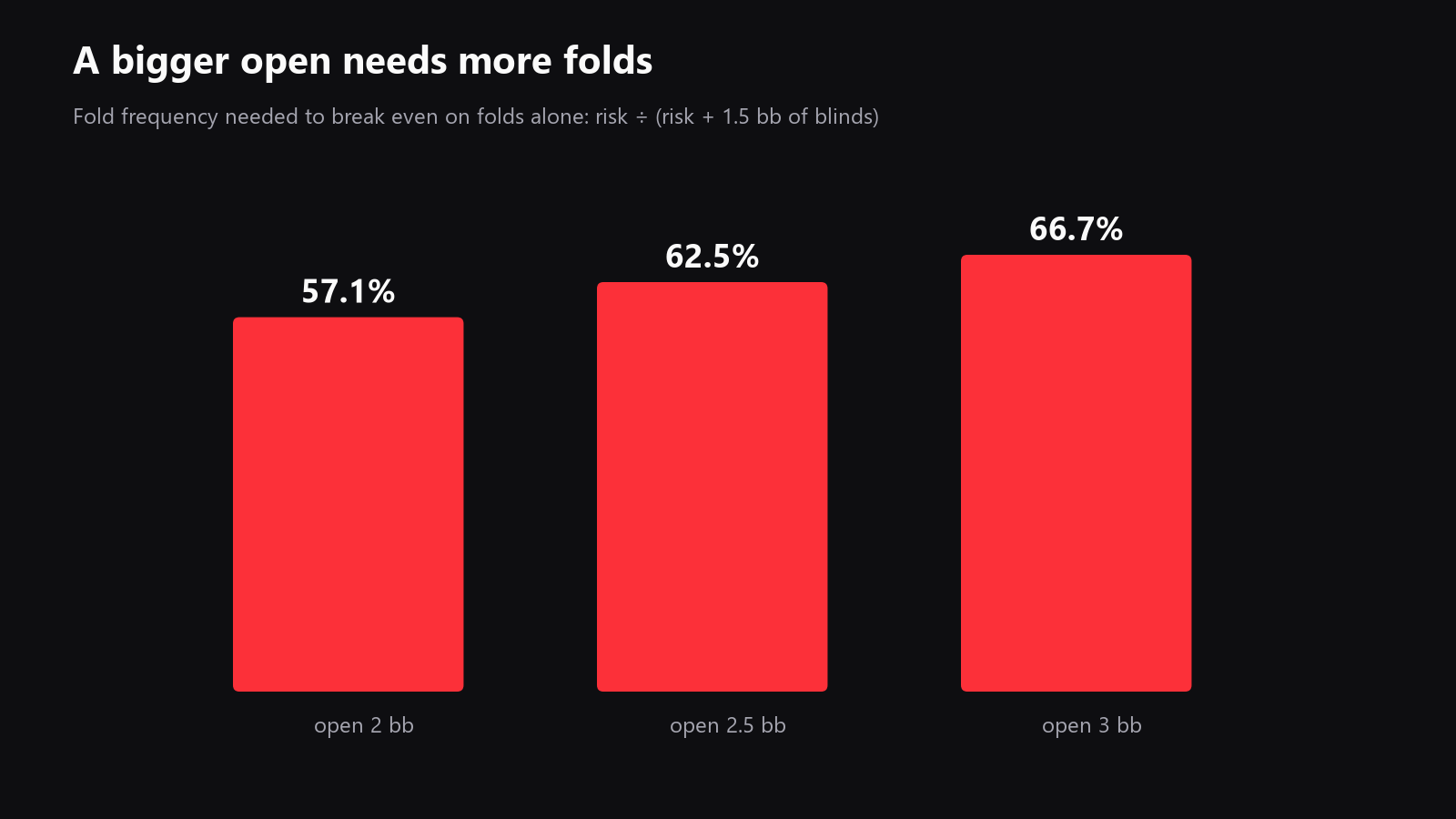
That means your break-even fold requirement rises as the size rises.
A simple way to see it:
| Open size | Risk | Reward if all fold | Fold frequency needed just to break even |
|---|---|---|---|
| 2 big blinds | 2 big blinds | 1.5 big blinds | 57.1% |
| 2.5 big blinds | 2.5 big blinds | 1.5 big blinds | 62.5% |
| 3 big blinds | 3 big blinds | 1.5 big blinds | 66.7% |
So if you move from 2 big blinds to 3 big blinds, you need a much higher fold rate before the open is profitable on fold equity alone.
That is why size should reflect the pool. A bigger open is not automatically better.
3. You change the stack-to-pot ratio
A larger open creates a larger pot before the flop, so the stack-to-pot ratio drops.
That means postflop decisions get more committed, faster.
A 2 big blind open keeps the pot smaller and leaves more room to maneuver.
A 3 big blind open makes top pair, overpairs, and strong draws easier to stack off with, but it also means you have less room to avoid trouble.
That is one reason small opens are common online. They keep your range flexible.
4. You change how often your bluffs and value hands get called
This is the strategic part many players miss.
Open sizing is not only a bluffing tool. It affects your entire range.
If you size up only with strong hands, observant opponents notice.
If you size down only with weak hands, observant opponents notice too.
A good default size should work for your whole opening range, not just for your monsters.
Why limpers call for a bigger size
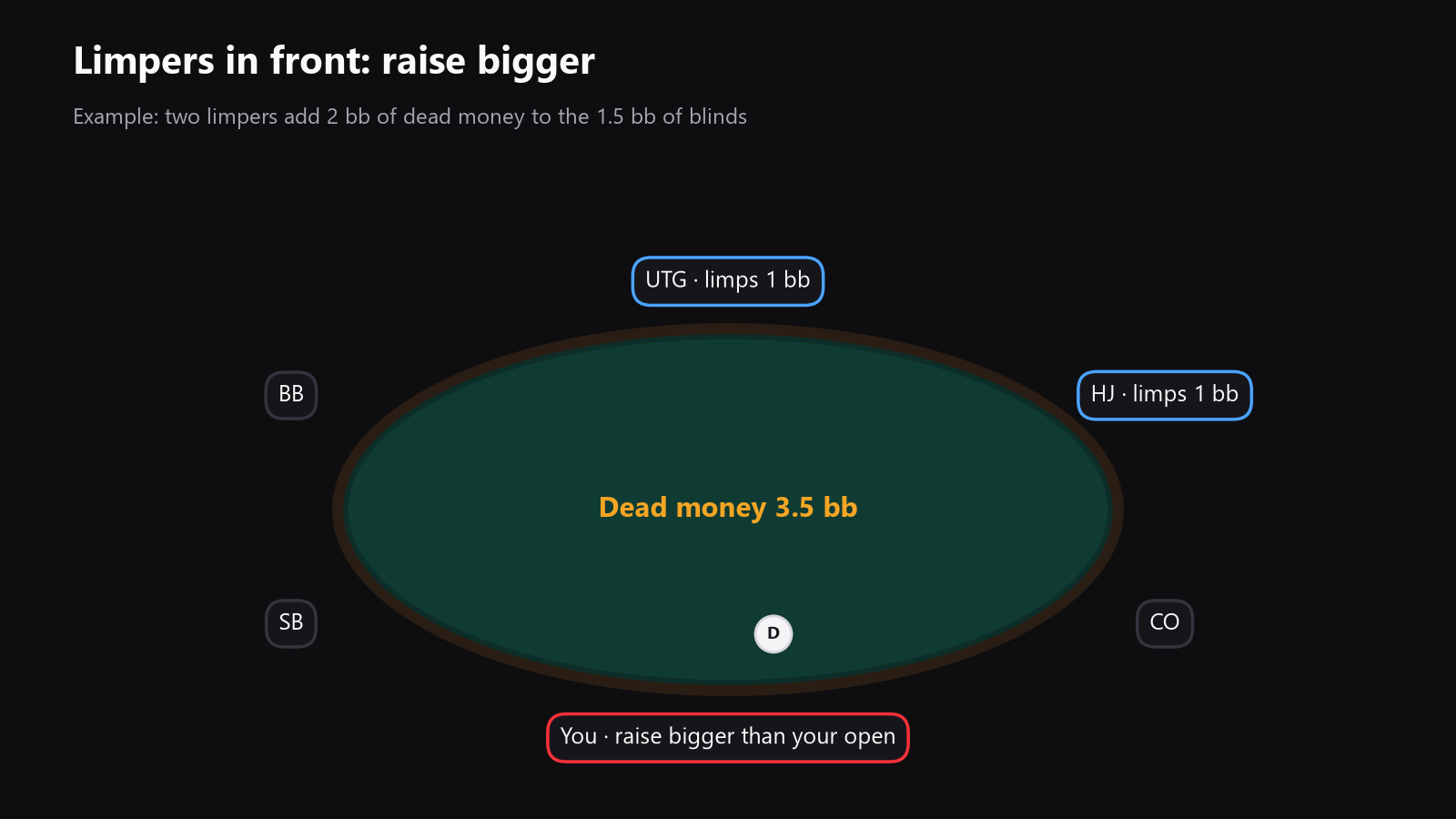
When one or more players limp in front of you, the pot is already bigger and the field has shown weakness.
That is the time to raise bigger, not smaller.
Why?
Because a limp means two things:
- There is more dead money to win.
- There is a higher chance you will go multiway if you make it too cheap.
If you only make a tiny raise over limpers, you often let too many hands in. That weakens your position advantage and makes your hand play harder after the flop.
A practical approach is to start with a bigger isolation size than your normal open, then adjust to the table.
Against one limper, many players go around 3 big blinds to 4 big blinds.
Against two limpers, many go larger still.
If the table is loose and sticky, you often need more than the minimum to thin the field.
If the table is tight and the limpers overfold, you can stay on the smaller end of that range.
The point is simple: limpers make the pot richer, so your raise should punish them.
Why the small blind often opens bigger
The small blind is a special case.
When action folds to you in the small blind, only the big blind remains, but you are out of position for the rest of the hand.
That matters a lot.
A slightly bigger open from the small blind can do two useful things:
- It charges the big blind more to realize equity.
- It reduces the big blind’s room to defend cheaply with hands that play well in position.
Many players make the mistake of using the same size from every seat.
That is usually too simplistic.
From the button, a smaller open often works well because you have position and you attack only one blind.
From the small blind, a larger open is often better because your postflop disadvantage is real.
You do not need to go huge. You do need to respect the fact that the small blind is one of the worst seats in poker.
How antes change the math in tournaments
Antes make open-raise sizing different.
They add dead money before you act.
That means there is more in the pot already, so your raise has to do less work.
In a tournament with antes, a smaller open can be enough to win the same pot pressure that would require a bigger open in a no-ante cash game.
For example, imagine an 8-handed tournament where everyone antes.
Before you act, the pot already contains the blinds plus the antes. That can make the unopened pot much larger than 1.5 big blinds.
As a result:
- Your open risks less relative to the pot.
- The blinds can defend wider, because the pot odds improve for them.
- You can often open smaller and still steal very profitably.
That is why tournament opening sizes are often smaller than cash-game sizes.
The antes do part of the work for you.
There is one more tournament factor: ICM.
Near pay jumps and final tables, chips are not worth linearly the same as they are in cash games. In those spots, smaller opens can become even more attractive because you want to risk less while still applying pressure.
A useful way to think about open size
Do not ask only, “What is the standard size?”
Ask instead:
- How much dead money is there?
- How much do the blinds fold?
- How often do they defend and continue well postflop?
- How strong is my postflop edge?
- Am I out of position?
That is how you choose a size with a reason.
A good default is stable.
A good adjustment is explainable.
A bad adjustment is random.
A simple sizing roadmap
If you want a quick practical rule set, use this:
- No limpers, normal online cash: 2 big blinds to 2.5 big blinds.
- Sticky table, players defend too much, or you are opening from earlier position: lean toward 2.5 big blinds to 3 big blinds.
- Small blind, folded to you: often 2.5 big blinds to 3 big blinds.
- Limpers in front of you: raise bigger than your normal open.
- Tournaments with antes: often smaller than cash, because the pot is already bigger.
That is not a chart to memorize forever. It is a starting point.
The real answer depends on the pool.
One mistake to avoid
Do not size your opens based on your hole cards.
If you open bigger with aces and kings, smaller with junk, and medium with medium-strength hands, you leak information.
Good opponents notice that pattern.
Try to make your open size come from the seat, the table, and the stack context, not from the exact hand in your hand.
What to study if you want to go deeper
If you want to test a preflop spot seriously, use a tool that shows the equilibrium strategy for that spot and lets you inspect the 169 starting hands by action.
That is often the fastest way to see whether your favorite size is doing what you think it does.
The Solver module is useful here because it shows the strategy grid for the spot you are studying, and the rest of the program lets you compare that study with what actually happens in your hands.

The short version
Open-raise sizing is about price, pressure, and postflop play.
Use a smaller size when the pot is already large enough, when the table overfolds, or when you want to keep the pot under control.
Use a bigger size when you need to charge callers more, when limpers are in the pot, when you are in the small blind, or when the table is too sticky.
And in tournaments, remember that antes change everything by adding dead money before you act.
If you understand that, you are no longer choosing a size by habit. You are choosing it for a reason.
Do it on your own hands.