
If you want the short answer, it is this: you open more hands as you sit later because fewer players remain behind you, you win the blinds more often, and you get to play more pots with position.
That is the whole idea behind opening ranges by position.
A hand like AJo can be too thin from UTG, perfectly normal from HJ or CO, and still not be a slam-dunk if the players behind you are aggressive. A hand like K9s may look small, but on the button it can become profitable because it steals often, makes playable top pairs, and keeps some blocker value when you face resistance.
The range you open is not just a list of pretty hands. It is a choice about:
- how often you get called or 3-bet,
- how well your hand plays when you do get action,
- how much position you will have after the flop,
- and how much rake or antes the spot has to beat.
Why later seats can open wider
There are three big reasons your opening range widens as you move toward the button.
1. You have more fold equity
The later you act, the fewer players remain who can wake up with a hand. That means your raise gets through more often.
If you open from UTG, five players still have cards. If you open from the button, only the blinds do. That difference alone is huge.
2. You will have position more often
Position matters because you act last after the flop. Acting last gives you more information, better control of pot size, and more chances to realize your equity.
A hand that is slightly too weak to open early can become fine late if it plays well in position.
3. You can steal with hands that are not pure value hands
Some hands make money not because they dominate everyone, but because they:
- block strong continues,
- flop enough equity,
- and profit from folds preflop.
That is why late-position ranges include many suited hands, connected hands, and broadways that would be too loose earlier.
A practical baseline for 6-max cash
The ranges below are an example baseline, not a universal chart.
Assumptions:
- 100bb stacks
- unopened pot
- online 6-max cash game
- standard rake
- no special read on the table
| Seat | Rough opening range | What that means in practice |
|---|---|---|
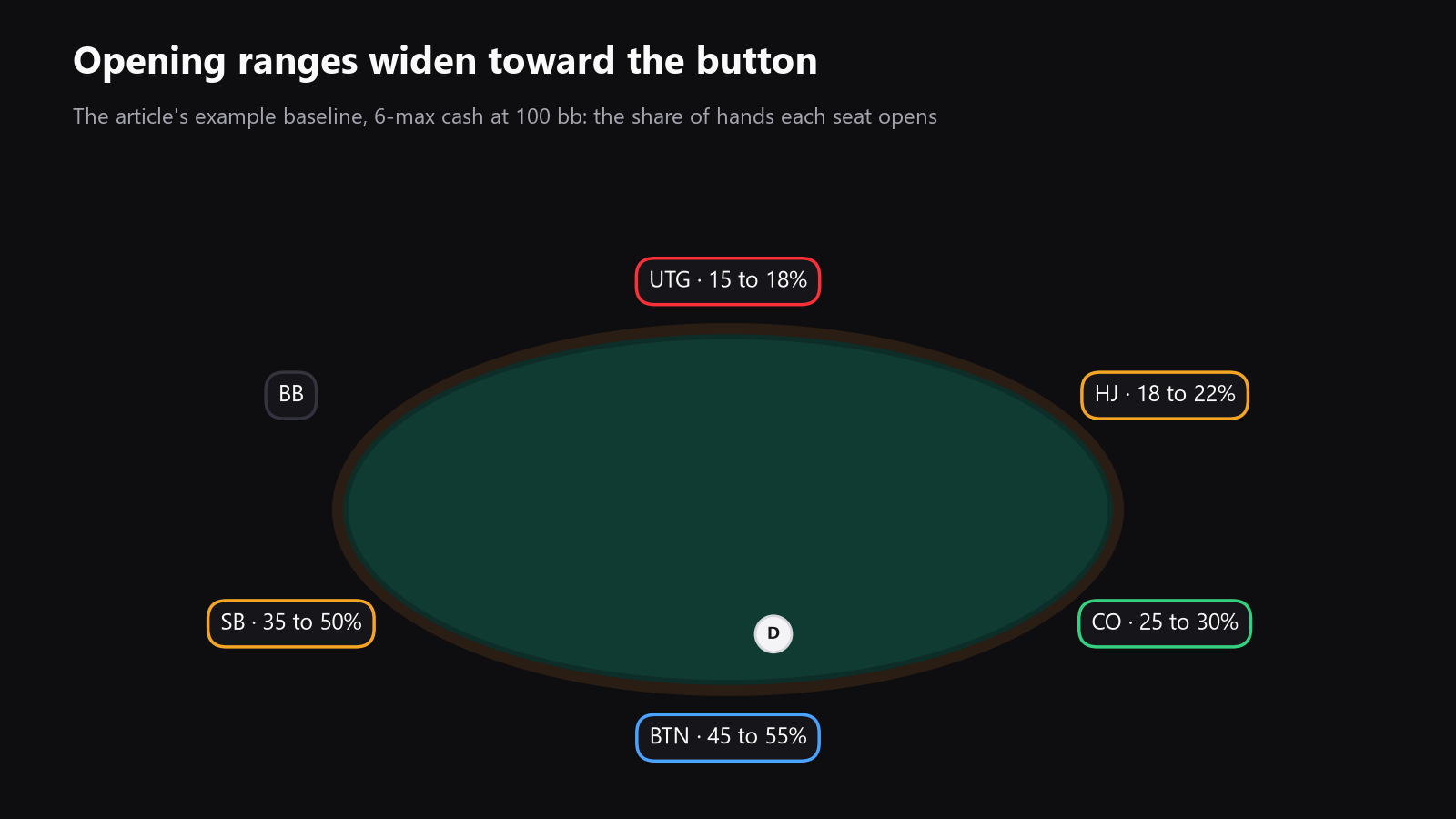
| UTG | 15% to 18% | Tight, strong, and hard to punish |
| HJ | 18% to 22% | Still solid, but wider than UTG |
| CO | 25% to 30% | A clear steal spot |
| BTN | 45% to 55% | The widest open range in 6-max |
| SB | 35% to 50% | Wide, but built differently from BTN |
Those numbers are only a baseline. A sticky player pool, a tough blind defender, deep stacks, short stacks, tournaments with antes, or high rake can move them.
UTG: open tight and strong
UTG is the first seat to act preflop in 6-max, so you still have five players behind you who can call or 3-bet. Because of that, your UTG range should be the most robust one at the table.
A good UTG opening range usually contains:
- all pocket pairs, especially 22+ depending on the table,
- strong aces such as AJs+, AQo+, AK,
- solid broadways such as KQs, KJs, QJs, JTs,
- a few suited connectors when the table is soft and the stacks are deep enough.
What usually does not belong here:
- weak offsuit broadways,
- random suited kings and queens,
- hands that often make second-best top pair,
- pure speculation with poor playability.
The main danger from UTG is domination. If you open hands like KTo or QJo too freely, you will often make a pair and still be behind the ranges that continue.
So from UTG, think quality first. You are not trying to print blinds. You are trying to enter the pot with hands that can stand pressure.
HJ: slightly wider, but still careful
The hijack is where the range starts to breathe.
You have one fewer player behind you than UTG, and that matters a lot. You still need a real range, but you can add hands that were too thin from early position.
HJ usually adds:
- more suited aces,
- more offsuit broadways,
- more suited connectors and one-gappers,
- some hands that play well in raised pots and can continue against light 3-bets.
This is the point where many players make a useful but dangerous mistake: they open wider, but not wider in the right way.
The right way is not just "more hands". It is "more hands that can realize equity well enough against the pool behind you".
For example:
- ATo may start to enter the range,
- KQo becomes very natural,
- KJs, QJs, JTs are comfortable opens,
- 87s or 76s can appear when stacks and table conditions support them.
If the players behind you are aggressive, HJ should still stay disciplined. You are not on the button yet.
CO: the first real stealing seat
Cutoff is where opening ranges begin to look wide enough that many beginners get uncomfortable.
That discomfort is normal. CO is supposed to be a big opening seat.
Why? Because there are only two players left behind, and the button is one seat away from you. You get a lot of fold equity, and if you get called, you often still play in a good postflop environment.
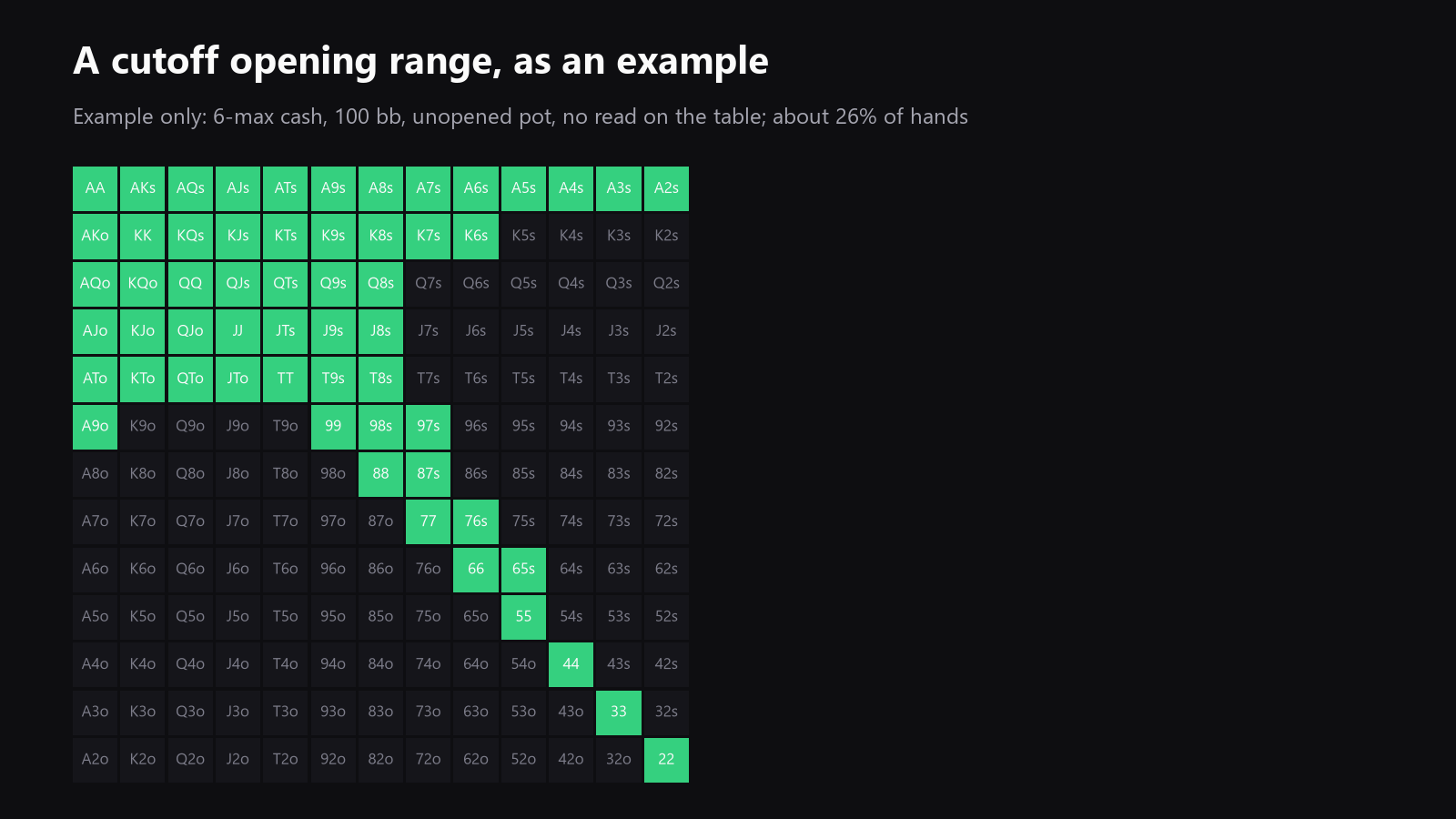
A typical CO range can include:
- all pairs,
- many suited aces,
- most broadways,
- lots of suited kings and queens,
- suited connectors and suited one-gappers,
- several offsuit broadways and offsuit aces that were not open from earlier seats.
This is also where blockers matter more. Hands like A9o, KJo, or A5s can become useful because they:
- block top continues,
- can make strong top-pair type boards,
- and profit from the blinds folding too often.
If you remember only one thing about the cutoff, remember this: you are no longer opening because you "have a hand". You are opening because your hand plus position plus fold equity is good enough.
BTN: widest seat, but not a license to open trash
The button is usually the widest opening position in 6-max.
That does not mean you open anything. It means you can profitably open a lot more hands because only the blinds remain, and you will have position on every postflop street when you get called.
Button opens often include:
- many weak and medium pairs,
- most suited aces,
- many suited kings, queens, and jacks,
- a lot of suited connectors and suited gappers,
- many offsuit broadways,
- and, against tight blinds, some very marginal hands that win mostly through steal value.
This is where player pool tendencies matter the most.
If the blinds fold too much, you can widen aggressively. If the blinds 3-bet a lot, your button range should be wider than early position, but smarter. If the blinds call too much, do not just add junk because it is the button. Prefer hands that make pair-plus or draw-plus situations more often.
The button is not a place to prove you can open 70%. It is a place to open what prints against the two players left to act.
SB: wide, but the hardest open to play
The small blind is special.
Preflop, you are near the end of the order, but postflop you are in the worst seat. You will be out of position to the big blind for the rest of the hand.
That means your SB open range is not just "button range minus a few hands". It has its own logic.
A good SB opening range often:
- keeps plenty of strong value hands,
- includes many suited hands that can still play decently out of position,
- avoids too many weak offsuit hands that suffer badly when called,
- and adapts strongly to the big blind.
Against a big blind that folds too much, you can open a lot. Against a big blind that defends well or 3-bets aggressively, your SB range should tighten and become more robust.
A common mistake is to copy a button chart into the SB. That looks wide on paper, but the postflop disadvantage is real. The SB needs a different mix.
A simple way to think about range construction
When you move later, you can open more hands because your edge comes from three sources:
- stronger fold equity,
- better position after the flop,
- and better equity realization.
That is why hands change seats.
Some hands gain value mostly because they are:
- suited,
- connected,
- block strong continues,
- or can make top pair with decent kickers.
Other hands lose value because they:
- are dominated too often,
- make weak pairs,
- or cannot stand a 3-bet and do not play well postflop.
So if you are unsure about a hand, ask:
- Does it win enough when called?
- Does it defend well enough versus 3-bets?
- Does it profit mainly by stealing, or also by playing postflop?
That is the right way to think about opening ranges, not "is this hand pretty?"
How to adjust to the players behind you
This is where your opening range stops being a chart and starts being poker.
If the players behind you fold too much
Widen, especially in CO, BTN, and SB.
Hands that gain value:
- suited aces,
- suited kings and queens,
- suited connectors,
- blockers,
- weaker offsuit broadways.
Why they gain value: they make money by taking the blinds now.
If the players behind you 3-bet too much
Tighten a little and prefer hands that can continue.
Hands that hold up better:
- strong broadways,
- pocket pairs,
- suited aces,
- hands with good blocker value,
- hands that can call a 3-bet or 4-bet sometimes.
Hands that lose value:
- weak offsuit hands with poor postflop playability,
- hands that hate being squeezed,
- hands that make too many second-best pairs.
If the players behind you call too much
Do not overdo the thin steal hands.
You want more:
- value,
- top-pair potential,
- stronger suited holdings,
- better kicker quality.
When people call too wide, your steal gets less valuable, so the opening range should become more honest.
If the blinds are short stacked
Pay attention to jam pressure.
Your open range can still be wide, but it should be built with the risk of getting shoved on in mind. Some hands that are fine against deep stacks become annoying when a short stack can reshove profitably.
If there are antes
Open wider, especially late.
Antes increase the dead money in the pot, so stealing becomes more valuable. That is one reason tournament late-position ranges are often wider than cash-game ranges.
Common mistakes players make
1. Using one chart for every table
A chart is a starting point, not a substitute for observing the pool.
2. Opening too wide early
Some players want to "play poker" from UTG. They end up donating money with dominated offsuit hands.
3. Opening too tight late
This is the opposite mistake. If you fold too much on the button or in the cutoff, you give up free money.
4. Copying BTN logic into SB
The SB is wide, but it is not the same seat as the button.
5. Ignoring rake
At micro and small stakes, rake matters a lot. Some thin opens that look fine in theory lose value once rake is counted.
How to build a better baseline for your own game
A solid process is:
- start from a reasonable example baseline,
- compare it with the players behind you,
- adjust for stack depth, rake, and antes,
- and then check whether your results support the change.
That is where the program helps.
The Solver module gives you a computed answer for one exact spot, so you can see what a strong baseline looks like. The Reveal module shows how the players at your limits actually behave, which is often very different from theory. The Plan module helps you see which leak costs you the most, so you do not spend study time on the wrong seat.


If you are studying opening ranges seriously, that combination matters. The chart gives you the first answer. Your table gives you the real one.
A quick recap
- UTG opens the tightest range because many players remain behind you.
- HJ can widen a little.
- CO is a big stealing seat.
- BTN is usually the widest seat.
- SB is wide, but it needs special care because you will be out of position postflop.
- The right open range depends on the players behind you, not just your seat.
- A range is only good if it fits the table you are actually at.
If you want one sentence to remember, make it this: open more hands later because position and fold equity improve, but always adjust the range to the players who still have to act.
Do it on your own hands.