
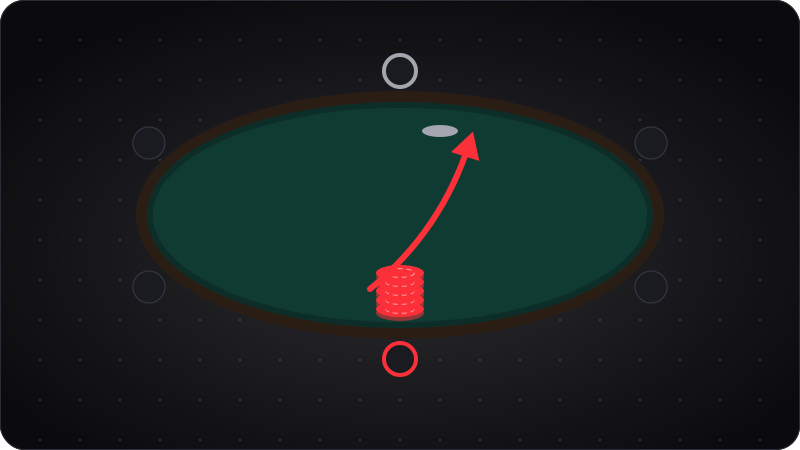
Open limping means you enter the pot first in by calling the big blind instead of raising. You were first to act, nobody entered before you, and you chose the limp.
That sounds harmless. In practice, it is usually a leak.
At most online No Limit Hold'em tables, especially micro and small stakes, open limping gives up too much. You lose the chance to win the pot right there, you give the table a clear invite to isolate you, and you often end up playing a small pot in a way that makes the rest of the hand harder.
What open limping costs you
There are three main problems.
1. You give up fold equity
When you raise first in, every player behind you has to make a decision against pressure. Some hands fold immediately. That is fold equity, and it is real money.
When you limp, you give that money away. You let everyone see a cheap flop, and you do not get to pick up the blinds and antes uncontested.
That matters a lot. Many hands do not need to make top pair to be profitable if they can win the pot now. Open limping throws that chance away.
2. You lose the initiative
The preflop raiser has the initiative. That means the raiser is more often the player who can credibly represent strength on later streets.
When you limp, you usually surrender that advantage. You check more often, you face more bets, and you have to react instead of act. Even when your hand is playable, it becomes less comfortable to navigate.
A simple example: with a hand that would happily raise and c-bet many boards, a limp often turns it into a hand that must guess postflop instead of steering the hand.
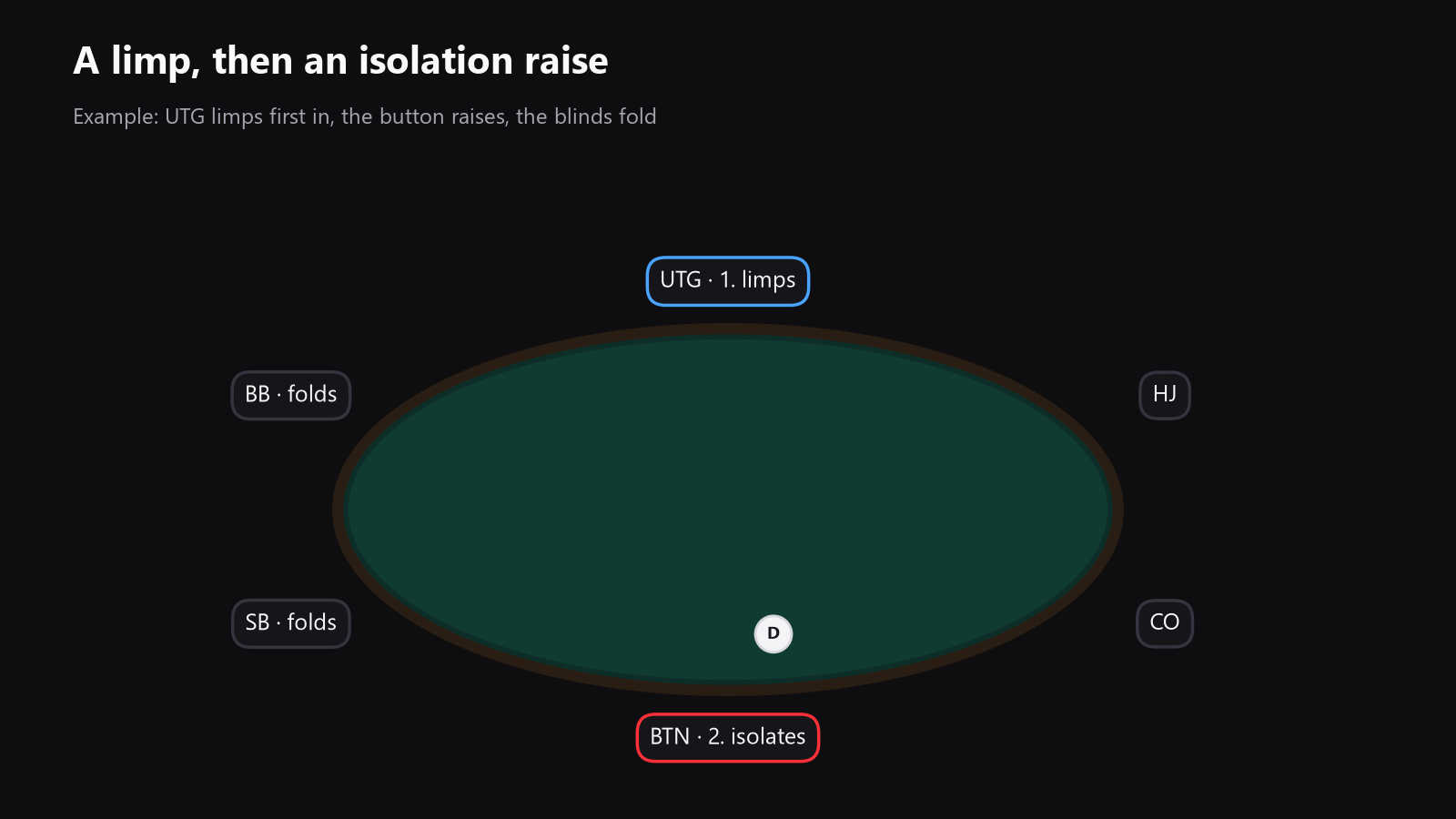
3. You invite isolation
A limp looks weak, because most of the time it is weak.
Good players behind you will notice. They will isolate with a raise more often, especially in position, because they want to play against your capped range and take the pot heads-up or against one caller.
That is the trap. You limp with the idea of seeing a cheap flop, and instead you face a raise, a bigger pot, and often a tough spot out of position.
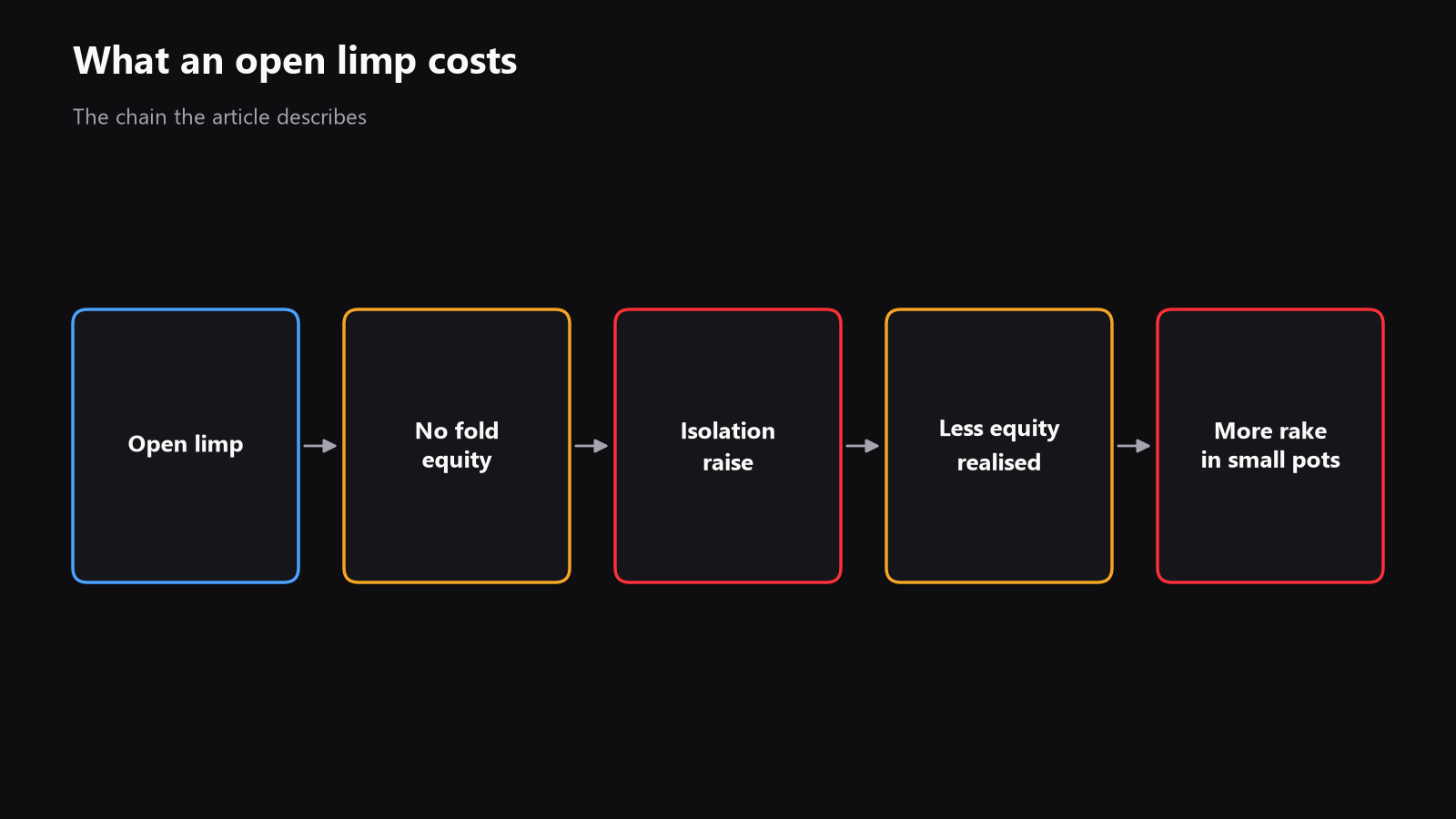
4. You make rake hurt more
At small stakes online, rake is a major part of the problem.
Limped pots are often small pots, and small pots get eaten by rake very quickly. That means a line that already has low fold equity can become even worse once the room takes its share.
If you are wondering why your win rate feels thinner than your cards deserve, limp-heavy preflop habits are a good place to look.
5. You play more weak multiway pots
A limp often leads to several players seeing the flop. Multiway pots are harder to play well, and your hand realization drops.
That is another hidden cost. Even when your hand has decent raw equity, it may not realize that equity cleanly when several ranges are still live.
Why limping feels attractive
Players limp for understandable reasons.
They want to see a flop cheaply.
They want to disguise a hand.
They want action with small pairs and suited hands.
They want to avoid a big pot with marginal holdings.
The problem is that poker does not reward comfort, it rewards good EV. A line that feels safe is not automatically the line that makes money.
Most of the time, open limping is not a clever balance trick. It is just passive.
The rare spots where limping can make sense
Almost never is not the same as never.
There are a few situations where limping can be part of a real strategy, but they are exceptions, not habits.
Very specific tournament and blind versus blind spots
In some tournament structures, especially near ICM pressure, some blind versus blind spots can contain limps. The same is true for certain short stack configurations.
But that is not a blanket permission to limp from everywhere. It is a reminder that stack depth, payout pressure, and position can change the answer.
Heads up
Heads up poker is its own game. Limping can appear much more often there than in full ring or six max play.
That does not mean it belongs in your default full ring or six max opening ranges.
A table that never punishes limps
If the players behind you are extremely passive and never isolate, limping can gain value in some rare live or soft environments.
Even then, you should be careful. Many players think their table is passive when in fact they have just not been punished yet.
Advanced mixed strategies
Yes, some solver outputs contain limps in specific nodes.
That is not a reason to copy them blindly. Those solutions depend on stack depth, positions, rake, and exact assumptions. Take one piece out of that context and you can turn a fine mixed strategy into a bad habit.
If you are playing typical online cash games or small field tournaments, open limping should be the exception you can explain, not the default line you use automatically.
Open limping versus overlimping
This distinction matters.
Open limping means you are first in.
Overlimping means someone already limped before you and you just call behind.
Those two actions are not the same. Overlimping can sometimes be reasonable when you are getting a good price, especially in position and against weak players.
Open limping is the one that is usually the mistake.
How to spot limpers at your table
You do not need a solver to notice limp-heavy opponents. You need observation.
Watch the first voluntary action
The easiest sign is simple. A player who enters many pots by calling instead of raising is a limper.
If this happens from early position or from the button, you already have useful information.
Look at VPIP and PFR
The HUD module helps here.
A player with a high VPIP and a much lower PFR is entering many pots voluntarily without raising enough. That gap often points to limp-call tendencies or passive preflop play.

Use notes and colours
If you already tagged a player as passive, sticky, or weak, keep that note visible in Player Profiles.
A label like "limps too much" is more useful than a vague memory. You do not want to rediscover the same leak every orbit.
Check what the field actually does
The Reveal module shows what the players at your limits actually do from the hands you have already played.
That matters because pool habits are not the same everywhere. If your field rarely limps, you should not build your own strategy around limping. If your pool does limp more often, you can isolate more aggressively and target those pots better.

What you should do instead
In most spots, the answer to "Should I limp?" is "No, raise."
That is not because raising is fancy. It is because raising usually does three useful things at once.
It gives you fold equity.
It takes the initiative.
It forces the table to play your range instead of yours being forced to react.
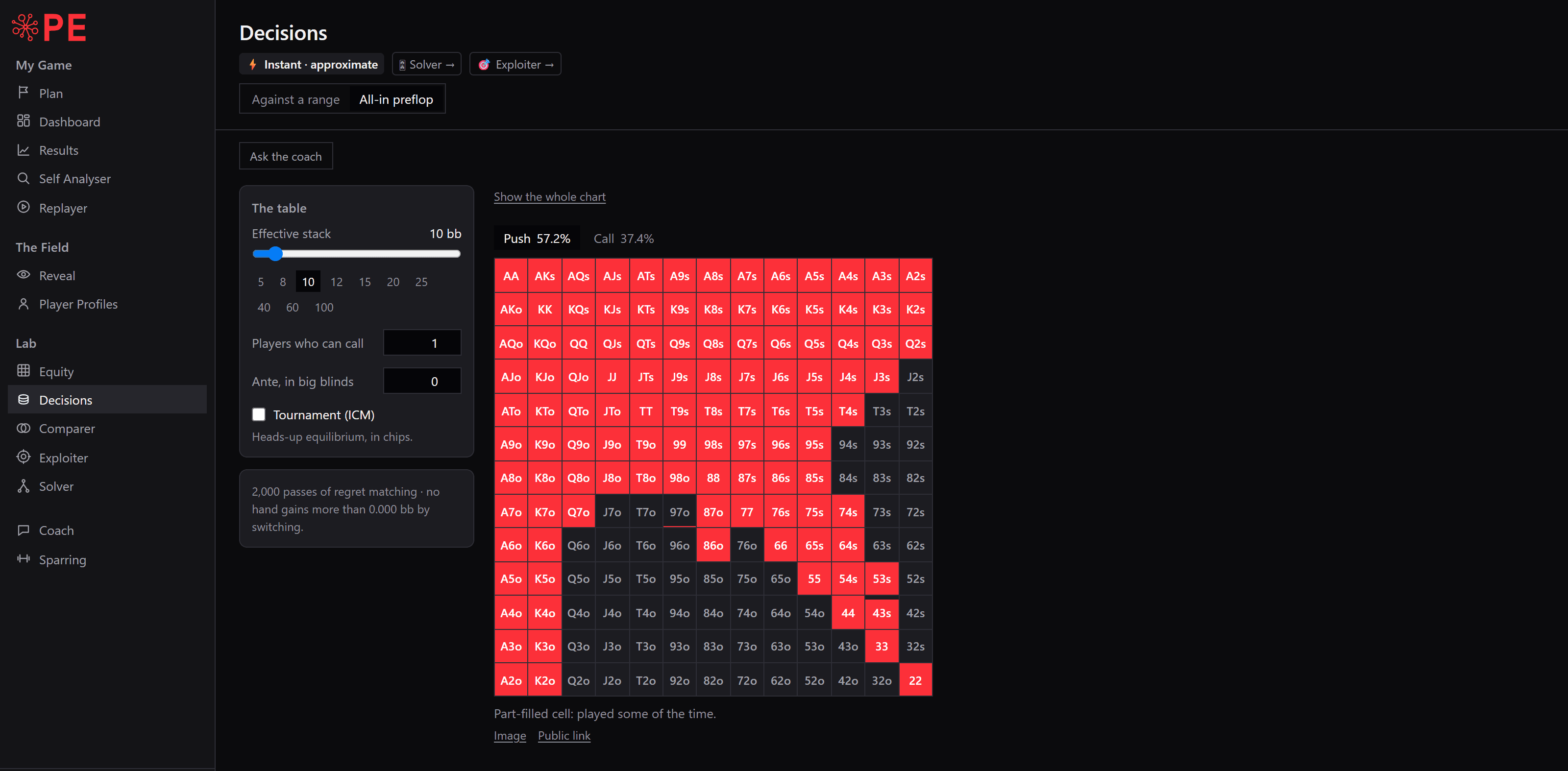
If you are worried about a short stack spot, do not guess at limp lines. Use the Decisions module, which gives you push, fold, or call answers for short stack situations.
If you are building a preflop plan for your own game, the key question is not "Can limping ever exist?" The key question is "What is the best action most of the time against my actual pool?"
That is exactly the kind of thing you can measure on your own hands instead of relying on folklore.
A practical checklist
Before you limp first in, ask yourself:
- Am I giving up fold equity?
- Will somebody behind me isolate often?
- Do I really want a small multiway pot with this hand?
- Am I better off raising and taking the initiative?
- Is this one of the rare spots where stack depth, position, or ICM changes the answer?
If you cannot give a concrete reason, do not limp.
The short version
Open limping is usually bad because it is passive, easy to attack, and expensive in rake-heavy environments.
It can make sense in a few rare and specific spots, but those are exceptions, not a default strategy.
If you want to spot limp-heavy opponents, watch their preflop line, their VPIP and PFR gap, and their pool tendencies. If you want to check your own game, the HUD, Reveal, Player Profiles, the Self Analyser, and the Decisions module give you a clean way to see what is actually happening in your hands.
That is the real value here: not an abstract rule, but a measurable one.
Do it on your own hands.