
3-bet pots are where a lot of players lose money without noticing why.
Preflop, the pot already got bigger. The ranges got tighter and stronger. The stack-to-pot ratio got smaller. That means the flop is not just “the next street.” It is often the street where the pot starts to commit itself.
If you want to play 3-bet pots well after the flop, you need three things in order:
- Read the stack-to-pot ratio first.
- Know which range is more likely to connect with the board.
- Choose a c-bet size that fits both the texture and the remaining stacks.
1. Why 3-bet pots play so differently
In a 3-bet pot, both ranges are usually stronger than in a single-raised pot.
The opener already showed strength by entering the pot. The 3-bettor showed even more strength by reraising. The caller usually continued with a tighter range than they would use against an open.
That removes a lot of weak hands from the later streets.
It also changes how you should think. In a normal pot, you can often afford to float around with medium strength. In a 3-bet pot, medium strength gets expensive fast. One bet and one call can already put you close to a stack-off spot.
So the question is not just “who was aggressive preflop?” The real question is “whose range fits this flop better?”
2. Stack-to-pot ratio is the first number to read
Stack-to-pot ratio, or SPR, is the remaining effective stack divided by the pot size.
It tells you how much room you still have before the pot starts playing for stacks.
A simple example:
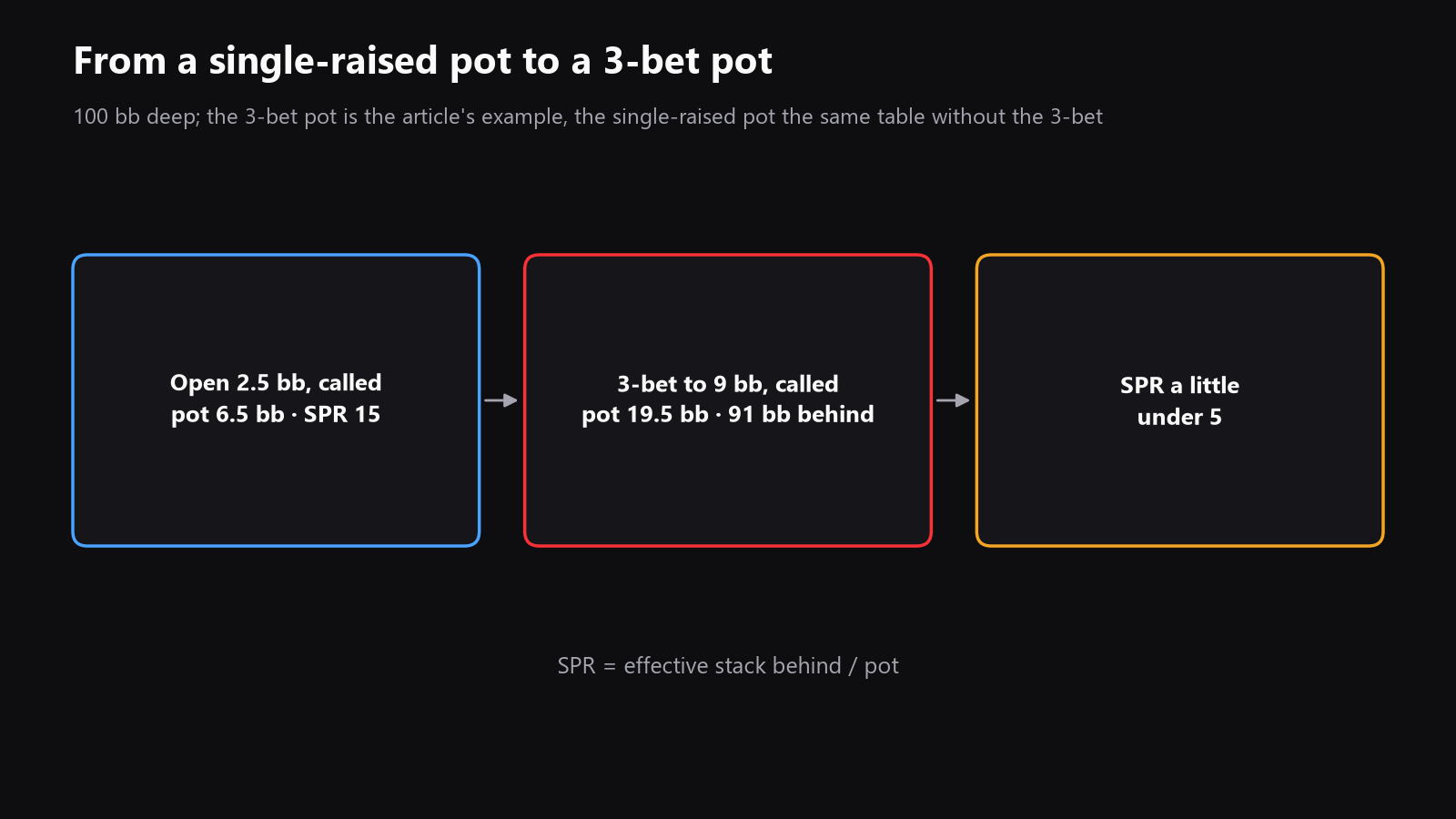
- Open to 2.5 bb
- 3-bet to 9 bb
- Call
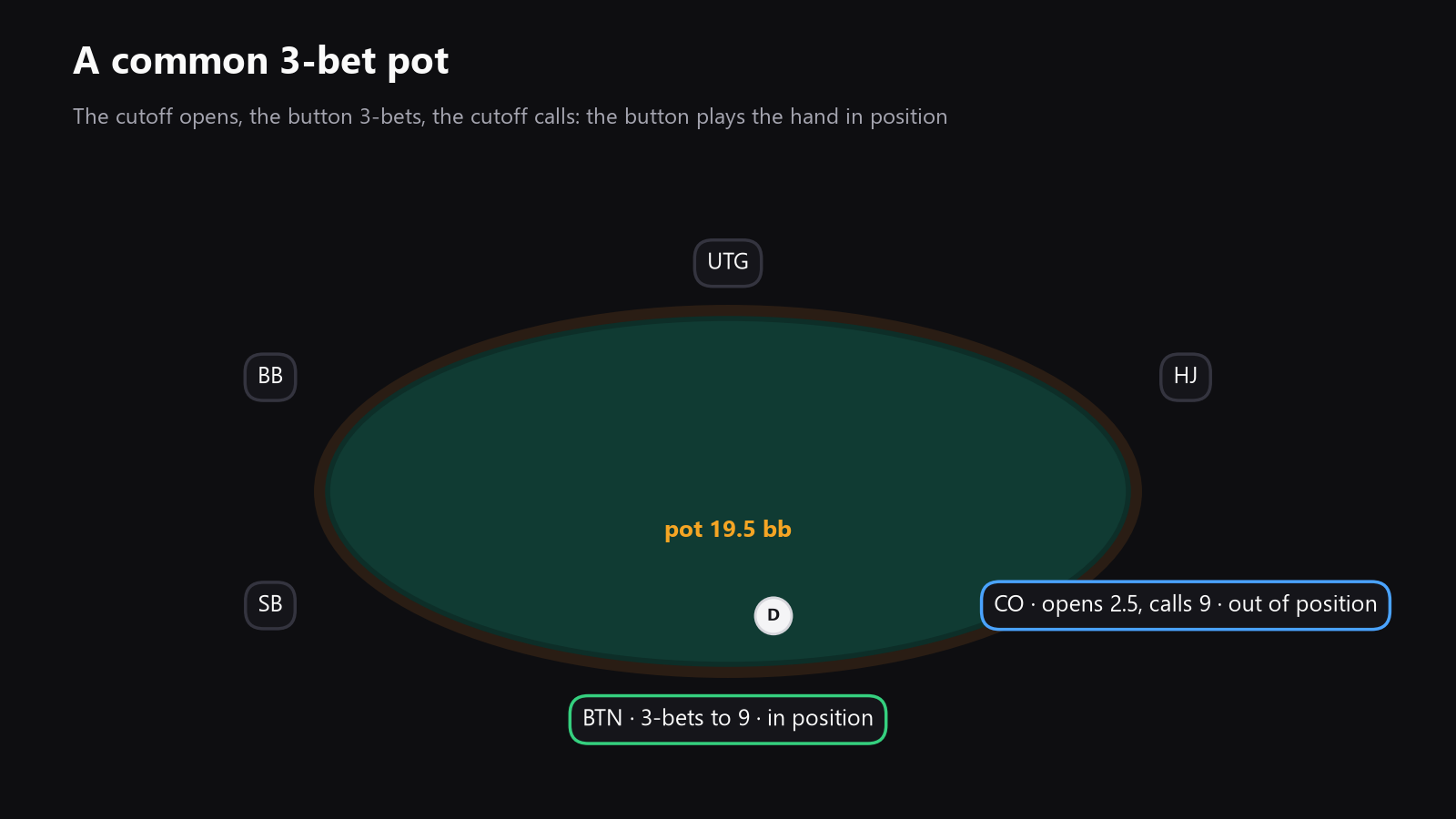
The pot is now about 19.5 bb before the flop. If both players started with around 100 bb effective, there is about 91 bb behind. That gives you an SPR a little under 5.
That is already a fairly committed pot.
Practical SPR guide
| SPR | Practical meaning |
|---|---|
| 1 to 2 | Many one-pair hands can continue aggressively |
| 2 to 4 | One pair is strong, but board texture matters a lot |
| 4+ | You need more caution, especially on coordinated boards |
The lower the SPR, the more value your strong but non-nut hands gain. That is why overpairs, top pair top kicker, and strong draws become much more valuable in 3-bet pots than in deeper pots.
3. Who has the range advantage?
This is one of the most important questions in postflop poker.
Range advantage means your range contains more of the strong hands that connect with the board. Nut advantage means your range contains more of the very strongest hands, such as sets, two pair, straights, or top overpairs.
Those are not the same thing.
Boards that usually favor the 3-bettor
On high-card, dry boards like:
- A-K-3 rainbow
- K-7-2 rainbow
- A-Q-6 rainbow
the 3-bettor often has the range advantage.
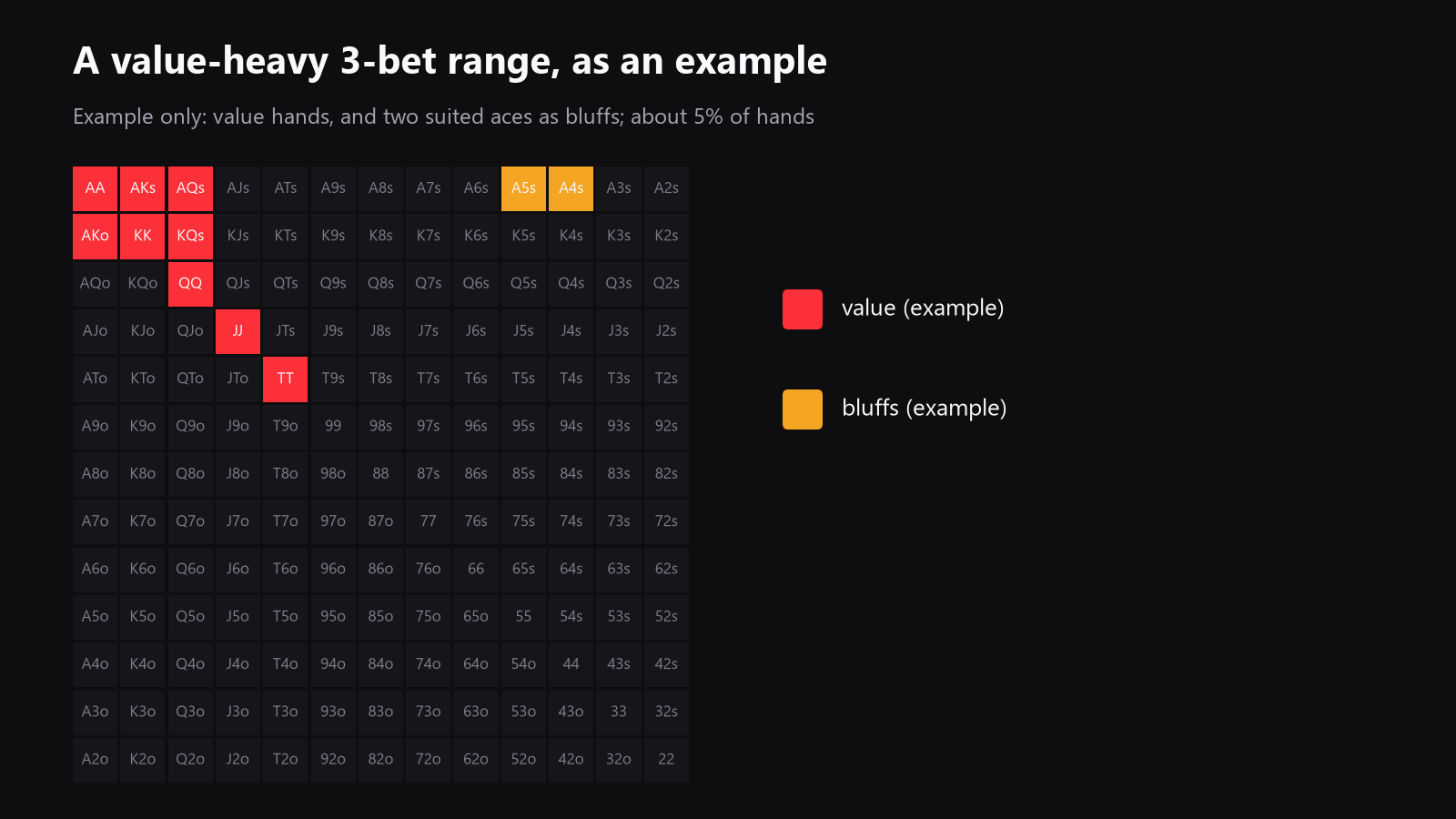
Why? Because the 3-bet range usually contains more strong Ax, Kx, QQ+, and high-card combinations that fit those boards well. The caller has more medium-strength hands that either missed or were forced to continue more thinly.
That is where small c-bets work well. You do not need a big bet to attack a range that missed often.
Boards that often favor the caller more
On connected boards like:
- 9-8-7
- T-9-6
- 8-7-6
the caller can have the better connection, especially if their continuing range contains more suited connectors, pocket pairs, and hands that interact with straights and two pair.
That does not mean you should give up automatically. It means you should slow down, narrow your value range, and be more selective with bluffs.
Paired boards
On paired boards like:
- K-K-4
- 8-8-2
- J-J-5
the texture often compresses the field. Trips are rare. Overpairs gain value. Bluffing usually becomes more delicate.
These boards can still favor the 3-bettor, but not because every hand is strong. They favor the 3-bettor because high cards and overpairs often stand up better than the caller’s medium-strength hands.
Monotone boards
On monotone boards, suit interaction matters a lot.
Your c-bet frequency and size should depend on:
- whether you hold the key suit,
- whether you block strong continues,
- and whether your range has enough nut flushes to value bet.
Do not auto-c-bet monotone flops just because you were the preflop aggressor.
4. How to think about c-bet sizing in 3-bet pots
A c-bet in a 3-bet pot should answer two questions:
- What do I want worse hands to do?
- How much of my range likes this board?
If the board heavily favors your range and the opponent misses often, a small c-bet is usually enough. If the board is dynamic and the caller has many draws and made hands, a bigger bet often makes more sense.
Common sizing logic
| Bet size | Typical use |
|---|---|
| 25% to 33% pot | Dry boards, range advantage, many missed hands, high-card flops |
| 50% pot | Mixed textures, some protection, some value, some pressure |
| 66% to 75% pot | Wet boards, draw-heavy textures, more polar value ranges |
| Check | Boards that favor the caller, or spots where your checking range needs protection |
A smaller bet does not mean weakness. It often means efficiency.
On a board like A-7-2 rainbow, a small c-bet can pressure many underpairs, broadways, and weak floats while keeping the pot manageable.
On a board like T-9-8 with two suits, a small bet can undercharge all the draws that want to continue. There, a bigger size or a check often makes more sense.
Minimum defense frequency, in plain poker arithmetic
If you bet 33% pot, the caller is facing a bet of 1 into a pot of 3. If they call 1, the final pot is 5, so they are risking 1 to win 4 more. That means they need 20% equity to call profitably in a vacuum.
The minimum defense frequency against that bet size is about 75%. That is the fraction of hands the defender needs to continue with, in theory, to avoid being overfolded against.
If you bet half-pot, the MDF is about 67%.
If you bet 75% pot, the MDF is about 57%.
That is not a complete strategy by itself, because real poker also includes position, range coverage, and future streets. But it is the arithmetic you should know.
A useful rule of thumb
The smaller the SPR, the more your bet size should be tied to commitment.
In a 3-bet pot, if you bet one-third pot on the flop and get called, the pot grows quickly on the turn. That means your later decisions matter much more than they do in a smaller pot.
So before you c-bet, ask:
- Am I building a pot with a hand that wants to stack off?
- Am I denying equity with a hand that cannot comfortably face big resistance?
- Or am I betting just because I was the preflop aggressor?
That last one is the leak.
5. When should you commit?
In 3-bet pots, commitment is less about “I have one pair” and more about:
- the effective stacks,
- the board texture,
- and how many worse hands continue.
You can usually get closer to committing when:
- the SPR is low,
- the board is dry or favors your range,
- you hold top pair top kicker or an overpair,
- and the runout does not change much.
You should be more careful when:
- the board is connected,
- the caller has lots of pair-plus-draw hands,
- the turn and river can change the nuts often,
- and your one-pair hand is vulnerable to many value hands.
A strong heuristic:
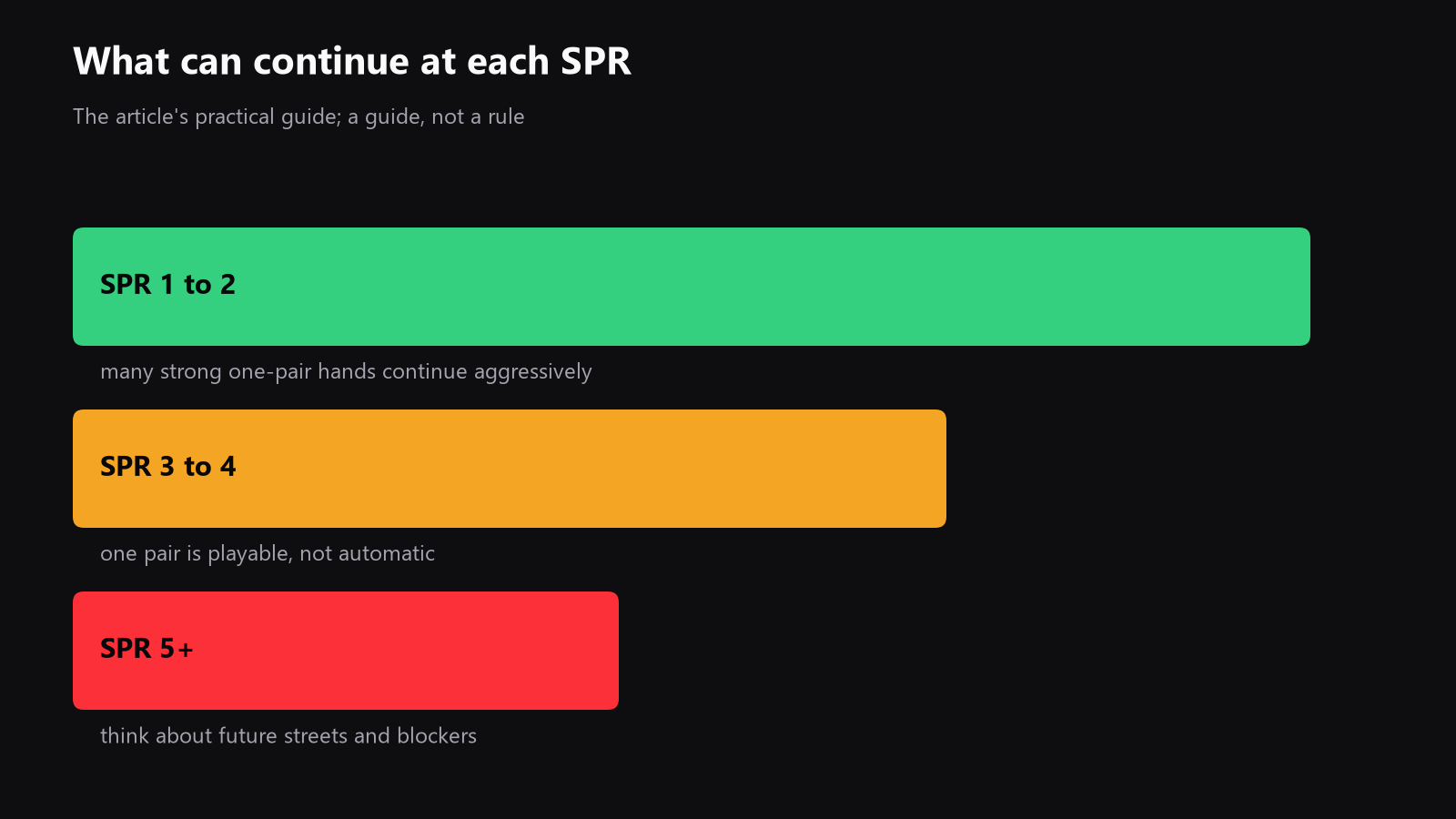
- At SPR 1 to 2, many strong one-pair hands can continue aggressively.
- At SPR 3 to 4, one-pair hands are playable, but not automatic.
- At SPR 5+, you need to think much more about future streets and blocker effects.
That is why top pair on A-7-2 can be very different from top pair on T-9-8. The hand category is the same. The commitment logic is not.
6. Common mistakes in 3-bet pots
Mistake 1: C-betting too big by default
You do not need to bomb every flop just because the pot is large. On many dry boards, a smaller size is enough to force mistakes.
Mistake 2: Treating initiative as if it were range advantage
You were the last aggressor preflop. That does not mean the flop belongs to you.
Mistake 3: Overvaluing one pair on bad textures
An overpair can still be strong, but it is not invincible on coordinated boards.
Mistake 4: Calling too wide preflop, then overfolding flops
If you defend too loosely against the 3-bet, you often arrive on the flop with too many hands that cannot continue.
Mistake 5: Ignoring position
A 3-bet pot in position is much easier to realize than one out of position. The same hand can become much more fragile when you must act first.
7. How to study 3-bet pots away from the table
This is exactly the kind of spot where off-table study pays.
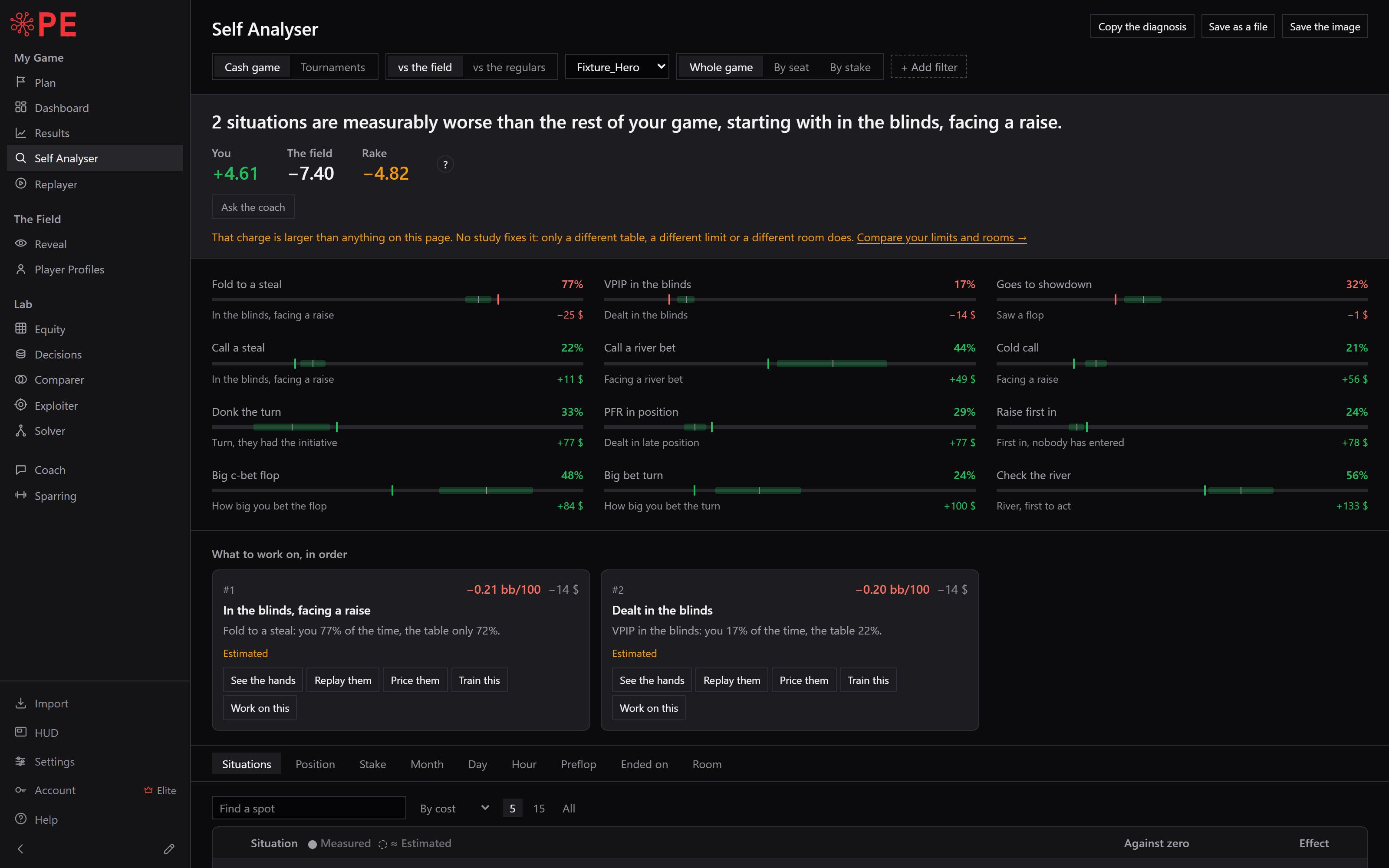
If you want to review how your 3-bet pot decisions line up against the field and against the rest of your game, the Self Analyser module can compare those situations directly.
And if you want to test a specific flop texture, stack depth, and preflop line away from the table, the Solver module can compute the spot when you ask it. That is the right time to study exact frequencies, not during a session.
8. The short version
If you only keep four ideas from this article, keep these:
- 3-bet pots have a lower SPR, so future streets matter sooner.
- The 3-bettor often has range advantage on high-card dry boards, but not always on connected boards.
- Small c-bets work well when your range is ahead and the board is not very dynamic.
- Commitment is a function of SPR, board texture, and how well your hand stands against the continuing range.
If you understand those four things, you already play 3-bet pots better than most players at micro and small stakes.
Do it on your own hands.