
When poker players talk about the indifference principle, they usually mean one simple idea: a decision point where two options have the same expected value.
If you are facing a river bet with a bluff-catcher, indifference tells you how often the bettor must be bluffing for your call to break even.
If you are bluffing, indifference tells you how often the defender must fold for your bluff to break even.
That is the core of a lot of poker theory. Once you know the price of the decision, you can turn it into frequencies.
And once you can turn it into frequencies, you can do something much more useful than memorise charts: you can spot when real opponents are not actually indifferent.
What indifference means in poker
A player is indifferent when two choices have equal expected value.
On the river, with no more cards to come, this becomes very clean:
- a bluff-catcher is indifferent between call and fold when the bettor has the right bluff frequency
- a bluff is indifferent between betting and checking when the defender folds the right amount
At equilibrium, neither side can gain by changing its own strategy alone. In real games, opponents rarely play that evenly.
That is why the principle matters. It gives you a benchmark.
The bluff-catcher formula
Let the pot be P and the river bet be B.
You face the bet with a hand that only wins when villain is bluffing. That is your bluff-catcher.
Let x be the share of bluffs in villain’s betting range.
If you call, your expected value is:
EV(call) = x(P + B) − (1 − x)B
Why?
- when villain is bluffing, you win the pot plus the bet, so you gain P + B
- when villain has value, you lose your call, so you lose B
To make the bluff-catcher indifferent, set EV(call) = 0:
x(P + B) − (1 − x)B = 0
Rearrange:
x(P + B) = (1 − x)B x(P + 2B) = B x = B / (P + 2B)
That is the share of bluffs in the betting range that makes your bluff-catcher indifferent.
Important: this is also your call equity requirement
Do not confuse that number with alpha.
If villain bets B into a pot of P, your required equity to continue is:
B / (P + 2B)
That is the classic call price on the river.
The bluff share that makes a bluff-catcher indifferent is the same number:
B / (P + 2B)
For a half-pot bet, those are:
- call equity requirement: 25%
- indifferent bluff share in villain's range: 25%
Same number, two different questions.
Example: half pot
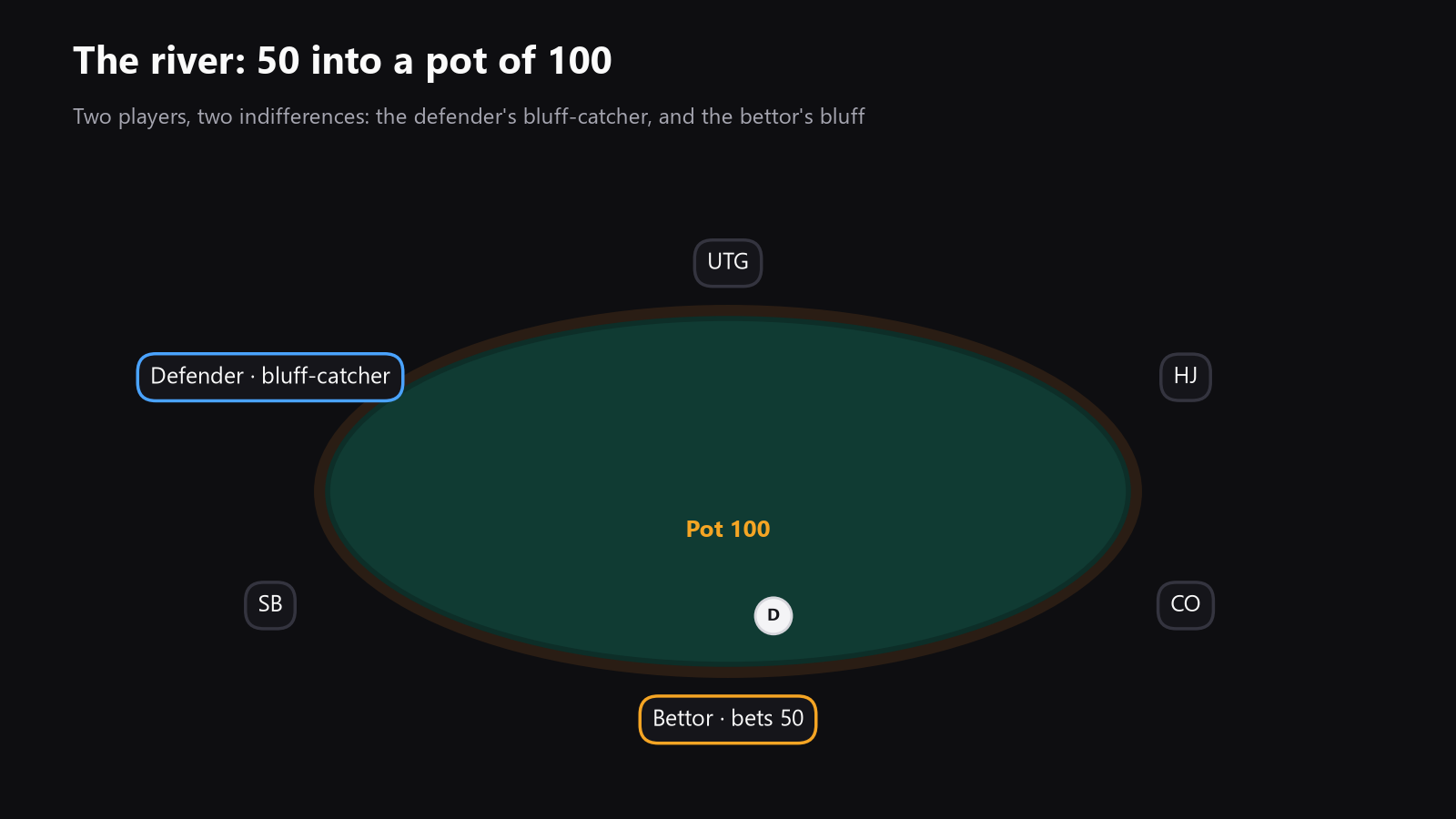
If the pot is 100 and villain bets 50:
x = 50 / (100 + 100) = 25%
So your bluff-catcher is indifferent when the betting range contains 25% bluffs.
That also means the betting range should contain:
- 25% bluffs
- 75% value
So the bluff-to-value ratio is:
bluffs : value = 1 : 3
At the same time, your call needs:
50 / (100 + 100) = 25% equity
So if you are the caller, 25% is the price of the call.
If you are asking how bluff-heavy villain’s betting range must be for your bluff-catcher to be indifferent, the answer is 25%.
Example: pot-sized bet
If the pot is 100 and villain bets 100:
x = 100 / (100 + 200) = 33.3%
So the indifferent bluff share is 33.3%, which means:
- 1 bluff for 2 value hands
Your call equity requirement is:
100 / (100 + 200) = 33.3%
Again, that is the same number.
Example: 75 into 100
If the pot is 100 and villain bets 75:
x = 75 / (100 + 150) = 30%
So the betting range can contain:
- 30% bluffs
- 70% value
That is a bluff-to-value ratio of:
3 bluffs for 7 value hands
Your call equity requirement is:
75 / (100 + 150) = 30%
A useful table
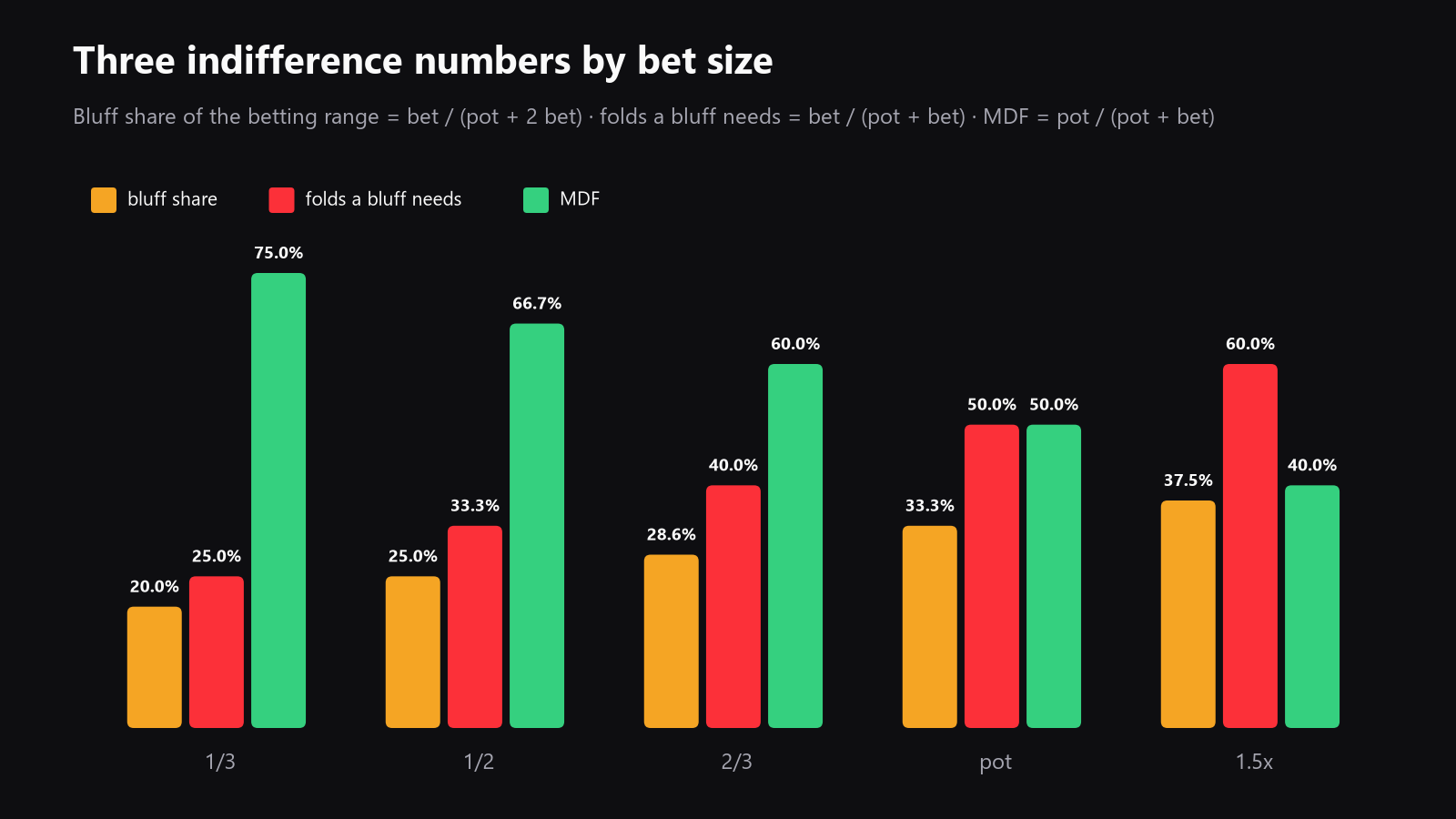
| Pot P | Bet B | Bluff share that makes a bluff-catcher indifferent | Bluff to value ratio | Required equity to call | Alpha | MDF |
|---|---|---|---|---|---|---|
| 100 | 50 | 25% | 1:3 | 25% | 33.3% | 66.7% |
| 100 | 100 | 33.3% | 1:2 | 33.3% | 50.0% | 50.0% |
| 100 | 75 | 30.0% | 3:7 | 30.0% | 42.9% | 57.1% |
Alpha is not the same thing as bluff share
This is where many players get confused.
The bluff share in the betting range is not the same thing as alpha.
- bluff share answers: "How many of villain’s bets are bluffs?"
- alpha answers: "How often must my bluff get folds to break even?"
For a pure bluff with zero showdown value, the EV is:
EV(bluff) = alpha × P − (1 − alpha) × B
Set that to zero:
alpha × P = (1 − alpha) × B alpha(P + B) = B alpha = B / (P + B)
So alpha is:
- 33.3% for a half-pot bet
- 50% for a pot-sized bet
That means:
- if you bluff half pot, you need folds one time in three
- if you bluff pot, you need folds one time in two
This is not the same number as the bluff share in the betting range.
For a half-pot bet:
- bluff share for an indifferent bluff-catcher = 25%
- alpha for an indifferent bluff = 33.3%
Those are two different questions, with two different answers.
MDF, the minimum defense frequency
The defender’s complement to alpha is the minimum defense frequency, or MDF.
MDF = P / (P + B)
And because alpha is B / (P + B), the two add up to 100%.
alpha + MDF = 100%
That is why half-pot betting gives:
- alpha = 33.3%
- MDF = 66.7%
And pot-sized betting gives:
- alpha = 50%
- MDF = 50%
MDF is the share of range the defender must continue with if he wants a bluff to be unprofitable in theory.
In practice, of course, range construction and blockers matter. MDF is a benchmark, not a magic rule that tells you which exact combo to call with.
Why real opponents are rarely indifferent
This is the part that makes the principle useful.
A real opponent does not usually:
- bluff at exactly the indifferent bluff share
- value bet at exactly the right ratio
- defend at exactly MDF
- mix perfectly on every node
Instead, real players tend to do one of these things:
- bluff too little
- bluff too much
- call too often
- fold too often
- value bet too thin
- value bet too thick
That means the river is often not a balanced puzzle. It is a leak.
If villain bluffs too little
Then your bluff-catchers should fold more often than MDF would suggest.
If the betting range is value-heavy, calling too wide is a mistake.
If villain bluffs too much
Then your bluff-catchers should call wider.
Now the bettor is giving away too much equity with his bluffs, so folding becomes too tight.
If villain folds too much
Then your bluffs become better than alpha.
You can bluff more often because your fold equity is stronger than the break-even point.
If villain calls too much
Then your bluffs should be reduced, and your value bets can often get thinner.
He is protecting too much of his range, so your bluffing loses value.
The practical use of indifference
The principle is not just a theory exercise. It gives you a repeatable workflow.
Step 1: identify the price
What is the pot? What is the bet size?
That gives you the math.
Step 2: compute the benchmark
For a bluff-catcher, compute:
B / (P + 2B)
For a bluff, compute:
B / (P + B)
For the defender’s overall continue frequency, compute:
P / (P + B)
Step 3: compare to the player pool
Ask a simple question:
Does this opponent or this pool bluff more or less than the indifference point?
Does he fold more or less than the bluff needs?
That tells you whether you should:
- call more
- call less
- bluff more
- bluff less
Step 4: adjust for the player, not the chart
This is where the practical value comes from.
A chart tells you what happens if villain is balanced.
Your job is to notice when he is not.
A quick river example
Imagine a river pot of 100.
Villain bets 50.
You hold a bluff-catcher.
The indifferent bluff share is 25%.
So if you think villain is betting with:
- 20% bluffs, your call is too loose
- 25% bluffs, you are indifferent
- 35% bluffs, your call is profitable in theory
Now imagine you are the bettor.
If villain folds more than 33.3% to your half-pot bluff, your bluff is profitable.
If he folds less, your bluff is losing money.
Same spot, two different indifference questions.
That is the key: the principle gives you both sides of the node.
A small note on rake
The clean formulas above assume:
- heads-up
- river
- no rake
- one bet size
Real online poker is not always so clean.
Rake makes calling slightly worse, especially in smaller pots and lower stakes games. That matters, and it is one reason the exact break-even point in practice can drift away from the neat formula.
How this connects to study
If you want to go one step further, the best use of these formulas is not to stare at them. It is to test them on real spots.
The Reveal module shows what players at your limits actually do, from your own hand histories, so you can compare a pool’s real bluffing or folding habits with the indifference benchmark.
And if you want to verify a spot away from the table, the Solver module computes the equilibrium strategy for that exact configuration, including turn and river, so you can check how close a spot really is to the clean theory.
The takeaway
The indifference principle is one of the simplest and most important ideas in poker.
It tells you:
- how many bluffs make a bluff-catcher indifferent
- how often a bluff needs folds to break even
- what the defender’s minimum defense frequency is
- why bluff share, alpha, call equity, and MDF are related, but not the same thing
Most importantly, it gives you a framework for noticing when a real opponent is off balance, so you can adjust your own strategy instead of following a chart blindly.
Do it on your own hands.