
Micro stakes online poker, roughly NL2 to NL25 cash games, are beatable, but not for the reasons many players think.
A lot of advice about micro stakes is vague folklore: "people never fold", "everyone is a calling station", "bluffs never work", "just get it in with any top pair". Some of that can be true in parts of a pool, but none of it is a strategy by itself. If you want to beat the games, you need to understand what actually changes at these limits:
- players call too much in some spots and fold too much in others,
- many pots go multiway,
- rake takes a bigger bite than your instinct expects,
- and the right answer depends on your own pool, not on what people say on forums.
The good news is that micro stakes reward clear, practical poker. You do not need to out-solve the pool. You need to punish the most common mistakes, especially overcalling, poor preflop discipline, and weak responses to value bets.
1. Start with value betting, not fancy bluffs
If your opponents call too much, your strongest source of profit is value betting.
That sounds obvious, but many players still leak money by trying to "win the pot" too often with bluffs. At micro stakes, the money is usually made when worse hands pay you. If somebody calls with second pair, weak top pair, gutshots, underpairs, ace-high, or draws that should fold, your job is to size your value bets well and let them make mistakes.
Why value betting prints at micro stakes
When a player calls too wide, you do not need them to fold. You want them to continue.
That changes your whole strategy:
- bet more often for value when you have a made hand,
- size up when worse hands can still pay,
- and bluff less in spots where the pool is sticky.
A lot of players at micro stakes under-bet their value hands because they are afraid of being called. That is backwards. If the pool is calling wide, the hand that wins the most money is usually the hand that gets called.
What "value" means in practice
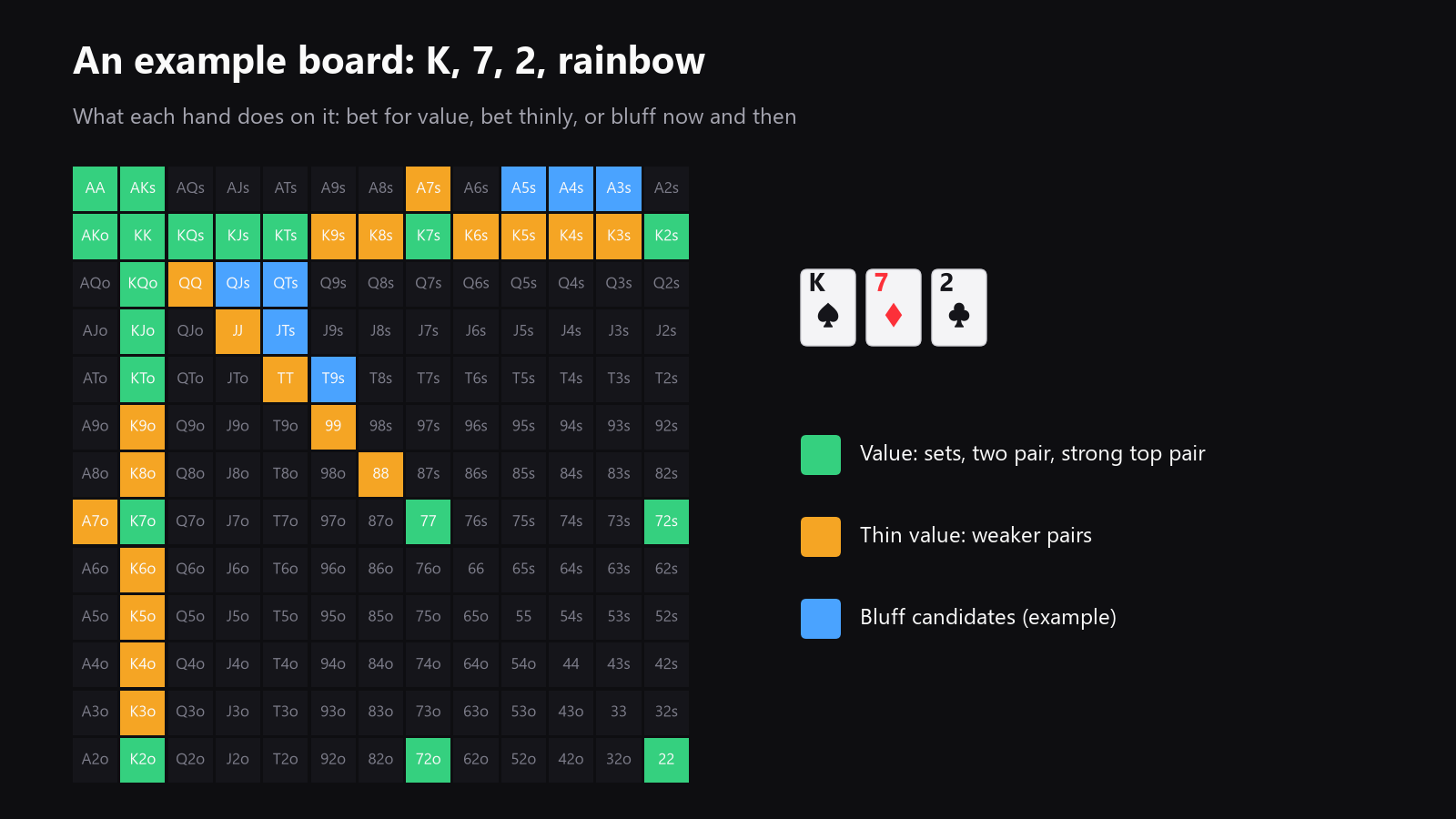
You do not need the nuts to value bet.
At micro stakes, many hands are strong enough to bet for value on one street, two streets, or even three streets against the right opponents:
- top pair with a good kicker,
- overpairs,
- two pair and sets,
- strong top pair on safe runouts,
- and some thin value spots when worse one-pair hands will call.
The key is not just hand strength. It is what worse hands continue.
If the hands that call you are worse, bet. If they fold all the worse hands and continue only with better ones, check more.
Board texture matters
A value bet is stronger when the board connects badly with your opponent's continuing range and well with yours.
For example:
- On a dry board, a medium-sized value bet may get paid by worse one-pair hands.
- On a wet board, you often want to charge draws, overcards, and pair-plus-draw hands.
- In multiway pots, value matters even more, because bluffs get worse and made hands get paid by several ranges at once.
A simple rule helps: if you expect calls from worse hands, bet. If you expect folds from worse hands and calls from better hands, check or choose a different line.
2. Which bluffs still work?
Bluffing does still work at micro stakes, but the bluffs that work are specific.
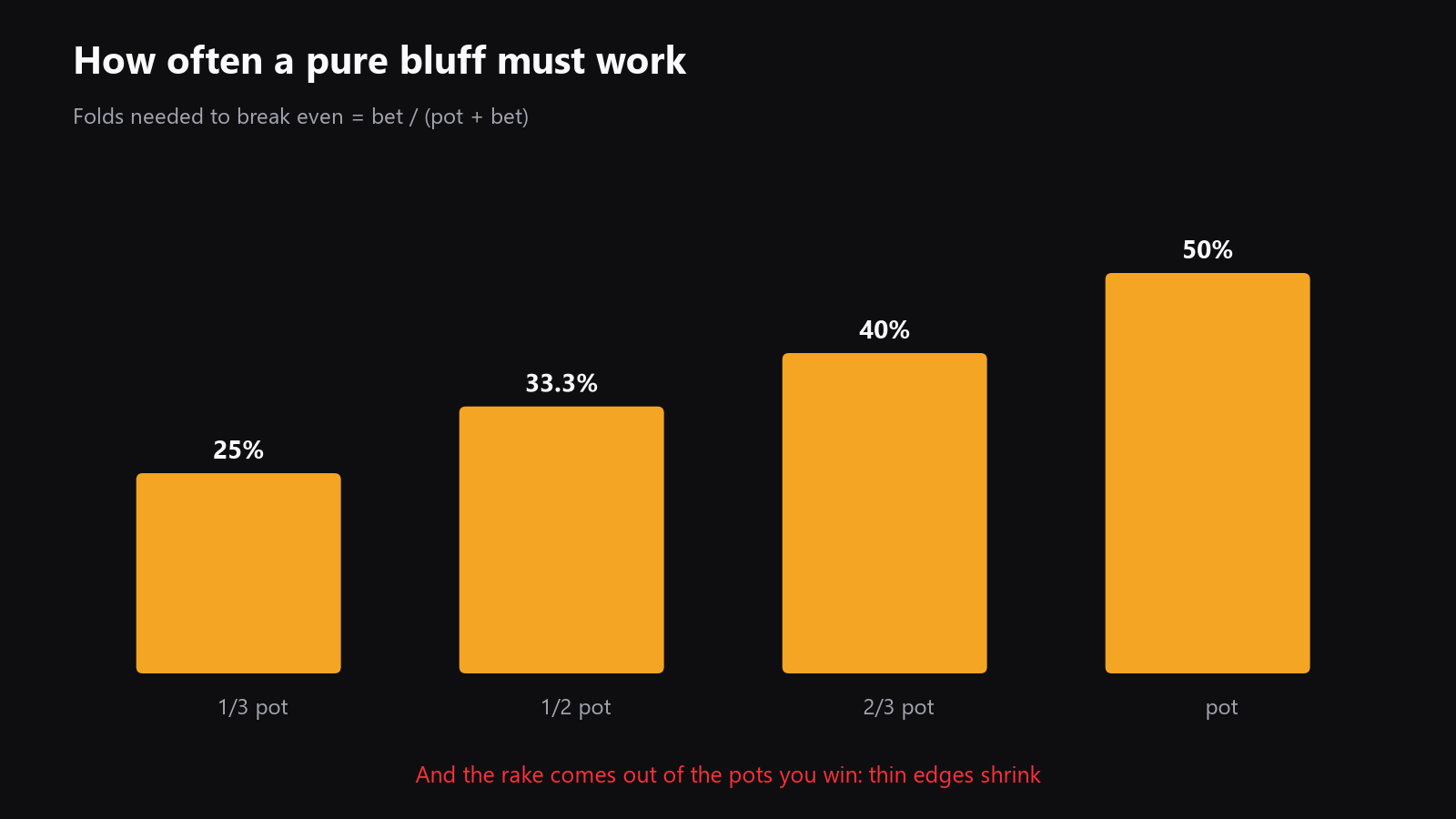
A pure bluff needs enough folds. The basic formula is simple:
Pure bluff break-even fold rate = bet / (pot + bet)
So if the pot is 10bb and you bet 6bb, your bluff needs folds more than 37.5% of the time to break even.
That means two things:
- If the pool is not folding enough, the bluff is bad.
- If your bluff has equity, blockers, or future barreling potential, it can still be good even when it does not need huge fold rates.
The best micro-stakes bluffs usually have at least one of these features
1. Real equity
A semi-bluff is much better than pure air.
If you have a flush draw, open-ender, overcards with backdoors, or some combination of those, you can continue when called and still have a chance to improve. That makes the bluff far more forgiving.
2. Good blockers
Some hands block the opponent's strongest continues. Those hands make better bluffs than random missed junk.
For example, if a river card makes a flush possible, holding a key blocker to that flush can improve your bluff. The same is true when your hand blocks the top of villain's value range.
3. Position
In position, you see what the other player does first. That lets you apply pressure more cleanly and realize more equity when your bluff gets called.
4. A credible line
Your line has to make sense.
If you check-call flop, check-call turn, then overbet river on a runout that favors your story, the bluff can be credible. If your line looks random, the bluff will not get enough respect.
The bluffs that are usually weakest
These are the ones many micro-stakes players overuse:
- pure air against calling stations,
- large multiway bluffs,
- random river bluffs with no blockers and no story,
- and "I have to bluff because I missed" thinking.
If your bluff needs the pool to overfold, check the pool first. If it does not overfold, do not donate.
One more practical distinction
Micro stakes are not one big pool. Some players are too sticky. Others overfold to aggression. Others hate river decisions but call too much on the flop. Good bluffing is not about bluffing more. It is about bluffing in the spots where your opponent actually folds.
3. Rake is not a detail, it is part of the strategy
At micro stakes, rake is often one of the biggest costs in your game.
That changes almost everything.
Rake hurts the most in small pots, in thinly profitable spots, and in lines that rely on making a small edge over and over. It also makes it harder to profit from hands that do not create big pots when they win.
On one Poker Exploit screen, a cash game player is paying 4.82 bb/100 in rake, more than any leak. That kind of number is a warning sign, even before you start looking for technical mistakes.
What rake changes
Because rake takes a large slice out of small and medium pots, you should think differently about:
- thin preflop calls,
- loose isolation with hands that do not realize well,
- small-margin speculative spots,
- and weak flop floats that depend on winning tiny pots later.
This does not mean you should become a nit. It means you should respect the fact that a small edge in an unraked game can vanish once rake is taken.
Practical adjustments against heavy rake
- Play tighter from early position.
- Value isolate limpers with hands that play well when called.
- Prefer hands that make strong top pairs, strong draws, or nutted hands.
- Reduce low-equity flats in marginal spots.
- Be more selective with small pots that look "cheap" but get raked hard.
A useful way to think about it: in raked micro-stakes games, position is even more valuable than usual, because it helps you win bigger pots and avoid paying rake on weak, low-return lines.
The result: small edges are not always real
A line that looks slightly profitable before rake can become neutral or losing after rake. That is why "just play lots of hands" is bad advice if it leads to many small, raked pots with thin equity.

4. Bankroll and moving up
Micro stakes are where many players learn the wrong lesson from a short heater.
You run hot, you think you are ready for the next level, and then the tougher pool or a cold stretch exposes the gap.
A conservative bankroll approach is still wise here. For cash games, many players like to keep a buffer of 30 to 50 buy-ins before moving up, and even more if they are taking shots or playing higher variance styles. That is not a law, but it is a sensible starting point.
What should decide a move-up
Do not move up just because the current limit is boring.
Move up when:
- your current limit is beaten over a meaningful sample,
- your bankroll can handle variance,
- the rake is no longer crushing your win rate,
- and your game plan says you are ready, not just your ego.
If you are beating NL10 only because the sample is tiny, that is not a green light. If your win rate is positive but the margin is huge, that is not enough either. You need enough hands to know whether the result is real.
That is why it helps to look at a win rate with its margin, not as a promise. A graph that settles nothing is not a license to leap upward.
5. Stop trusting "micro stakes wisdom" and check your own pool
This is the biggest mistake in micro-stakes strategy: assuming all micro-stakes pools are the same.
They are not.
Your room, your stake, your format, your time of day, and even your table selection change the pool. Some groups call too much. Some underdefend. Some overfold to continuation bets. Some love to see flops but hate to face pressure later.
If you do not measure that, you are guessing.
What to look at in your own hands
The most useful questions are usually simple:
- How often do players fold to flop c-bets?
- How sticky are they on turn and river?
- How often do they fold to 3-bets?
- How often do they defend blinds?
- How much do they limp, and how often do they turn those limps into real strength?
- Which regulars overplay top pair?
- Which opponents call down too light?
If you know those answers, your strategy becomes sharper immediately.
A tracker and analysis tool can make this much easier. In Poker Exploit, the Reveal module reads what the field at your limits actually does from your own hand histories, the Self Analyser module shows what you play badly, and the Plan module tells you what to work on next. The Dashboard shows your win rate with its margin, your rake, and whether your sample is large enough to mean something.

A simple micro-stakes blueprint
If you want a practical starting point, use this:
- Open tighter from early position.
- Value bet more often against callers.
- Bluff with equity, blockers, and a real story.
- Size up when worse hands still call.
- Avoid low-equity flats that get eaten by rake.
- Study your own pool, not the internet's average pool.
- Move up only when your results and bankroll both support it.
That is the heart of beating micro stakes online.
Not "bluff more". Not "always play GTO". Not "just wait for premiums". The real edge comes from making the obvious money where your opponents actually leak, then removing the spots where rake and weak assumptions eat your win rate.
If you remember only one sentence, make it this: at micro stakes, value is usually worth more than ego, and your own data is worth more than poker folklore.
Do it on your own hands.