
If you play cash games, table size changes more than most players think.
A 6-max game is not just a shorter full ring game. It changes the cost of the blinds, the width of your opening ranges, how often you play out of position, how often pots go multiway, how aggressive the game feels, and how much variance you should expect.
So when someone asks, “Should I play 6-max or full ring?”, the real answer is not “one is better.” The real answer is, “It depends on what edge you have, what kind of poker you like, and which format you actually beat after rake.”
The first difference is pure arithmetic
The simplest way to compare the two formats is to start with the blinds.
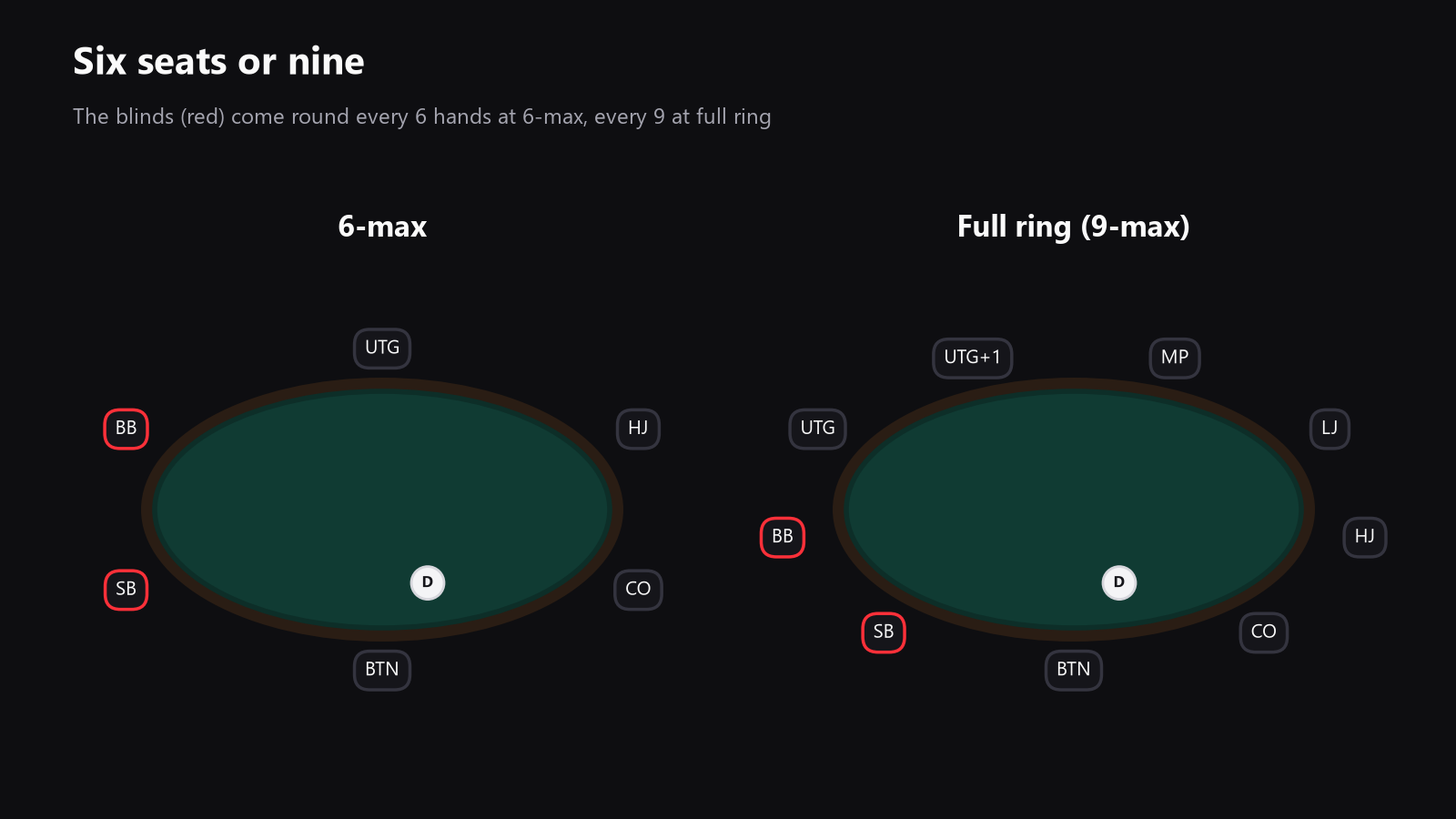
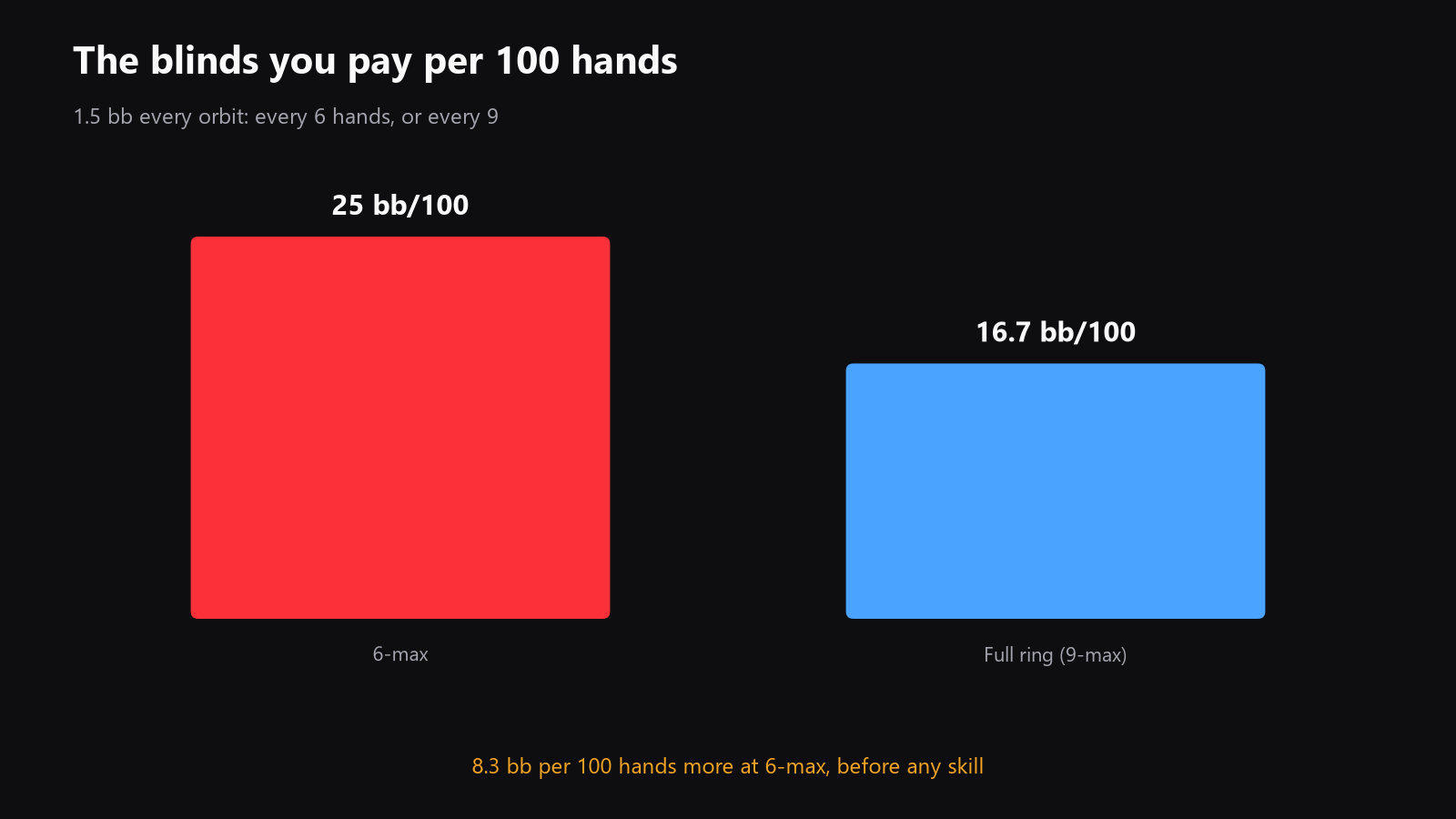
At a 6-handed table, each player pays the blinds 1.5 big blinds every 6 hands. That is 25 big blinds per 100 hands.
At a 9-handed table, each player pays the blinds 1.5 big blinds every 9 hands. That is about 16.7 big blinds per 100 hands.
So before you even think about skill, you are paying about 8.3 big blinds more per 100 hands in 6-max than in full ring.
That matters a lot. It means your seat comes with a bigger fixed cost in 6-max, so you need more edge from your late-position play, your blind defense, and your postflop decisions to make up for it.
Here is the comparison in simple form:
| Format | Blinds paid per orbit | Blinds paid per 100 hands |
|---|---|---|
| 6-max | 1.5 bb every 6 hands | 25 bb/100 |
| Full ring, usually 9-max | 1.5 bb every 9 hands | 16.7 bb/100 |
Why opening ranges change so much
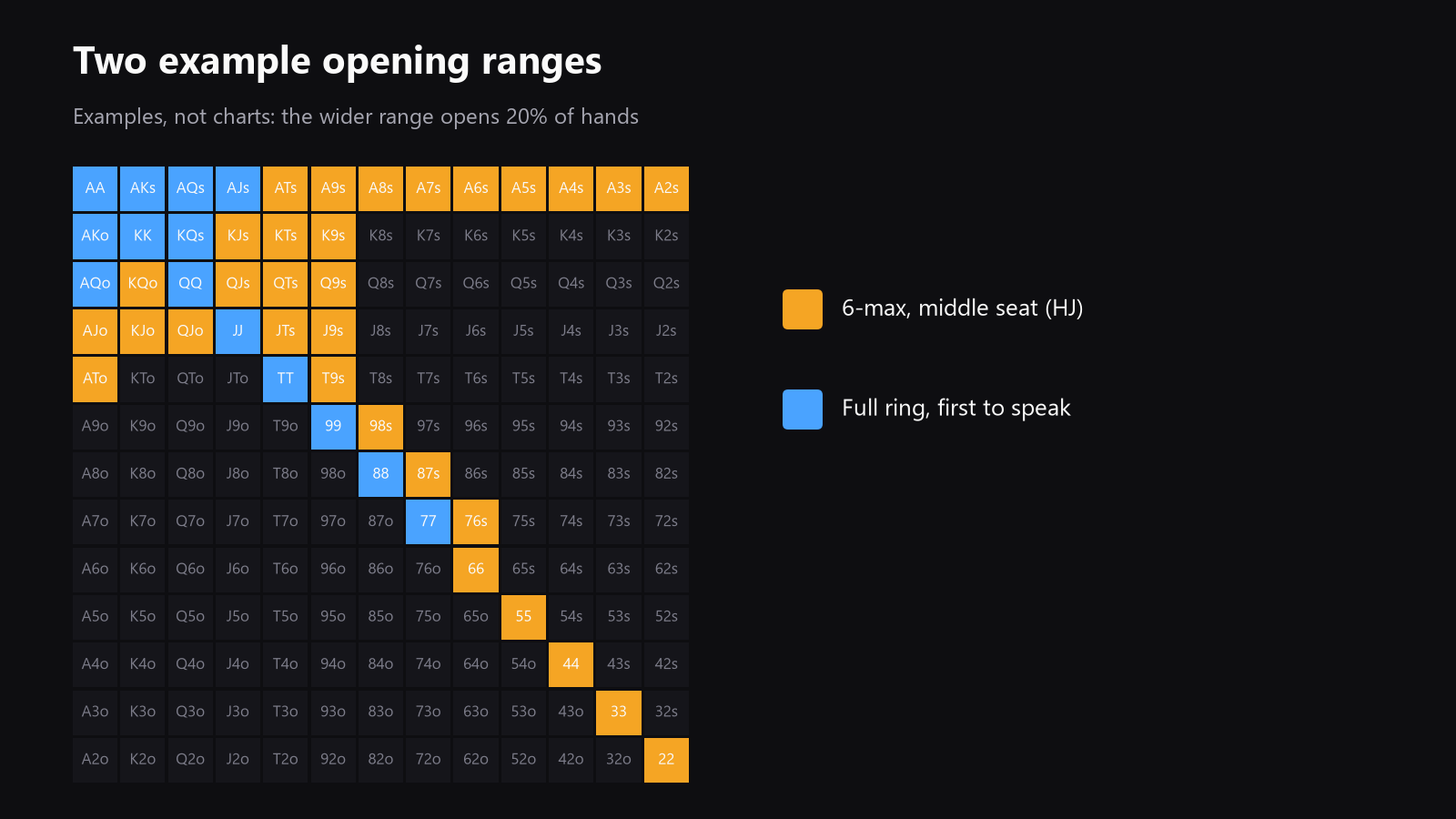
The fewer players there are left to act, the wider your opening ranges can usually be.
That is the core reason 6-max plays looser than full ring. Fewer opponents remain behind you, so the chance that someone has a strong hand goes down, and your opens get attacked less often than they would in a tighter lineup.
In full ring, under the gun is a true early position. You have many players left to act, so your range should be tighter and more robust.
In 6-max, under the gun is still an early seat, but it is less crowded. Many hands that are marginal in full ring become playable in 6-max, especially as you move toward the cutoff and button.
A good practical summary is this:
- Full ring early position should be tighter.
- 6-max early position can be wider.
- The cutoff and button matter more in 6-max because you reach them more often relative to the size of the table.
- The late seats are where a large part of your win rate comes from in both formats, but especially in 6-max.
That does not mean you should open recklessly. It means the same hand has different value depending on how many players are left and how often you are punished for entering the pot.
You play out of position more often in 6-max
This is one of the biggest practical differences.
At a 6-handed table, you are in the blinds 2 times every 6 hands, which is 33.3% of the time.
At a 9-handed table, you are in the blinds 2 times every 9 hands, which is 22.2% of the time.
So in 6-max, you face the worst seats 50% more often.
That is a huge deal. Out of position poker is harder. You realize less of your equity, you are forced to defend more frequently, and your mistakes cost more because you have less informational advantage.
This is why strong blind play matters so much in 6-max. If you can defend well, 3-bet well, and avoid lighting money on fire in the blinds, you gain a real edge over the field.
If you dislike blind battles and want to spend more time in cleaner seats, full ring may feel more comfortable.
Postflop changes too
A lot of players think the only difference is preflop ranges. That is not true.
In 6-max
You get more heads-up pots, more 3-bet pots, and more direct confrontations. Players attack more often because ranges are wider and the table is shorter. That means:
- c-betting matters more,
- bluffing matters more,
- range advantage matters more,
- and blind defense mistakes get punished faster.
In full ring
You see more multiway pots. That changes the value of many hands and many lines. Multiway pots usually reward:
- tighter value ranges,
- better board reading,
- more patience,
- and less automatic aggression.
This is also why some hands that look attractive in full ring lose value in 6-max. When the table gets shorter, you face more pressure and fewer easy pots where everyone folds.
The common stereotype is that 6-max is “aggressive” and full ring is “passive”. That is too simple. The real difference is that 6-max is more confrontational, while full ring is more often multiway and range-constrained.
Those are very different games.
Variance is usually higher in 6-max
Shorter tables usually produce bigger swings.
Why? Because you play more hands from the blinds, more pots out of position, and more contested pots. Wider ranges also mean that more marginal hands go to showdown, so your results swing more.
Full ring usually feels calmer. You wait more. You enter pots with stronger hands more often. The game is less chaotic, even if it is still hard.
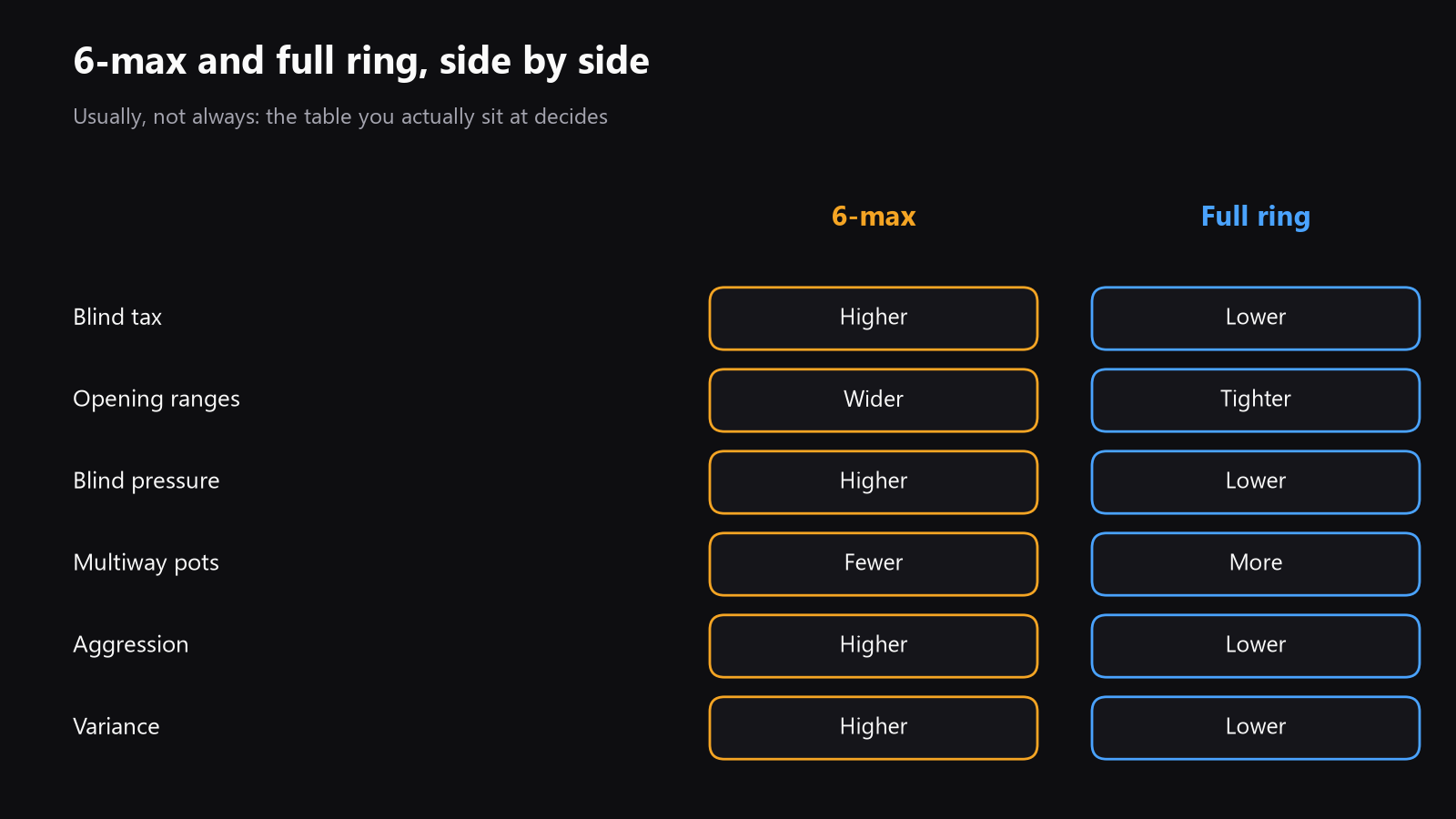
A simple summary:
| Topic | 6-max | Full ring |
|---|---|---|
| Blind tax | Higher | Lower |
| Opening ranges | Wider | Tighter |
| Blind pressure | Higher | Lower |
| Multiway pots | Fewer | More |
| Aggression | Higher | Lower |
| Variance | Higher | Lower |
Which format suits which player?
There is no universal answer.
6-max may suit you if:
- you like late position play,
- you are comfortable defending blinds,
- you can handle 3-bet pots,
- you enjoy pressure and aggression,
- and you do not mind swings.
Full ring may suit you if:
- you prefer tighter, more selective poker,
- you are stronger at value betting than bluffing,
- you like multiway pots,
- you prefer fewer marginal confrontations,
- and you want a game that feels a little less volatile.
There is also a learning angle.
If you are newer to poker, full ring can feel easier because you face fewer marginal spots. That does not mean it is simpler to beat, only that the game gives you more room to play straightforwardly.
If you are improving quickly, 6-max often teaches you more of the game. You are forced to play more blind defense, more positional poker, more aggressive pots, and more difficult postflop lines.
So the right question is not, “Which format is more respectable?” It is, “Which format fits the way I actually make money?”
How to know which one you actually play better
Do not guess.
Do not choose based on reputation, and do not choose based on what strong players say on forums.
Instead, compare your own results by format after rake, with enough hands to make the answer meaningful.
You want to look at:
- win rate in big blinds per 100 hands,
- the margin around that win rate,
- rake paid,
- and sample size.
If one format is ahead but the margin is wide, you do not know enough yet. If one format is behind but you have a tiny sample, that tells you almost nothing. And if the rake is a bigger part of your result in one format, that matters too.
The best answer comes from your own hands, not from reputation.
Poker Exploit helps you keep your review honest by showing your results, your curve, and the rake next to the result in the Results module, so you can judge what the game is actually costing you. If you want to compare 6-max and full ring, the important part is to keep those samples separate in your study and not blur them together.
That is the right way to decide which game suits you. Not by theory alone, but by your actual numbers.
The short version
If you want the fastest possible summary:
- 6-max costs more in blinds.
- 6-max widens your opening ranges.
- 6-max puts you out of position more often.
- 6-max creates more aggression and usually more variance.
- full ring gives you tighter ranges, more multiway pots, and usually a calmer game.
- the best format is the one you beat better on your own hands, after rake, with enough sample to trust the result.
So yes, both formats can be profitable. But they are profitable in different ways.
If you want to know which one is better for you, start with your own results by table size. That is where the answer is.
Do it on your own hands.