
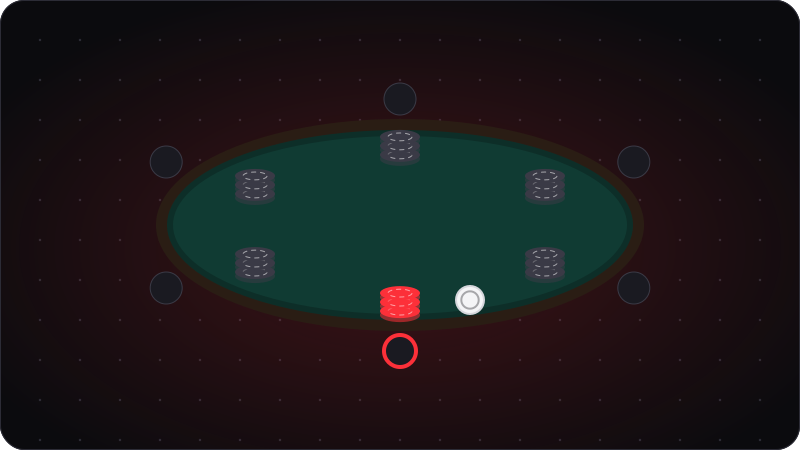
If you are starting with online No-Limit Hold'em cash games, the first thing to understand is that cash is not just a smaller version of tournament poker. It has its own logic.
In a cash game, chips are money. If you win 100 big blinds, you won 100 big blinds of real value. You can reload whenever you want, and you can leave the table whenever you want. Stacks are often around 100 big blinds, which means the game is deep enough for postflop skill to matter, but not so deep that everything becomes a pure bluffing war.
That changes almost everything:
- There is no ICM.
- Your stack does not get more valuable just because the blinds rise.
- Rake matters a lot, especially at micro stakes.
- Good seat selection and table selection are part of strategy, not an afterthought.
Cash game strategy is therefore not just about making the right move in one hand. It is about building an edge across many hands, at the right tables, with the right stack depth, and with the rake in mind.
Cash games vs tournaments: the key difference
In tournaments, survival has value because payouts are top heavy. In cash games, survival has no extra value. A chip is always worth the same amount of money relative to the stake, and if a table is bad, you should be willing to leave it. If a stack gets low, you can rebuy. If a game is too tough, you can stop.
That freedom changes the way you should think:
- Your goal is not to outlast anyone. Your goal is to make profitable decisions.
- 100 big blind stacks are normal. That makes position, range construction, and postflop planning important.
- Rake is a real opponent. At small stakes, the house takes a meaningful cut of every pot, so small edges can disappear if you ignore it.
This is why a cash game player should never copy tournament habits blindly. A tournament player often cares about chips accumulated relative to payout pressure. A cash game player cares about expected value, seat quality, and the long run.
Position is the first strategic edge
If you remember only one thing from this lesson, make it this: position is power.
The later you act, the more information you get. You see what your opponents do before you decide. That makes it easier to value bet thinly, bluff selectively, control pot size, and realize your equity.
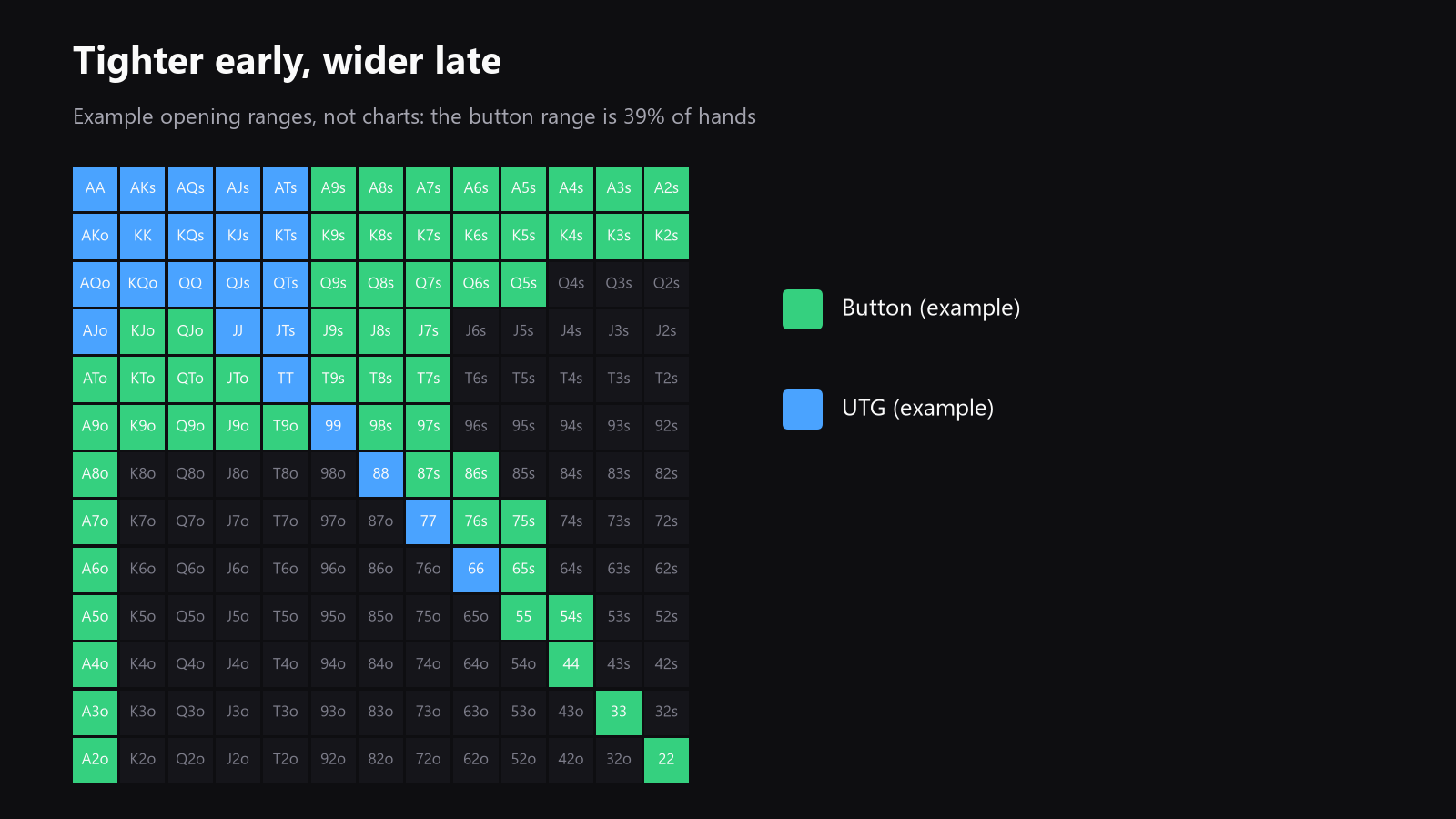
This is why your opening range should be tighter early and wider late. Under the gun, you act first before the flop; after the flop the blinds act first, and UTG is out of position against every player left to act behind it. On the button, you act last after the flop, turn, and river, so you can open much wider.
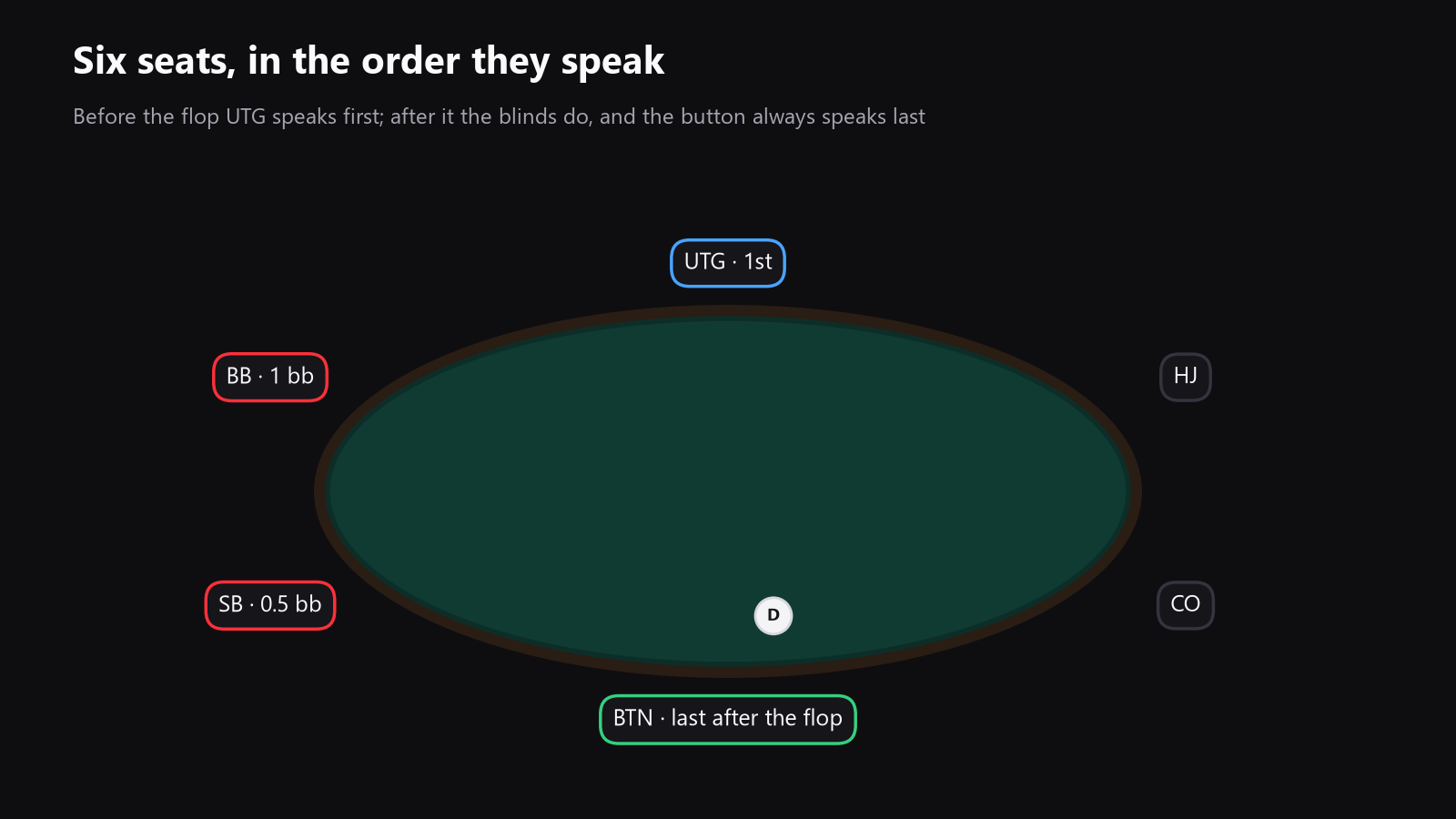
A simple way to think about position is this:
- In early position, you need hands that can stand pressure.
- In middle position, you can widen a bit.
- In late position, you can steal more often and play more hands profitably.
- In the blinds, you are at a structural disadvantage because you will often play out of position.
That last point matters a lot. The blinds may look cheap, but they are not free. If you defend too loosely and too passively, you will leak money every orbit.
Opening ranges and 3-betting build the hand before the flop
Cash game strategy starts preflop. Your opening range determines the shape of the whole hand.
When you open, you do two things at once:
- You try to get called by worse hands.
- You try to win the blinds and antes, if there are any.
That is why open-raising is stronger than limping in most standard cash game situations. Raising gives you initiative, builds the pot when you have an edge, and creates fold equity.
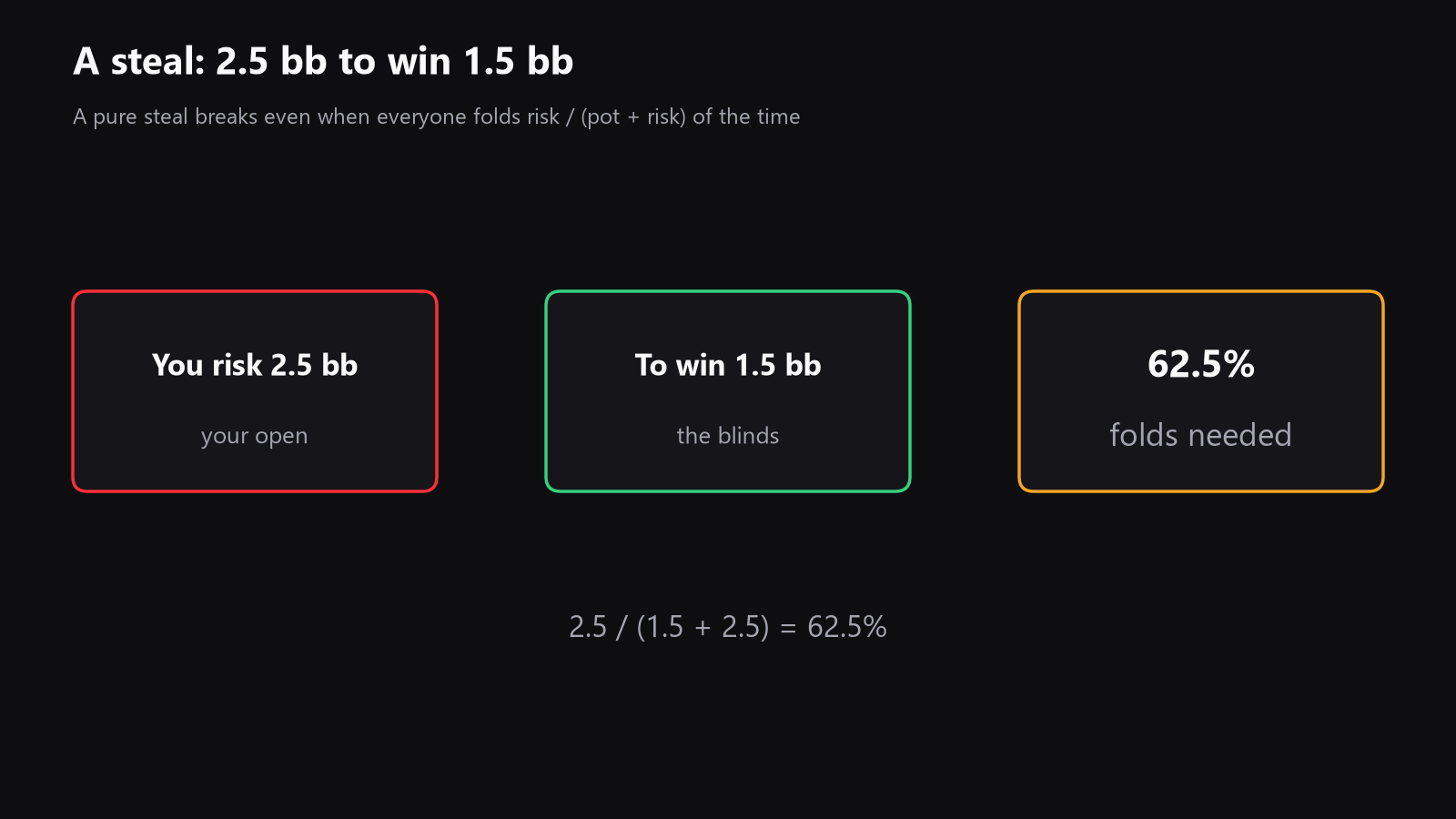
A simple piece of arithmetic shows why stealing blinds matters. If you open to 2.5 big blinds and everyone folds, you win the 1.5 big blinds already in the pot from the small blind and big blind. You risk 2.5 to win 1.5, so a pure steal needs everyone to fold 62.5% of the time to break even.
The same logic applies to 3-betting. A 3-bet has value when:
- you have a hand that performs well against the opening range,
- you can isolate a weaker player,
- you can deny equity to hands that would otherwise realize too much for free,
- or you can take the pot down preflop often enough.
At 100 big blinds, 3-bets are still deep enough to matter postflop. You are not simply inflating the pot and hoping. You are building a hand tree where range advantage, position, and stack depth all interact.
A few practical ideas:
- Open tighter from early position.
- Open wider from late position when the players behind you are passive or tight.
- 3-bet for value against players who call too wide.
- Add selective bluff 3-bets when your hand blocks strong continues and the opener folds often enough.
- Defend the blinds with structure, not emotion.
If you want a simple rule to start with, use this: the closer you are to the button, the more hands you can play. The more out of position you are, the more disciplined you need to be.
Postflop play is where your preflop choices pay off
A lot of players think cash game skill is only about preflop charts. It is not. Preflop gives you the right kind of hand in the right kind of pot. Postflop is where you convert that structure into profit.
On the flop, turn, and river, your decisions should be guided by three questions:
- Who has the range advantage?
- Who has the nut advantage?
- How much fold equity do I have?
For example, if you opened from late position and the big blind defended, you often have the stronger overall range. But on some boards, the blind can have more very strong made hands or more two pair and sets relative to your range. The board texture changes the story.
That is why top pair is not always a big hand, and why a missed draw is not always a lost cause. It depends on ranges, position, and the action before the flop.
A few postflop fundamentals:
- Value bet enough. Many low stakes players call too much, especially with medium-strength hands.
- Do not bluff without a reason. A bluff should attack a range that can fold.
- Use position to control pot size. In position, you can check back more often, realize equity, and keep weaker hands in the pot.
- Do not overvalue one pair in big pots. The bigger the pot gets, the stronger the ranges tend to be.
If preflop is about building a good structure, postflop is about reading that structure well.
How cash players measure results
In cash games, the standard unit is big blinds per 100 hands, or bb/100. That is much better than looking only at dollars, because a dollar result means different things at different stakes.
The formula is simple:
bb/100 = total big blinds won or lost / number of hands x 100
So if you win 1,000 big blinds over 25,000 hands, your win rate is, for example:
1,000 / 25,000 x 100 = 4 bb/100
That is just an example of the formula. Over 25,000 hands, such a win rate can still have a wide margin, about ± 11 bb/100 if the standard deviation is 90 bb/100 (1.96 x 90 / square root of 250 = 11.2).
That is useful, but only when you respect variance. A short-term result can lie to you. You can run well and look strong, or run badly and look crushed. That is why you should never judge yourself from a tiny sample.
The right question is not just "Am I winning?" It is also:
- How many hands have I played?
- How wide is the margin on my result?
- Is this win rate likely to be stable yet?
A good tracker should show your win rate with its margin, not as a promise. It should also show where the money comes from and where it goes. In cash games, the rake matters enough that you should always look at it next to your result.

If you track your own hands seriously, you can see more than a single headline number. You can cut your results by room, stake, position, and hour. That is important, because a global win rate can hide where you are actually strong or weak.
Table selection and stake selection
One of the biggest edges in cash games has nothing to do with card play. It is seat selection.
At the same stake, some tables are much better than others. Your win rate depends on who you sit with, who is left of you, how aggressive the table is, and how much rake the game takes.
Good table selection means:
- looking for weaker players,
- avoiding too many strong regulars to your left,
- choosing positions where you act after the players you want to play against,
- and leaving games that are clearly bad for your edge.
Stake selection matters too. A stake is not good just because you can beat the blinds. It has to be beatable after rake. At micro stakes, rake can eat a surprisingly large part of your edge, which means a small technical leak can become very expensive.
A practical rule: if the rake is a bigger problem than your own gameplay leak, change the game first. Sometimes the right move is not to study one more river spot. It is to move to a better table, a better stake, or a different room.
A simple framework for your first cash game study
If you are new to online cash games, start with this order:
- Learn position and opening ranges.
- Learn what a good 3-bet does, and why.
- Learn basic postflop thinking around range advantage and board texture.
- Track your results in bb/100, not only in dollars.
- Respect rake and table selection.
- Review your results by stake, position, and hour.
That is the backbone of cash game strategy. Once you have it, more advanced work starts to make sense.
If you want to study your own cash game results properly, a tracker that shows win rate with its margin, rake next to the result, and breakdowns by room, stake, position, and hour can save you a lot of guesswork. That is exactly the kind of feedback that turns "I think I am okay" into "I know where my edge is".
Do it on your own hands.