
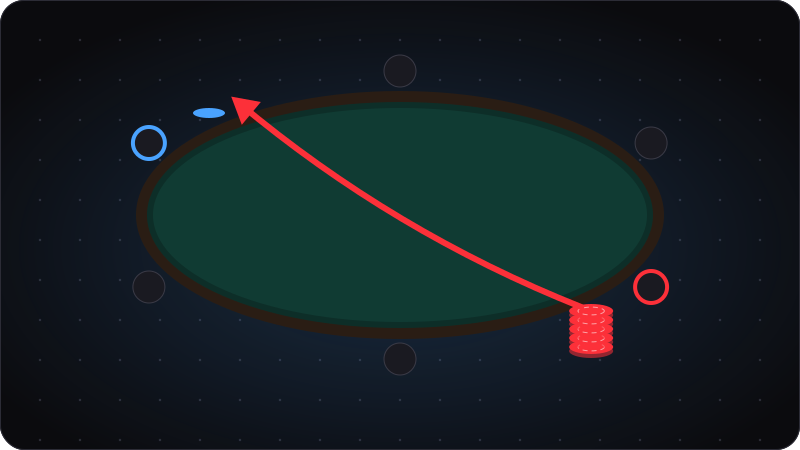
If a player limps in front of you, you should pay attention. At small stakes especially, a limp often means a weak, capped range, the kind of range that hates pressure and gives away too much money after the flop. That is why the isolation raise, often called an iso-raise, is one of the best preflop tools you can use.
An isolation raise is simple: a player limps, you raise, and your goal is to play a bigger pot against that weaker player, ideally heads-up or close to it. You are not raising just to "be aggressive". You are trying to win the dead money, punish a weak range, and take initiative with hands that play well when called.
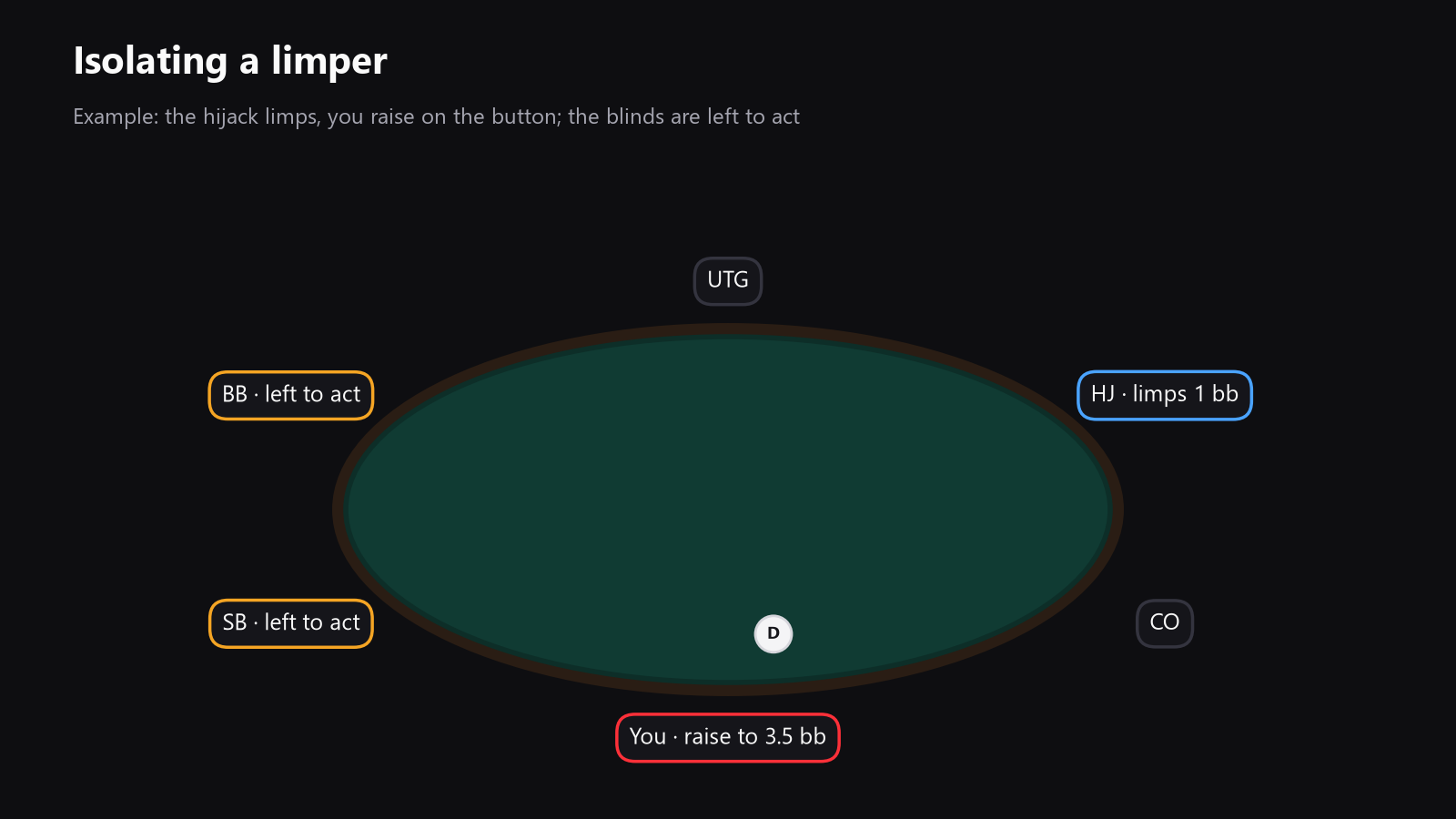
Why isolating a limper is so profitable
The main reason is dead money. The limper has already put chips in the pot, and the blinds are still waiting behind. That money is there for the taking.
The second reason is range quality. Most limps at small stakes come from hands that are not strong enough to raise, but are still too weak to continue comfortably versus a raise. When you isolate well, you force the limper to make a mistake. Sometimes they fold too much. Sometimes they call with worse hands. Sometimes they call and then check-fold too often after the flop.
The third reason is structure. A raise after a limp often gives you the betting lead and a simpler postflop plan. That matters a lot when you are still learning. You want spots where your range is easy to manage and where the field makes obvious mistakes.
There is one important caveat: not every limp is weak. Some players limp traps. Some limp strong hands in certain games. So the correct response is not "raise every limper". The correct response is "raise the limpers who are weak, passive, and overfolding, then adjust to the players left to act".
Which hands should you isolate with?
Think in categories, not in a fixed chart. The right isolation range depends on position, stack depth, the limper, and the players behind you.
A good starting point is this:
- Clear value hands: big pairs, strong aces, strong broadways.
- Good isolation hands in position: pocket pairs, suited aces, suited broadways, some suited connectors.
- Hands to be careful with: weak offsuit aces, dominated broadways, disconnected offsuit hands, and hands that dislike a 3-bet or a multiway pot.
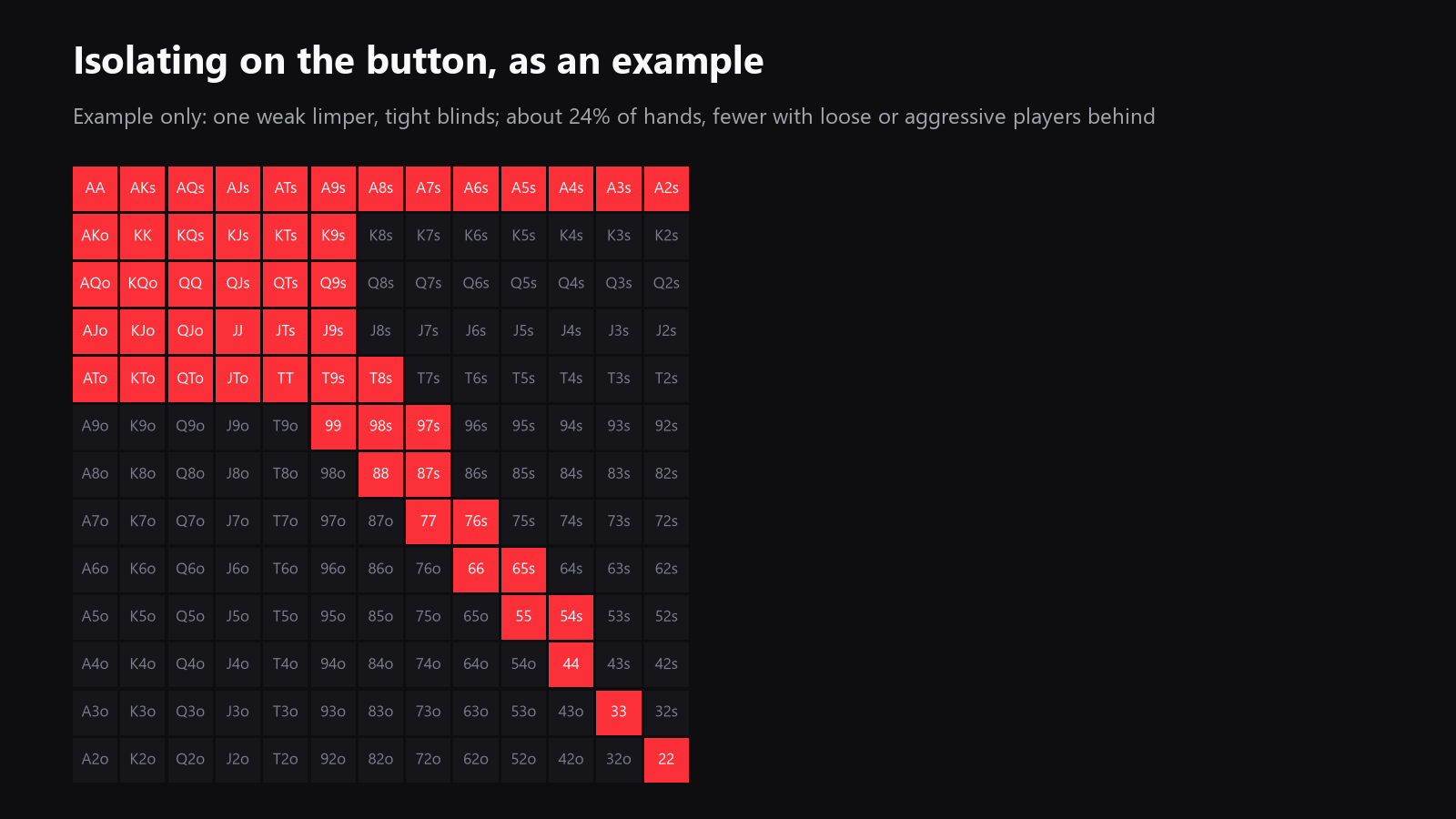
If you are on the button against one weak limper and the blinds are tight, you can usually isolate quite wide. That is an example, not a fixed chart, because the right range changes with the table. In that kind of spot, hands like these often become profitable isolation candidates:
- Any pocket pair
- Most suited aces
- Strong broadways like AQ, AJ suited, KQ
- Many suited broadways
- Some suited connectors and suited one-gappers
- Some offsuit broadways if the limper is weak and the blinds do not defend much
Now compare that with a tougher spot, such as the blinds, or a situation where several players still have to act. Your range should tighten. You want hands that do well when called and do not hate being played for stacks if the pot gets bigger.
A simple way to think about it is this:
- If your hand plays well heads-up and in position, it is a better iso candidate.
- If your hand relies on winning a big pot cheaply, it is less attractive.
- If your hand is dominated often, do not inflate the pot just because there is dead money.
That last point matters. Many players see a limp and start isolating too wide with weak offsuit hands. That is exactly how you turn a good spot into a noisy one.
How big should you make it?
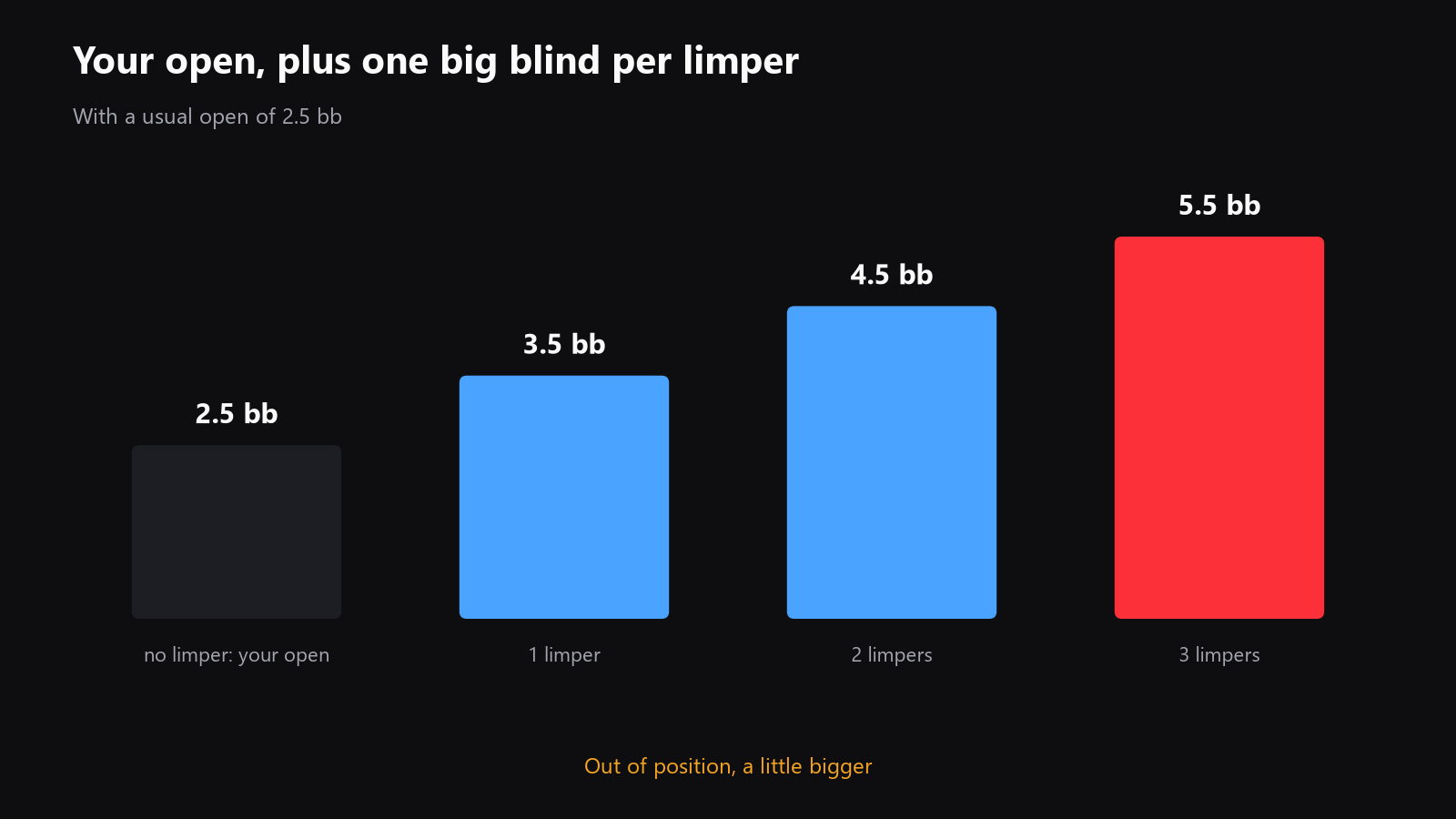
A very solid baseline is: your normal open size, plus one extra big blind per limper.
So if your standard open is 2.5bb:
- versus one limper, you raise to 3.5bb
- versus two limpers, you raise to 4.5bb
- and so on
The exact base size can change from one game to another, but the principle stays the same. Every limper adds dead money, and your raise should charge that extra dead money.
Why not make it tiny? Because small sizing invites callers. If you go too small, the limper feels priced in, the blinds defend more often, and the pot becomes multiway. That is often the opposite of what you want.
Why not make it huge every time? Because you do not want to overinvest with medium-strength hands that are happy to isolate but not thrilled to play a massive pot. A sensible raise size gets the job done without forcing you into an unnecessarily bloated pot.
You should also adjust for position and stack depth:
- In position: the baseline sizing usually works well.
- Out of position: go a little bigger.
- Deeper stacks: a slightly larger size can deny better odds to callers.
- Shorter stacks: you often do not need to size as large, because the pot-to-stack ratio changes quickly.
How the players left to act change the spot
This is where many players make their biggest mistake. They focus on the limper and forget the rest of the table.
The players still to act after you matter a lot.
1. Tight players behind you
If the remaining players are tight and do not defend much, you can isolate more freely. You are less likely to get squeezed, and you are more likely to pick up the pot preflop or go heads-up in position.
2. Loose callers behind you
If the players behind love to cold-call, you should tighten your isolation range and value your hands more highly. The pot may become multiway even after a raise. That changes everything.
In a multiway pot, you want hands that make strong one-pair hands, strong top pairs, good kickers, and hands that retain value when called. Purely speculative hands lose some of their appeal.
3. Aggressive players behind you
If someone behind likes to 3-bet, you need to be more selective. A hand that looks good against the limper can become awkward fast when a squeeze appears.
Against that kind of table, ask yourself:
- Can I continue against a 3-bet?
- Does my hand play well in a bloated pot?
- Am I isolating for value, or just trying to steal dead money?
If the answer is not clean, fold more often and isolate less wide.
4. Position matters a lot
On the button, isolation is at its best. You act last after the flop, which helps you realize equity and control pot size.
In the cutoff, it is still often strong, but the blinds are more dangerous and you have less information.
In the blinds, isolation becomes much more serious. You are out of position, and you should usually be tighter and more value-heavy.
What to do against multiple limpers
More limpers means more dead money, but it also means more ranges that can connect with the flop. So the correct adjustment is not just "raise bigger and keep the same range".
Usually you should do both:
- Raise bigger
- Tighten your value range
If the table is soft and passive, you can still isolate fairly wide in position, because people will make postflop mistakes. But the more limpers there are, the less attractive your weakest hands become.
A very useful habit is to separate two questions:
- Do I want to isolate this limper?
- Do I want to play a multiway pot if I get called in several spots?
If the answer to the second question is no, your range should tighten fast.
Common mistakes
Here are the biggest leaks I see around isolation raises:
- Raising too wide out of position
- Using one size for every table
- Going too small and letting everyone call
- Isolating automatically instead of thinking about the players behind
- Ignoring limper tendencies
- Forgetting stack depth
One more mistake is subtle: players sometimes isolate because they think that is what they are supposed to do. That is not enough. An isolation raise is profitable when the limper is weak, the table behind is manageable, and your hand performs well in the resulting pot.
A simple rule you can use today
If you want a practical shortcut, use this:
- Raise weak limps more often when you are in position
- Tighten in the blinds
- Add one extra big blind per limper
- Value hands go up in priority when players behind are sticky
- Speculative hands go down in priority when players behind are aggressive
That is not a chart. It is a framework. And that is better, because the right answer depends on your table.
How Poker Exploit helps you study this spot
If you want to stop guessing, the Reveal module shows how the players at your limits really behave. You can see how often they fold, call, raise, bet, or check through in the spots you study, and that makes a big difference when you decide whether an isolation raise is worth it.
And if you want to check a concrete spot, the Solver module computes the strategy for that situation. That helps you compare your instinct with an actual result instead of relying on a vague rule.
The goal is not to memorize a universal chart. The goal is to understand why the isolation raise works, then adjust it to the table in front of you.
The takeaway
A limper is often a target, not a problem.
When the limper is weak, the players behind are manageable, and your hand can play well after the flop, an isolation raise is often one of the best ways to put money into the pot. Use a sensible size, usually your normal open plus one extra big blind per limper, then tighten or widen depending on position and on who still has to act.
If you get that part right, you will stop treating limps as dead spots and start treating them as opportunities.
Do it on your own hands.