
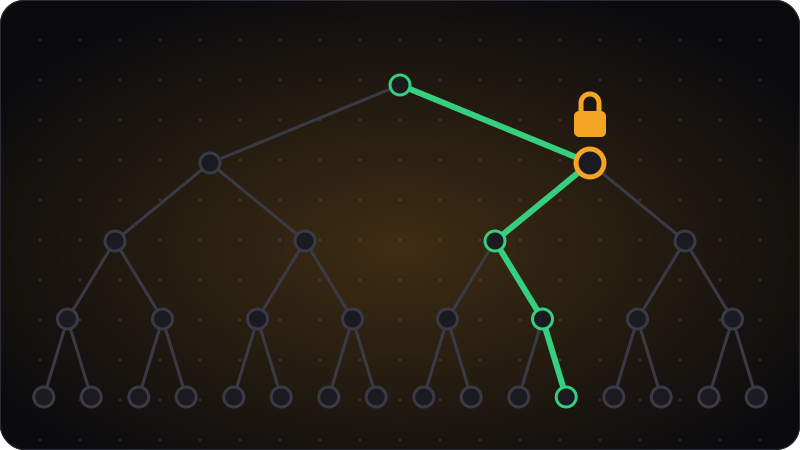
If you search for node locking in poker, you are usually after one thing: how to punish a real opponent who does not defend a spot correctly.
That is the right instinct, but there is a trap.
A solver can show you the best response to a fixed mistake, yet the answer can look much more extreme than what you should actually use in game. Sometimes that is because the leak is huge. Often, though, it is because the model is too clean, the sample is too small, or you locked the wrong node.
So the real question is not just, "What does the solver do if villain folds too much?" It is also, "How do I know the lock is real enough to trust?"
What node locking means
A node is one decision point in the game tree. For example:
- facing a flop c-bet
- choosing a turn barrel
- defending a river bet
- deciding whether to call a 3-bet preflop
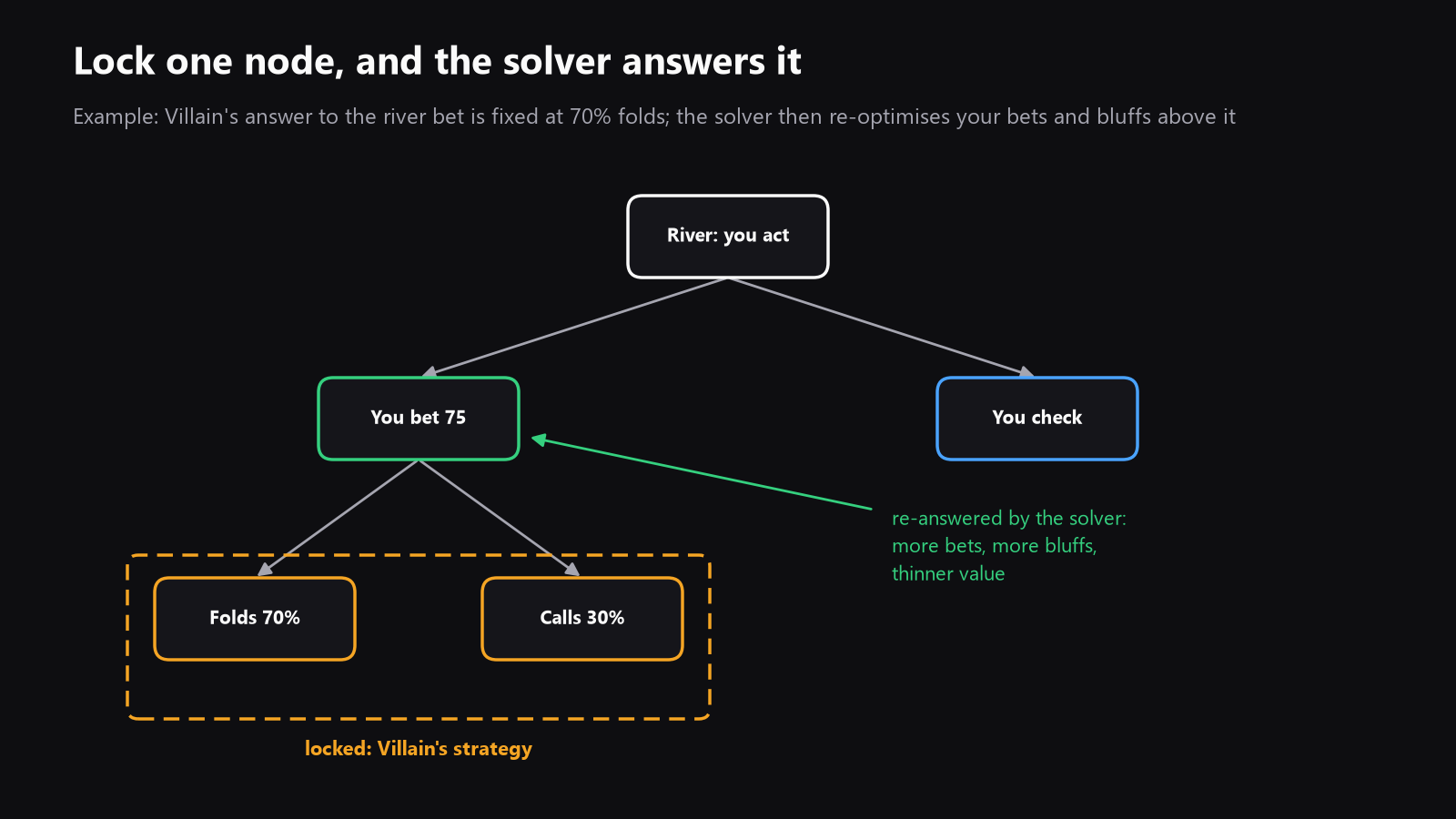
To lock a node means to fix an opponent's strategy at that point.
For example, you might say:
- villain folds 70% to this river bet
- villain calls 30%
- villain never raises
Then you let the solver compute the best answer to that model.
That is the key idea.
Node locking does not ask, "What is perfect poker?" It asks, "If this player really behaves like this at this point in the tree, what should I do next?"
That is why node locking is so useful against pools, population leaks, and specific opponents. It turns a vague feeling, like "they overfold rivers," into a concrete strategy adjustment.
Why the solver often overreacts
The solver is not being dramatic. It is doing its job.
Once you lock a node, the solver is free to exploit that mistake as hard as possible. A human opponent would not respond that cleanly, but the model can. That is why the answer often looks too aggressive, too thin, or too polarized.
There are three main reasons.
1. The solver assumes the leak is real and stable
If you lock villain to overfold a river spot, the solver assumes that fold rate is true every time the same node appears.
Real players are messier.
They may:
- overfold only some board textures
- defend better versus one bet size than another
- change strategy after a few showdowns
- play differently when stacks are deeper or shallower
A lock ignores all that unless you build it into the model yourself.
2. One node can change the whole tree
This is the part many players miss.
A node lock does not only affect that one decision. It can change the whole line that leads to it.
If villain overfolds the river, then:
- your turn barrels may become more aggressive
- your flop betting range may change
- your checking range may shrink or widen
- your thin value hands may shift from check to bet
- your bluff candidates may become more selective
So when you see a big change in the locked answer, it is not always "the river got solved." Sometimes it means the whole line is sensitive to that river response.
3. Small samples create false certainty
A solver will happily exploit a 70% fold rate whether that number came from 7 hands or 700 hands.
That is where players go wrong.
If your sample is tiny, the lock is not a fact. It is a hypothesis. A useful one, maybe, but still a hypothesis.
A real exploit needs a real sample behind the lock, not just a memory of one showdown where villain tank-folded the nuts.
A simple river example
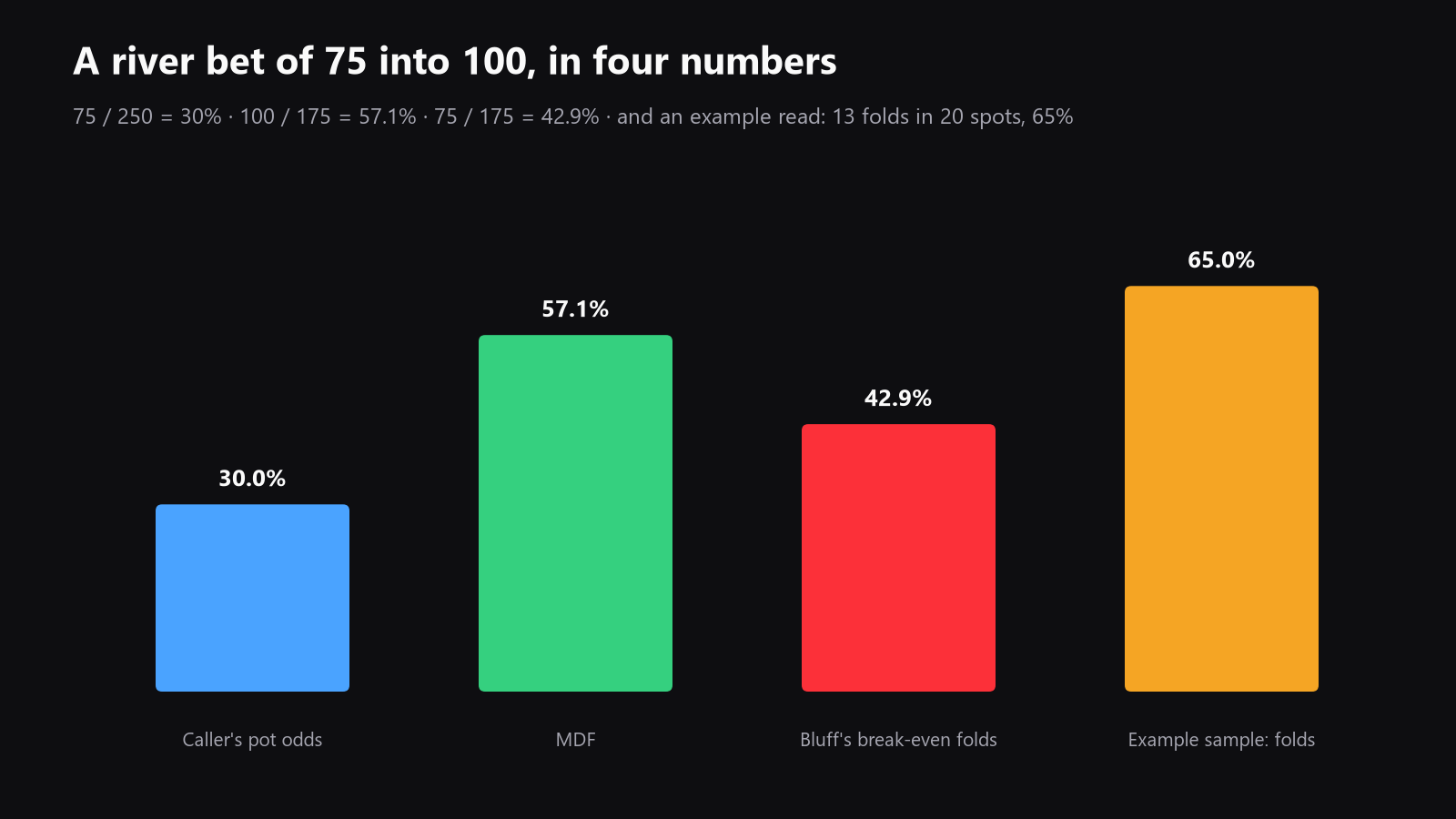
Suppose the pot is 100 and you bet 75 on the river.
Two useful numbers come out of the arithmetic.
Minimum defense frequency
The defender's minimum defense frequency is:
MDF = Pot / (Pot + Bet)
So here:
MDF = 100 / 175 = 57.1%
That means, in a simplified model, villain needs to continue more than 57.1% of the time to avoid letting your bet print too easily.
Balanced bluff to value ratio
For a 75 into 100 river bet, the balanced bluff to value ratio is:
Bluffs / Value = Bet / (Pot + Bet) = 75 / 175 = 0.43
So if you wanted a balanced betting range in this toy model, you would use about 3 bluffs for every 7 value combos, which is 30% bluffs.
Now imagine your real sample says villain folds 65% to this exact kind of river bet.
That is a big overfold.
A locked solver answer will usually respond by:
- betting more often
- bluffing more often
- value betting thinner
- choosing bluffs with better blockers
- sometimes using a bigger size if the line supports it
That is not a bug. It is exactly what an exploitative model should do.
But if the sample is weak, that same response can be too extreme.
Why the answer can be right and still be too much
This is the part that matters in practice.
A solver answer can be mathematically correct for the lock and still be too aggressive for real play.
Why?
Because real poker is not a frozen tree with perfect inputs.
You may be locking:
- the wrong sizing
- the wrong board class
- the wrong stack depth
- the wrong population
- the wrong line
Or you may be locking the right spot, but the sample is not strong enough to justify a hard change.
So when you see a solver output that says, in effect, "blast this node," ask yourself three questions:
- Is the node exact? Same line, same size, same stack depth, same board texture.
- Is the sample real enough? Not just "I saw this once," but enough hands to mean something.
- Is the exploit robust? If the opponent starts defending a little better, does your adjustment still make sense?
If the answer to any of those is no, the solver may be overreacting to your model, not to the player.
How to build a useful lock from a real sample
This is where a good study process matters.
Do not start with the solver. Start with the sample.
Step 1: isolate the exact node
Filter for the spot as tightly as you can:
- same street
- same position
- same stack depth
- same betting line
- same size
- same board texture
A river overfold on a dry paired board is not the same thing as a river overfold on a completed flush board.
Step 2: look at what villain actually did
Count the actions in that exact node.
Do not mix:
- calls and folds to different sizes
- different runouts
- different player pools
- different stack depths
A lock built from mixed situations is usually noise with confidence attached.
Step 3: treat the number as a range, not a law
If the sample is small, do not lock a single exact frequency with false precision.
For example, if a player folded 13 times in 20 similar spots, that is 65%.
Useful? Yes. Certain? No.
A better mindset is, "this looks like an overfold, and I should test a response that is stronger than baseline."
Step 4: compare the locked answer to the baseline
This is where the solver becomes valuable.
Start from the clean baseline strategy, then see how it changes when you apply the lock.
Ask:
- Does the betting frequency rise a little or a lot?
- Do thin value hands start betting?
- Which bluffs become better?
- Do blockers matter a lot?
- Does the best size change?
If the answer changes only a bit, the leak may be modest. If the answer changes a lot, the node is probably sensitive.
Step 5: turn the result into a real exploit, not a script
The final step is the one most people skip.
Do not copy the solver line like a robot.
Instead, ask:
- what kinds of hands does this player overfold against?
- what is the cheapest size that already prints?
- which value hands can bet thinner?
- which bluffs have the best blockers?
- which hands should still check because they are too weak to bet or too valuable as bluff-catchers?
That is how you turn node locking into a useful exploit in your study, away from the table.
What a solver is really telling you
A locked solver answer is not a command.
It is a stress test.
It tells you how much pressure the node can take before the opponent's mistake becomes expensive.
That makes node locking useful in two very different ways:
As a leak detector
If the locked answer barely changes, the leak may not be worth much. If the locked answer changes a lot, you probably found a spot worth studying.
As an exploit builder
Once you know the size and shape of the leak, you can build a practical strategy around it.
That strategy may be less extreme than the solver's pure answer, but it should still push hard enough to gain EV.
Common mistakes
Here are the errors I see most often.
1. Locking the river and ignoring the earlier streets
If the line that gets to the river is already unusual, the river node may not represent the opponent's normal range.
You are not only locking the final decision. You are also locking the story that led there.
2. Using one fold rate for every board
A player who overfolds on scary runouts may defend fine on dry boards. A player who hates bluff-catching on paired boards may defend better when draws miss.
Board texture matters.
3. Forgetting blockers
In real hands, blockers are often the difference between a good bluff and a bad one.
If you block villain's strongest continues, bluffing becomes more attractive. If you block the hands that fold, your bluff loses value.
A solver sees this immediately. You should too.
4. Treating a small sample as proof
This is the biggest mistake.
A small sample can point you in the right direction. It cannot always justify a hard exploit.
If the sample is weak, the best answer is usually to widen the margin of safety and keep watching.
5. Thinking node locking is only for rivers
Rivers are the cleanest place to start, because ranges are narrow and the decision is direct. But node locking is useful on the flop and turn too, especially when a player overfolds to one size or under-defends a specific line.
How this fits your study process
The best use of node locking is not to replace solver study. It is to connect solver study to real opponents.
A clean workflow looks like this:
- Build the baseline with a solver.
- Find the real leak in your sample.
- Lock the node to that observed tendency.
- Compare the new answer to the baseline.
- Keep only the parts that survive scrutiny.
That is how you avoid two common traps:
- pure theory with no exploit
- pure exploit with no proof
If you already track your own hands, this becomes much easier.
Poker Exploit has no node locking feature. Its Solver gives only the equilibrium baseline. The Exploiter module is separate: it gives the best answer to an opponent's recorded habits, hand by hand, ICM included, and says so when the sample does not prove it.

The practical takeaway
Node locking is powerful because it forces the question to become concrete.
Not "what is poker?" Not "what is GTO?" But "if this player folds too much here, how much value can I print, and which bluffs become best?"
That is why node locking is so popular with serious players.
It bridges the gap between a clean model and a real opponent.
Just do not forget the limits:
- the lock is only as good as the sample behind it
- a solver can overreact to a leak that is not stable
- one node can distort the whole tree
- the right exploit is often narrower than the raw output suggests
Use the solver to stress test the spot. Use the sample to decide whether the leak is real. Then use the answer only as far as the evidence supports.
That is the difference between studying poker and just decorating a graph.
Do it on your own hands.