
In tournament poker, chips are not money. They only become money at the end, when the prize pool is split. That is why a stack of chips is not worth its face value in dollars, and why two situations with the same number of chips can have very different cash value.
That idea is what ICM means. ICM stands for Independent Chip Model. It is the standard way to turn tournament chip stacks into a share of the prize pool.
If you are used to cash games, this is the first mental shift to make: in a tournament, doubling your stack does not double your dollar equity, and busting does not just cost you the chips you lost. It can cost you your entire share of the payouts.
What ICM actually does
ICM takes the stacks left in the tournament and asks a simple question for every finishing place: who is most likely to finish there?
Then it converts those chances into prize-pool shares.
The model does not care about skill, position, blinds, table dynamics, or who is a better player. It only looks at stack sizes. That is why it is called a chip model, not a player model.
A useful way to think about it is this:
- more chips give you more chances to survive,
- but each extra chip is worth a little less than the one before it,
- because chips matter most when they help you avoid busting or climb a payout ladder.
That last point is the heart of ICM.
Why a lost chip hurts more than a won chip helps
In chip EV, one chip won is worth the same as one chip lost, just with the sign reversed.
In ICM, that is not true.
The reason is the shape of the prize curve. Your tournament equity does not rise in a straight line with your stack. It bends. When your stack gets bigger, each extra chip adds a little less prize-pool equity than the previous one. When your stack gets smaller, each chip lost hurts more because it pushes you closer to elimination.
This is why ICM creates a risk premium. In plain English, that means you need extra chip equity before you should gamble, especially when a bust costs you a big payout jump.
A very simple example shows the idea.
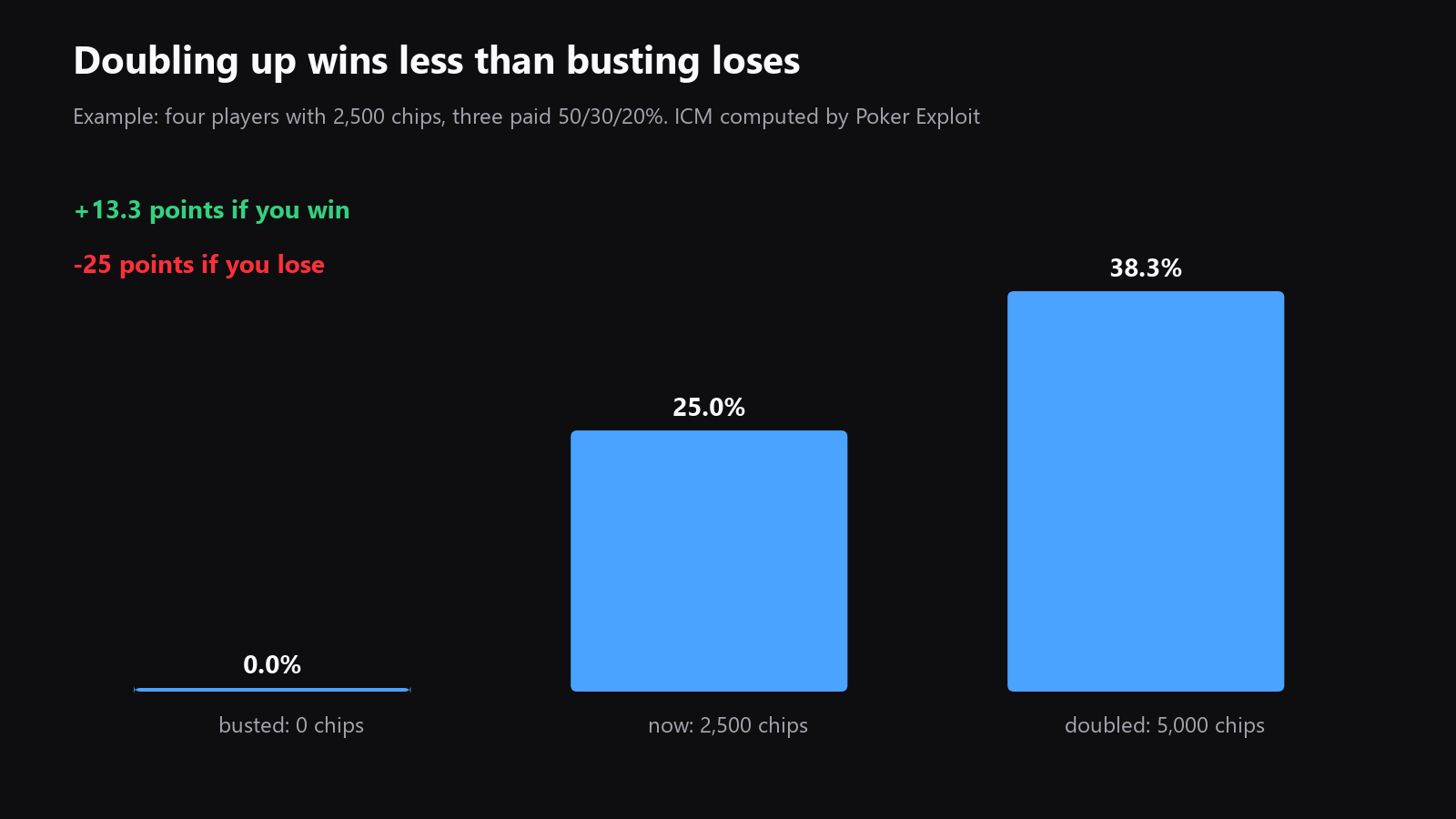
Suppose four players are left, all with 2,500 chips, and three places are paid 50%, 30%, and 20% of the pool. Under ICM, each stack is worth 25% of the pool.
Now imagine one player doubles to 5,000 chips against two other 2,500 stacks. That stack becomes worth 38.3% of the pool, a gain of 13.3 points.
But if that same player busts, the stack loses its entire 25% share.
So the upside of doubling is not equal to the downside of busting. Losing hurts more than winning helps, because busting wipes out all future payout chances.
A worked ICM example
Let us use a three-player example with real tournament arithmetic.
Three players remain. The payout is 50%, 30%, and 20% of the pool.
The stacks are:
- 5,000 chips
- 3,000 chips
- 2,000 chips
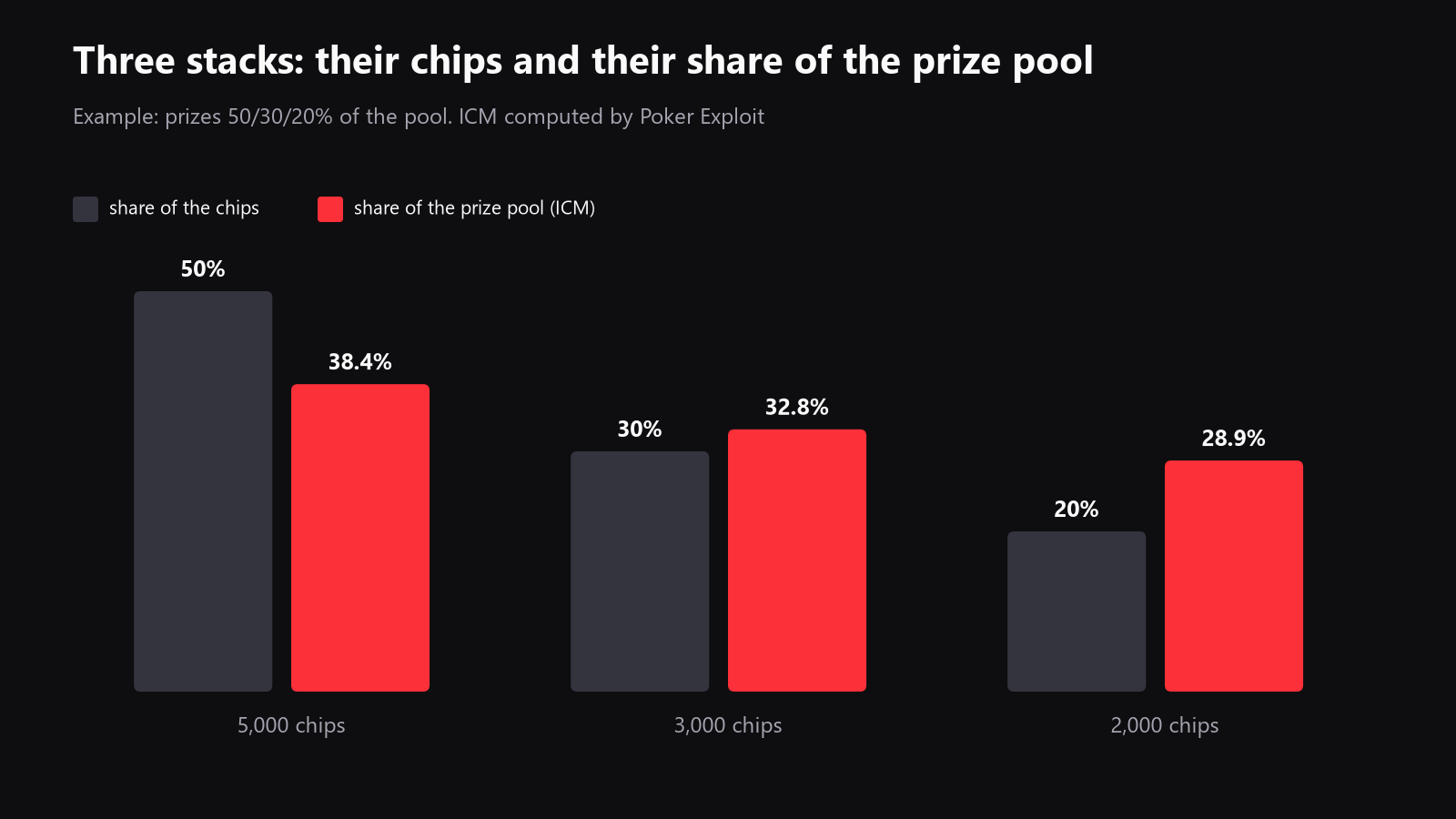
If you compute ICM, those stacks are worth:
- 38.4% of the prize pool
- 32.75%
- 28.9%
Notice what happened. The chip leader has 50% of the chips, but only 38.4% of the prize pool. The shortest stack has 20% of the chips, but 28.9% of the prize pool.
That is the key ICM redistribution effect:
- chip leaders lose some dollar share,
- short stacks gain some dollar share,
- and the middle stack often sits in the most awkward spot.
Why awkward? Because the middle stack is often the one that must avoid busting while still trying to keep enough chips to attack the weaker stacks. That tension is what makes bubble and final table play so different from chip-EV play.
How ICM changes calling and shoving near the money
ICM matters most when a bust is expensive.
That usually means two places:
- near the bubble, just before players get paid,
- and at the final table, where each pay jump is large.
In those spots, calling all-ins gets much tighter. A call that is fine in chip EV can become bad in dollar EV, because the penalty for busting is too large.
The player who shoves also changes their strategy. When opponents are under ICM pressure, they cannot call as wide as they would in chips alone. That means some shoves become more profitable because the fold equity goes up.
So ICM pulls the two sides in different directions:
- callers need more equity,
- shovers can sometimes attack more often.
A useful rule of thumb is this: the closer you are to a meaningful payout jump, the more your stack preservation matters.
That does not mean you should never take flips. It means the threshold changes. A hand that is a simple chip-EV call can become a fold once you convert it to tournament equity.
The example below shows how large that change can be.
With four players left and equal 2,500-chip stacks, one player calling another 2,500 stack’s all-in needs 65.2% equity under ICM, while in pure chip terms it needs only 50%.
That gap is the risk premium ICM creates.
Bubble play and final table play are not the same thing
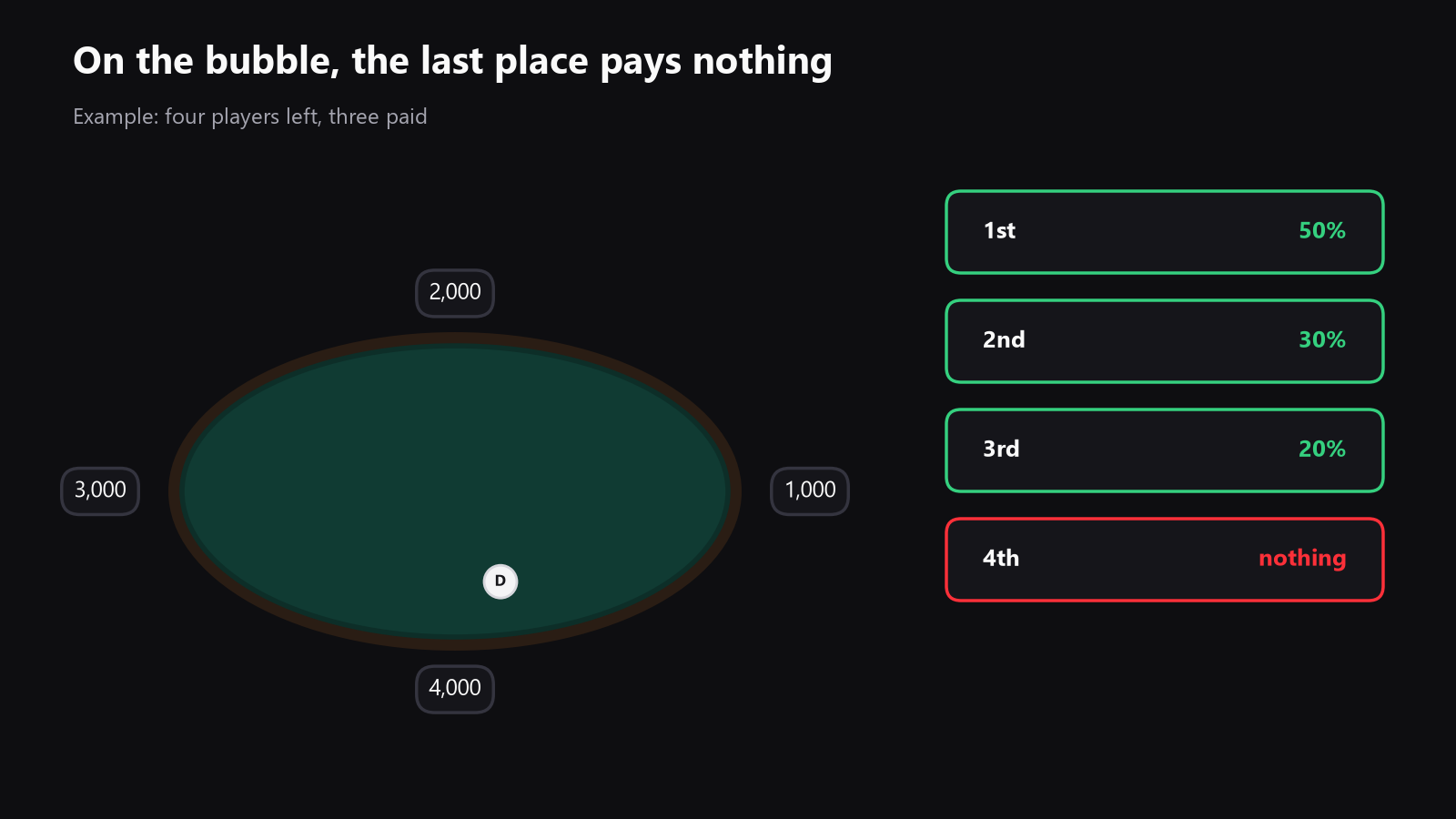
The bubble is the stage just before the money. The final table is where the remaining pay jumps are often the steepest.
Both stages apply ICM pressure, but not in exactly the same way.
On the bubble, medium stacks often become the most careful. They do not want to bust before the money, especially when shorter stacks are still alive. That makes them fold more than they would in chips alone.
Short stacks, by contrast, may have more incentive to push, because they are already under pressure and can sometimes steal blinds and antes from players who are trying not to call.
At the final table, the same logic continues, but the payout ladder is usually steeper. One elimination can change your cash by a lot, so every call and every shove must be judged against the prize jumps, not just against the pot odds.
The practical mistakes ICM punishes
If you want the shortest possible list of ICM mistakes, it is this:
- calling too wide when a bust is costly,
- treating every all-in like a cash-game pot,
- ignoring the stacks behind you,
- ignoring pay jumps,
- thinking in chips only when the tournament is really about dollars.
The biggest leak is usually not a crazy bluff. It is a medium-strength call that feels fine in chip EV but burns too much tournament equity.
That is why ICM training is so useful. It teaches you to ask a different question:
Not “am I ahead of this range?” But “is this enough equity once the payout structure is part of the hand?”
Where ICM has limits
ICM is powerful, but it is also simple by design.
Classic ICM does not know:
- skill differences between players,
- position,
- future blind levels,
- future table dynamics,
- bounty money,
- or anything beyond current chip stacks and payouts.
That means ICM is a baseline, not the whole truth.
If you are much stronger than your opponents, real tournament equity can be better than ICM says, because your skill gives you future advantage. If the event has bounties, the payout is not just the prize pool, so the model needs more than plain ICM. And if stacks are changing fast, blind pressure can matter a lot too.
So use ICM as a decision frame, not as a blind law. It is the right first model for many tournament spots, especially bubbles and final tables, but it is not the last word on every tournament hand.
How to study ICM spots without guessing
If you want to work on these decisions, you need more than a vague sense that “bubbles are tight.”
You need to see the numbers.
That is where the Decisions module helps: it gives you push, fold, or call answers for short-stack spots, plus push/fold charts. For tournament spots where ICM matters, the Exploiter module includes ICM, so you can study how stack pressure changes the correct action.
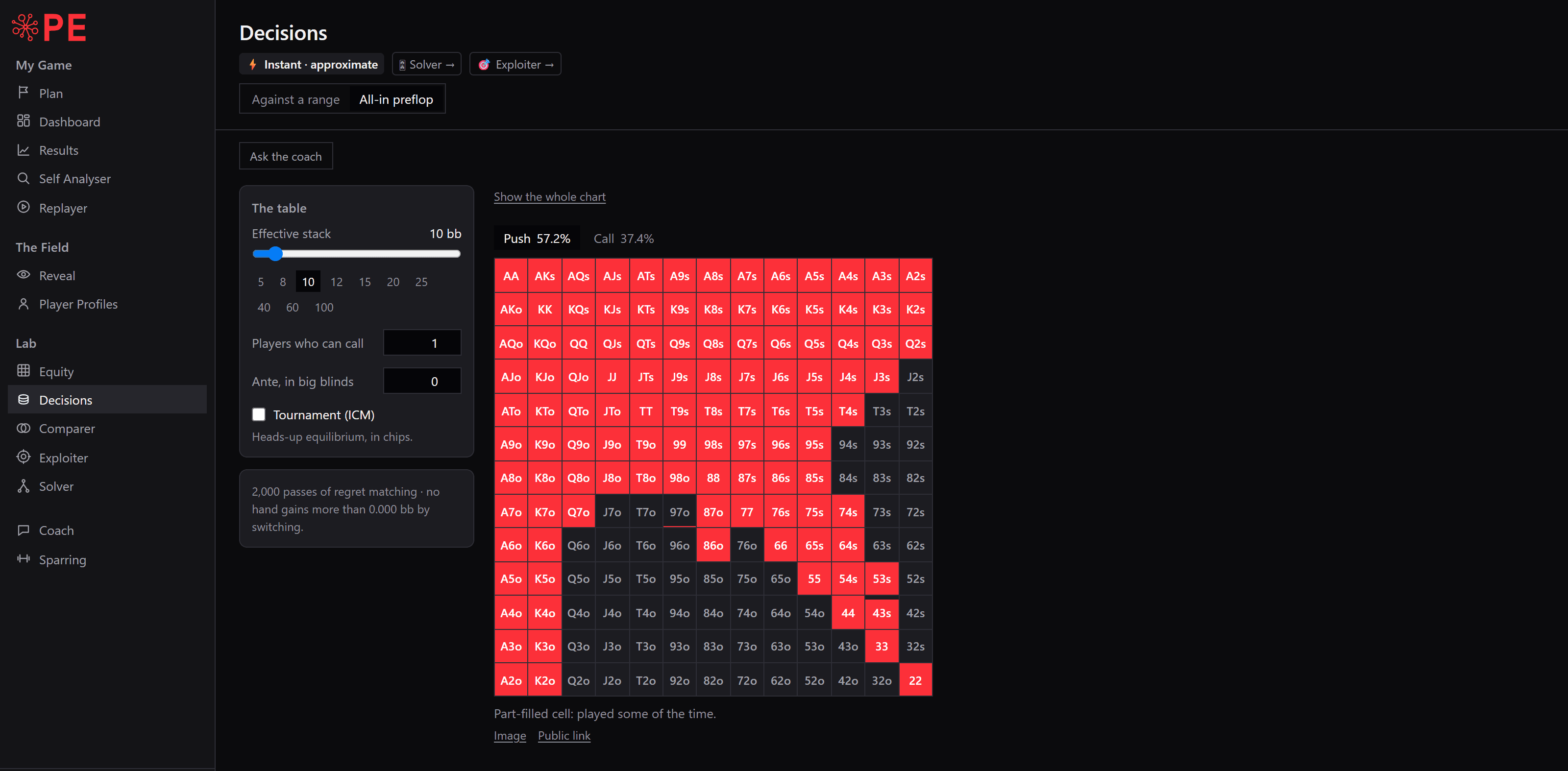
If you are also tracking your tournament results, the Results screen shows ROI and ITM, so you can see not just whether you are winning chips, but whether your tournament finishes are actually improving.
That is the real point of studying ICM: it helps you stop measuring tournament decisions only in chips when the prize pool is what you are playing for.
The takeaway
If you remember only three things about ICM, make them these:
- Tournament chips are not linear in dollar value.
- A chip lost is worth more than a chip won.
- Calling thresholds tighten a lot near the bubble and final table, and a covered player's shoving range can widen.
Once you see tournaments through that lens, many “close” spots stop being close.
And that is where ICM becomes useful, not just as theory, but as a practical edge in real tournament play.
Do it on your own hands.