
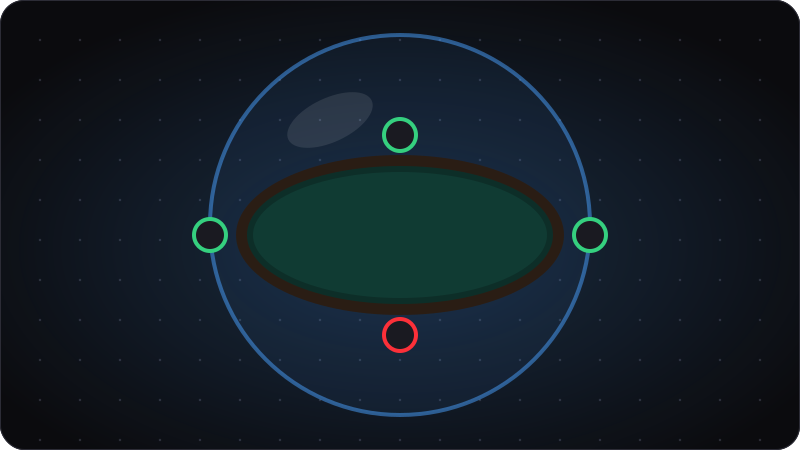
The bubble is the most emotional part of a poker tournament because it changes the value of chips.
Before the money, your goal is no longer just to win chips. You also want to survive, because surviving one place longer can be worth more than a small chip gain. That is why the last places before the payouts feel so different from the rest of the event. A medium stack feels trapped, a big stack feels powerful, and a short stack often feels like it has to choose between folding into oblivion and shoving for its life.
If you understand the bubble well, you gain in two ways. You make better decisions under pressure, and you recognize when the field is making obvious mistakes.
What the bubble really changes
In a cash game, a chip is a chip. In a tournament, a chip is not always worth the same amount, because prizes are not linear.
That is the heart of bubble strategy. When you are near a pay jump, losing chips hurts more than winning the same amount helps. This is why players tighten up so much, especially when they do not cover the stack that can bust them. The effect is called ICM pressure, and you do not need to memorize the term to feel it at the table. You only need to notice that calling all-in becomes much more expensive than chip EV would suggest.
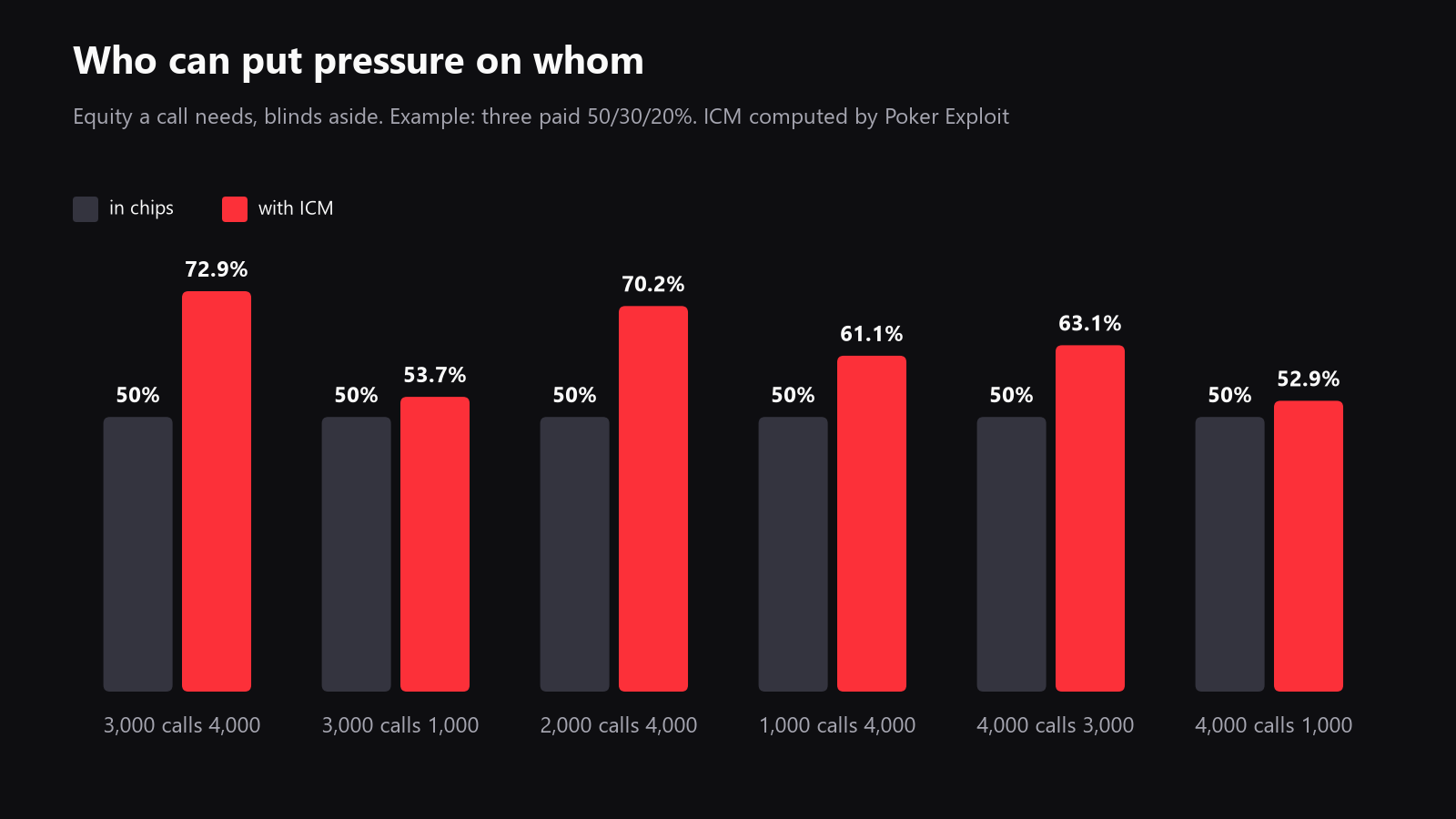
Here is a simple example computed with Poker Exploit. Four players remain, three get paid, with payouts of 50%, 30%, and 20% of the pool. The stacks are 4,000, 3,000, 2,000, and 1,000 chips. In chip terms, those stacks are 40%, 30%, 20%, and 10% of the chips. In ICM terms, they become 33.6%, 29.5%, 23.6%, and 13.3% of the prize pool.
That matters because the stacks are no longer worth what they look like.
Why medium stacks feel the most pressure
Medium stacks suffer the most on the bubble because they are squeezed from both sides.
If you are medium, you cannot bully everyone the way a chip leader can, because some players cover you and can threaten your tournament life. At the same time, you cannot call off lightly, because busting now is far worse than losing chips in a chip EV spot. So you sit in the uncomfortable zone where many hands are playable in chips but not playable in tournament equity.
That creates a very common mistake. Medium stacks fold too much to pressure, but they also call too wide when they finally pick up something strong enough to look "obvious". The right adjustment is not to panic. It is to become selective.
As a medium stack, you usually want to:
- avoid thin stack offs against players who cover you,
- attack stacks that hate busting more than you do,
- prefer stealing blinds from players in pure survival mode,
- reduce speculative calls that put your tournament life at risk.
This is where bubble discipline matters. A medium stack often wins the tournament by not getting involved in the wrong pot.
How big stacks should attack
If you cover the table, the bubble is your best friend.
A big stack can put pressure on medium stacks that do not want to tangle. That does not mean you should open any two cards and pretend ICM does not exist. It means you should choose targets.
The best targets are usually:
- medium stacks that are not desperate enough to call light,
- players who cannot afford a confrontation,
- players in the blinds who know a bust would be costly.
The wrong targets are also easy to identify. Another big stack can fight back. A very short stack may have less fold equity than you think, because they are already committed to survival or to a shove. If you open too wide into the wrong stack, you simply donate equity.
A good big stack does not just "pressure the bubble". A good big stack applies pressure where the field is least willing to resist.
How short stacks should survive or gamble
Short stacks are not always dead on the bubble. Sometimes they are the most dangerous players at the table, because they can shove with fold equity and still have leverage against stacks that do not want to call.
But short stacks have to be honest about their situation.
If you are too short, waiting can be a mistake. Every orbit reduces your options. Once your stack becomes tiny, you stop having meaningful fold equity, and the bubble stops protecting you. At that point, your best spots are often the ones where you can move first, especially in late position or from the blinds when the table is passive.
Short-stack bubble strategy is usually about three things:
- Keep fold equity alive.
- Jam hands that play well when called.
- Avoid calling without a clear edge.
That last point is important. A short stack often wants to survive, but survival is not free. If a call risks your tournament life and the bubble pressure is high, many hands that look strong in chips become folds in ICM.
Shoving on the bubble
Shoving is one of the most misunderstood parts of bubble play.
A shove can win the pot immediately, which is why many players overestimate its power. But the bubble changes what happens after the shove. Opponents do not call as they would in a cash game. They call tighter because elimination has a cost.
That means the value of a shove depends on who is left to act, who covers whom, and how much ICM pressure is in the hand.
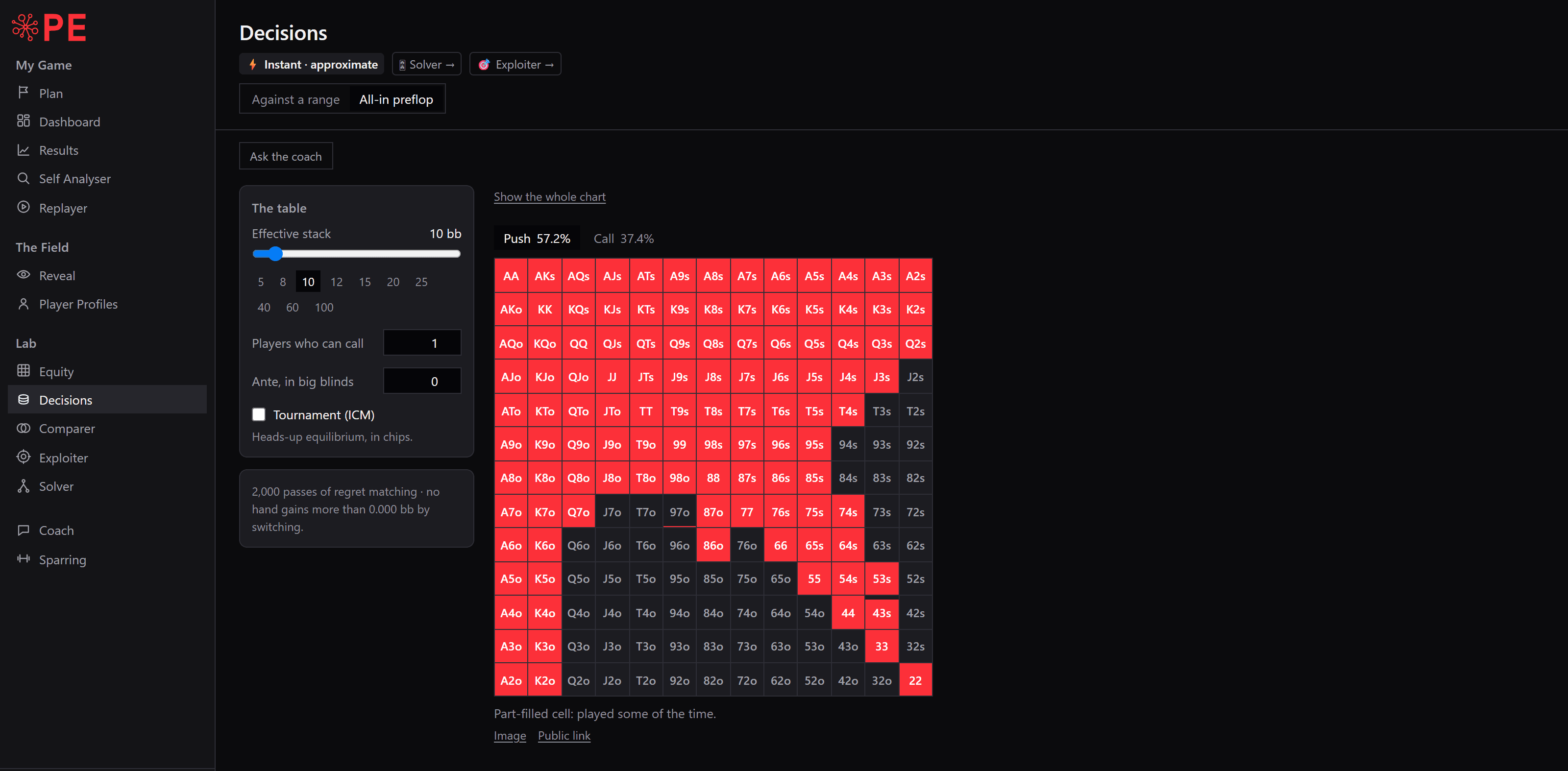
A useful baseline comes from push/fold charts. The Decisions module gives you push, fold, or call spots with a short stack, and it is excellent for building a first-in baseline. But you must read those charts correctly. They are equilibrium references for a shove when everyone before has folded, and for calling it in chips, without antes unless said otherwise. When several players are still left to act, the model lets only one of them call with the same range, which understates how often a shove gets called in real life.
So if several players can wake up behind you, be more cautious than a simple chart might suggest.
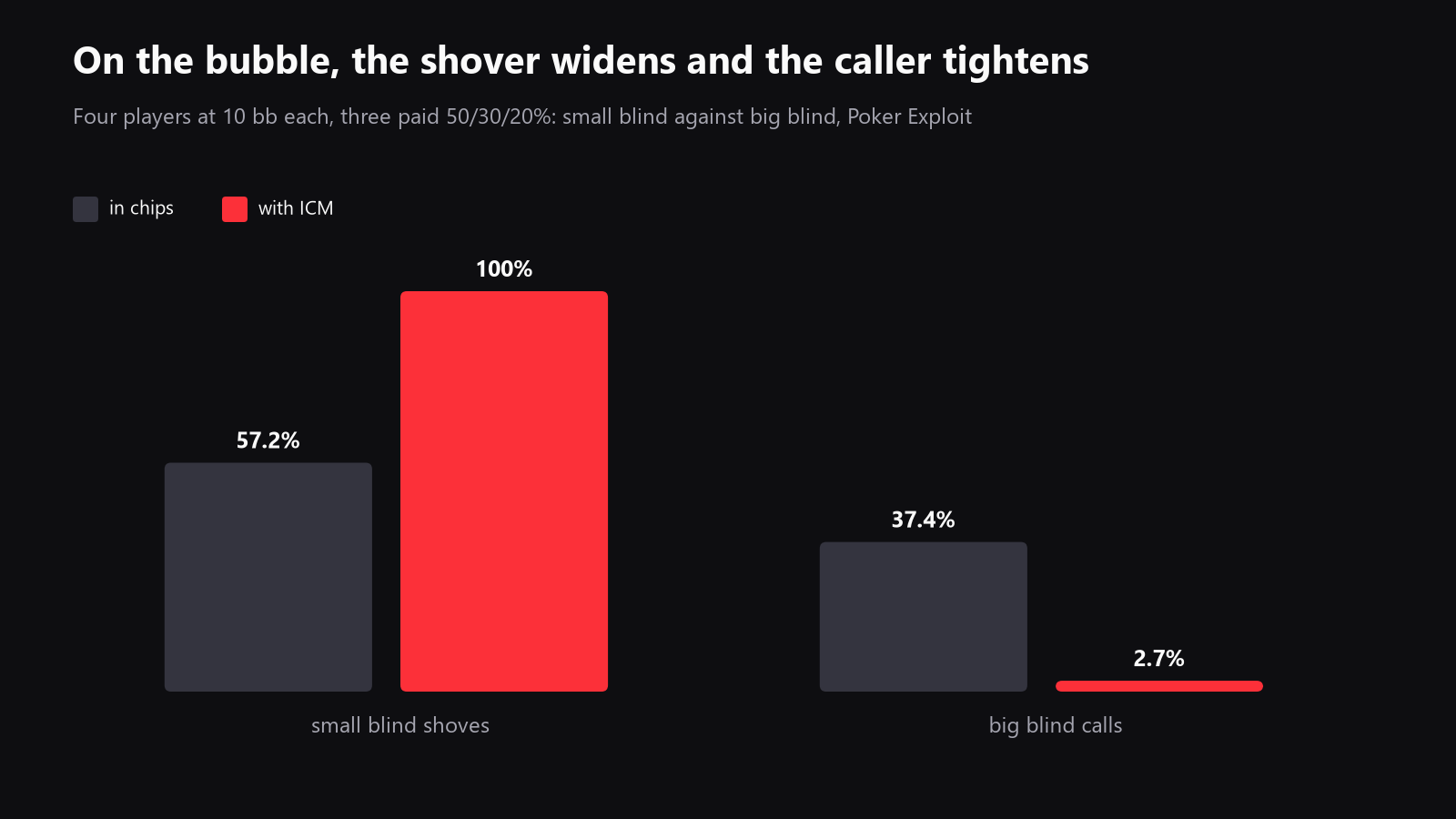
That difference is not small. With four players at 10 big blinds each and the same payout structure as above, small blind versus big blind, the small blind shoves 100% of hands and the big blind calls 2.7% with ICM, against 57.2% and 37.4% in chips. Bubble pressure turns a normal short-stack fight into a much more aggressive one for the shover.
Calling on the bubble
Calling is where many tournament players burn the most equity.
The reason is simple. When you call all-in, you are not only deciding whether your hand is ahead often enough. You are also deciding whether the risk of busting is worth the prize pool you may lose if you lose. That is why ICM raises the bar so sharply.
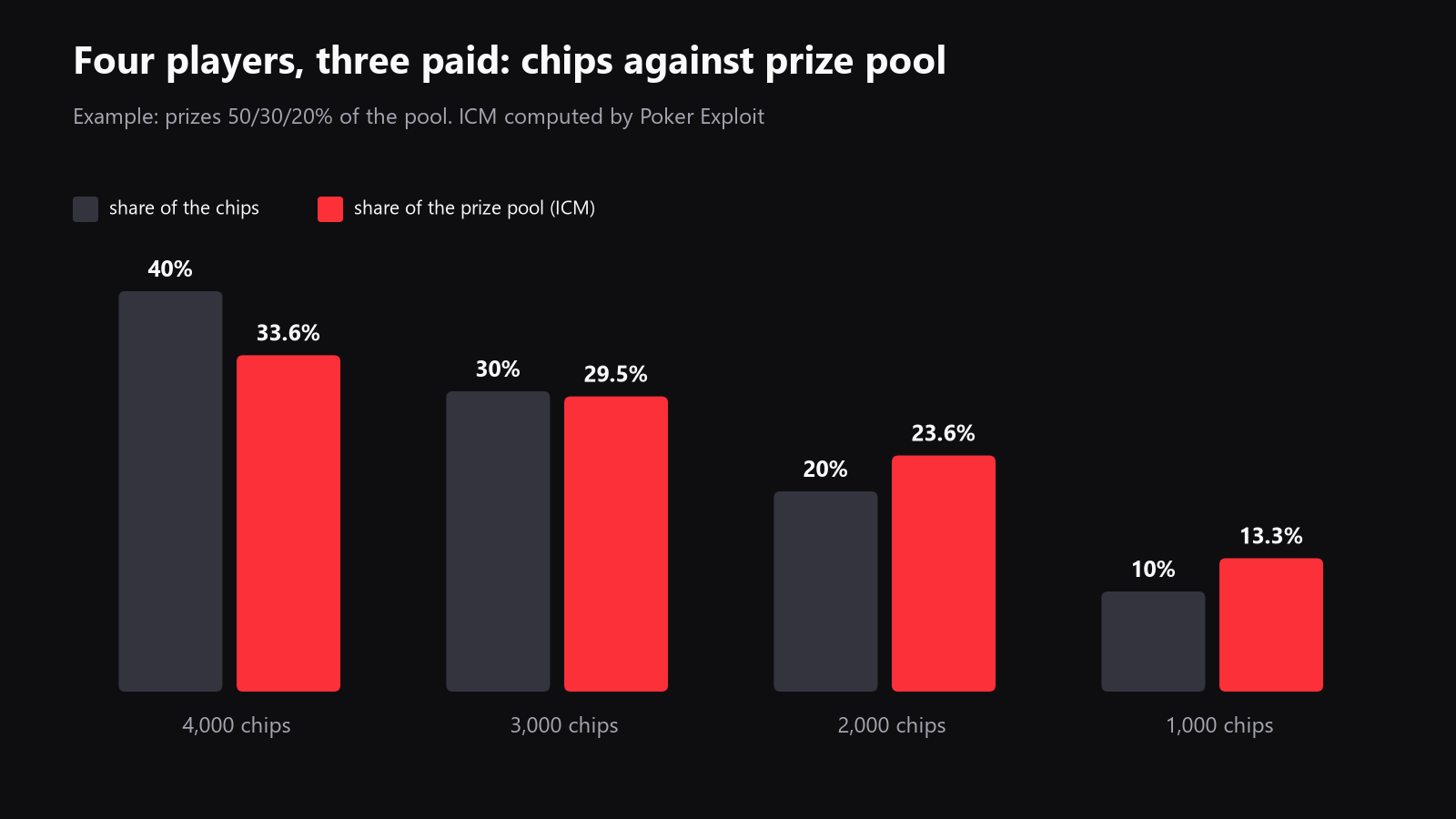
Here are the calling thresholds from the four-player example, computed with Poker Exploit:
- 3,000 calling 4,000: 72.9%
- 3,000 calling 1,000: 53.7%
- 2,000 calling 4,000: 70.2%
- 1,000 calling 4,000: 61.1%
- 4,000 calling 3,000: 63.1%
- 4,000 calling 1,000: 52.9%
The lesson is not that you should memorize those exact numbers forever. The lesson is that stack coverage changes everything.
If you are the stack that can bust, you can call much wider than the stack that is being covered. If you are medium and covered, your calling range shrinks fast. Among the covered stacks in the example, the shortest one has the loosest call. If you are very short and can ladder by folding, your calling range often becomes extremely tight.
This is why "I was ahead in chips" is not a good reason to call on the bubble. In tournament terms, you need to ask a better question: if I lose this pot, what do I lose in prize pool equity?
Sit & Go bubble vs MTT bubble
The bubble matters in both formats, but it behaves differently.
In a Sit & Go, the bubble is often the entire strategic center of the game. The field is small, the payouts are concentrated, and the stack distributions are easier to model. That makes ICM very sharp. A small mistake in a Sit & Go bubble spot can be expensive, because one player busting changes everyone’s equity immediately.
In an MTT, the bubble is still crucial, but it sits inside a much larger event. The field is bigger, stack sizes are more varied, and the pressure is not always evenly distributed across tables. Also, tournament structures differ. Antes, pay jumps, and table composition can change the exact amount of pressure in a spot.
A practical way to think about it:
- In a Sit & Go, the bubble is often more standardized and more punishing.
- In an MTT, the bubble is more chaotic, but the same ICM logic still applies.
- In both formats, the stacks that can cover others are the ones with the most leverage.
- In both formats, the stacks that are covered must be the most careful.
So do not copy a Sit & Go bubble plan into a big-field MTT without thinking. The principle is the same, but the texture is not.
A simple bubble checklist you can use
When you face a bubble spot, ask yourself these questions:
- Who covers whom?
- How close are we to the money, or to the next pay jump?
- Who is under the most ICM pressure?
- If I shove, who can really call?
- If I call, what happens to my tournament life if I lose?
- Am I trying to win chips, or am I trying to maximize prize pool equity?
If you can answer those questions calmly, your bubble game will already be better than most of the field.
How to study bubble spots off the table
The bubble is a great place to study because the mistakes are measurable.
If you want to check how your own game behaves in these spots, the Results module shows ROI and ITM, so you can see whether your tournament results reflect good survival and good finish quality. The Decisions module gives you push, fold, or call answers with a short stack, which is useful for building a solid baseline. The Reveal module is built for tournaments too, so you can see how the players at your limits actually behave on bubble and pay-jump spots, instead of guessing.
That is where study becomes practical. You do not need a dozen fancy ideas. You need to know whether your pool overfolds, overcalls, or gets scared at the wrong time.
And once you know that, the bubble stops being a mystery. It becomes an edge.
The main idea to remember
On the bubble, chips are not worth chips anymore. They are worth future prize pool equity.
That one fact explains almost everything:
- why medium stacks freeze,
- why big stacks can pressure,
- why short stacks can still find profitable shoves,
- why calling becomes much tighter,
- and why a good bubble strategy depends more on stack dynamics than on raw hand strength.
If you learn to see the bubble as a pricing problem, not just a survival problem, you will make better decisions in both Sit & Gos and MTTs.
Do it on your own hands.