
A final table is where tournament poker stops being just chip poker.
Before the last table, you still care about chips, but you can often play a hand as if every chip were worth the same. At the final table, that is no longer true. A stack that looks healthy in big blinds can be fragile in money terms. A call that is fine in chips can be wrong in tournament value. A shove that would be attractive in a cash game can become a mistake because the next pay jump is too valuable to risk.
That is why final table strategy is mostly about three things:
- pay jumps,
- ICM pressure,
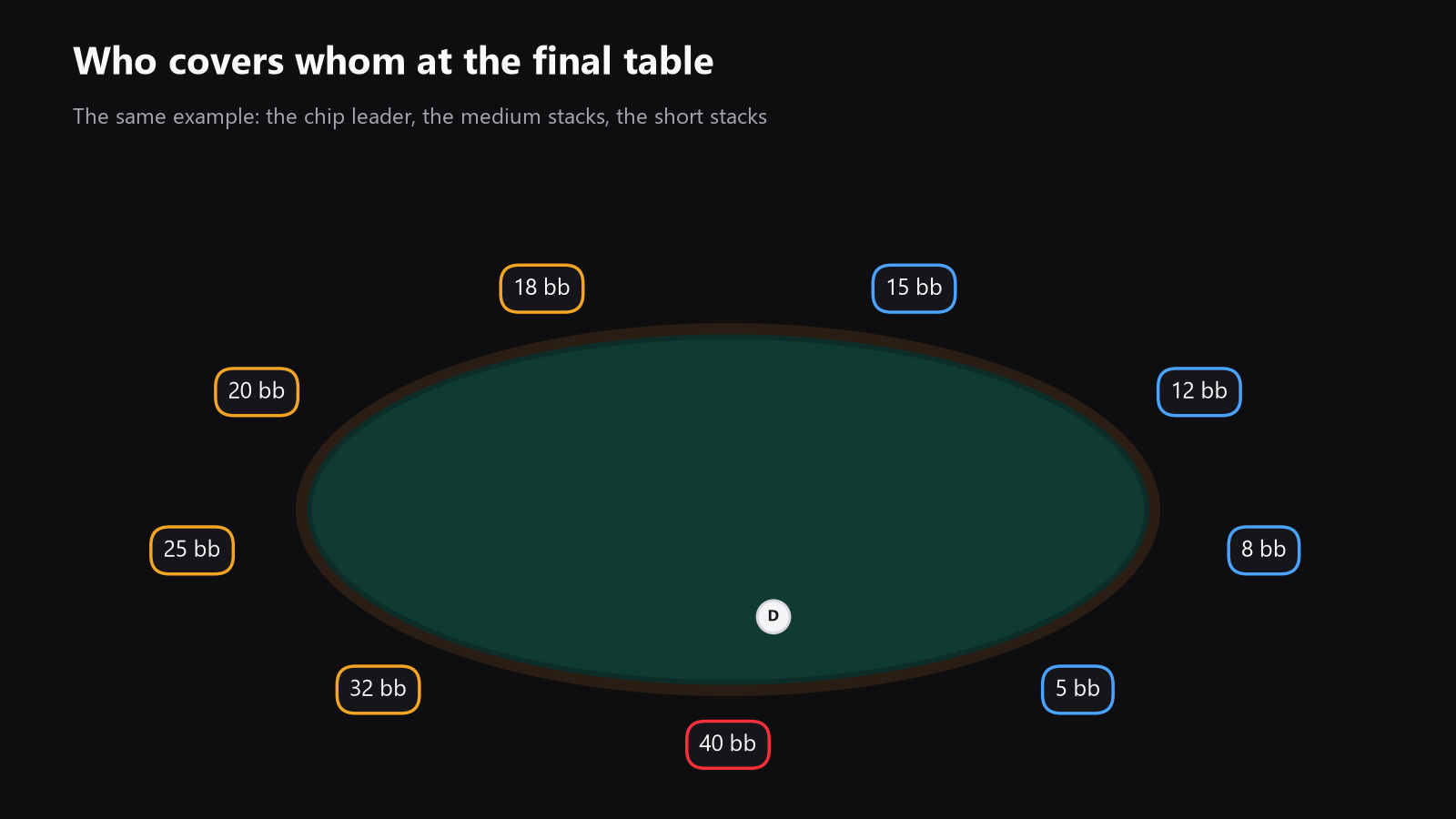
- stack interaction, meaning who covers whom.
If you understand those three pieces, you can stop guessing and start making decisions that fit the money at stake.
1) Why pay jumps change everything
A pay jump is the money gap between two finishing places.
At a final table, those gaps matter because you are no longer playing for one prize, but for a ladder of prizes. Every elimination changes what the remaining stacks are worth. That means the same all-in can be correct for one player and terrible for another, even when both hold the same hand.
The first mental shift is this:
A chip is not always worth the same amount of money.
That sounds obvious, but a lot of final-table mistakes come from forgetting it. In chip terms, winning 10 big blinds and losing 10 big blinds are symmetric. In money terms, they are not. If losing those 10 big blinds moves you from a safe stack to a short stack, or from second stack to fourth stack, the loss hurts more than the gain helps.
2) ICM, in plain language
ICM is the classic model that turns chips into prize-pool equity.
It works from chips alone. It does not use skill, position, blinds, or future edge. It looks at each stack and asks, "If all that matters is who finishes first, second, third, and so on, what share of the prize pool does this stack deserve right now?"
That is why it changes final table strategy so much. It does not say, "This player is good, so call wider." It says, "This stack is worth this much money, so do not risk it lightly."
Here is one example computed with Poker Exploit.
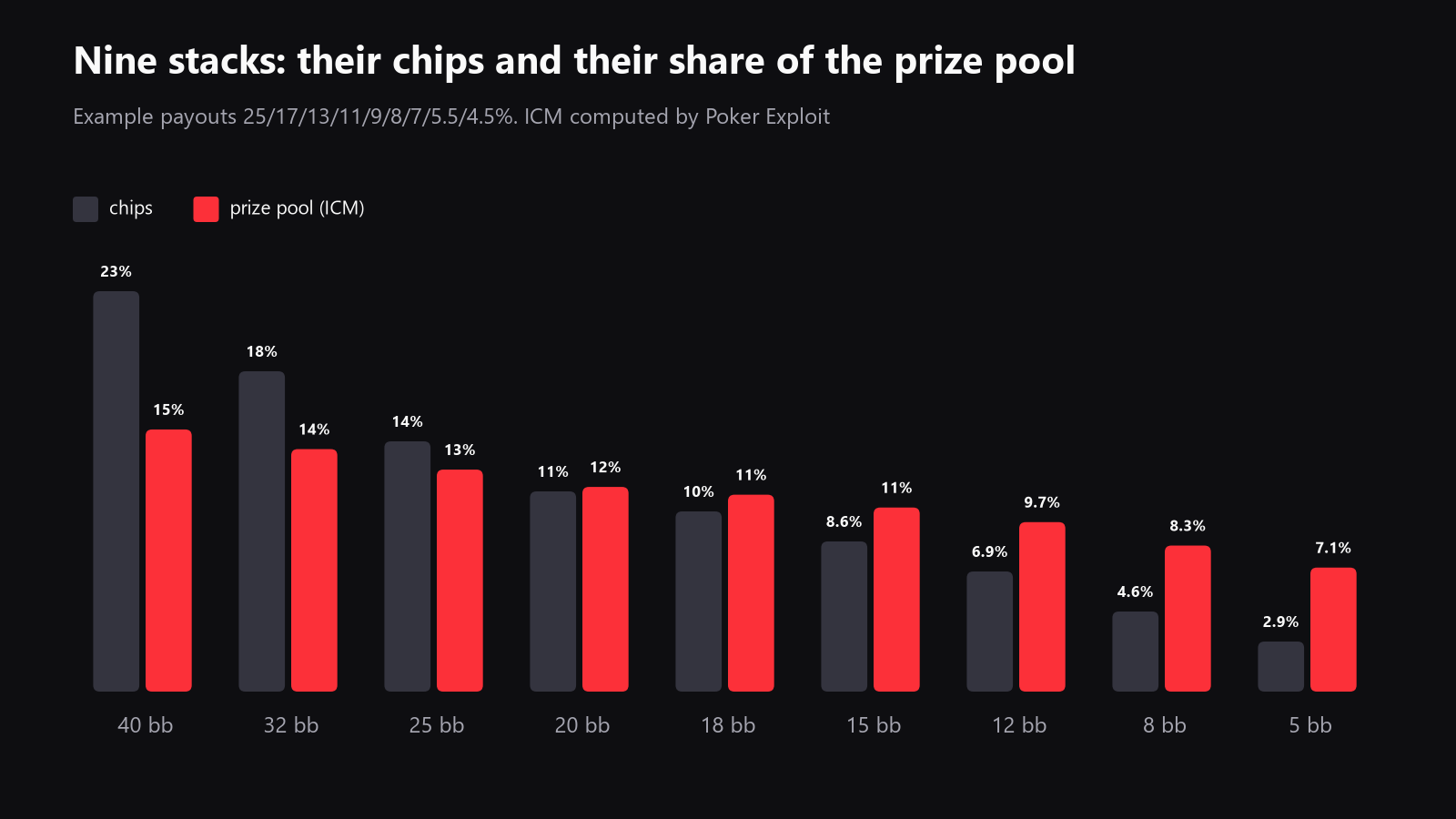
Imagine nine players left with stacks of 40, 32, 25, 20, 18, 15, 12, 8, and 5 big blinds, and payouts of 25%, 17%, 13%, 11%, 9%, 8%, 7%, 5.5%, and 4.5% of the pool.
ICM gives those stacks 15.0%, 13.8%, 12.7%, 11.7%, 11.2%, 10.5%, 9.7%, 8.3%, and 7.1% of the prize pool.
Now compare that with chips:
- the 40 bb stack has 22.9% of the chips, but only 15.0% of the pool,
- the 5 bb stack has 2.9% of the chips, but 7.1% of the pool.
That is the whole story of final table pressure in one glance.
The short stack is more valuable in money than in chips, because surviving one more ladder rung matters so much. The big stack is less valuable in money than in chips, because extra chips beyond a point do not buy as much prize equity.
That is why a medium stack can become very cautious, even with a hand that would be a clear call or raise earlier in the tournament.
3) What ICM does to all-in calls
The strongest ICM lesson is that calling all-ins gets much tighter than shoving.
A shove can win the pot uncontested, so it benefits from fold equity. A call has no fold equity at all. Under ICM, that asymmetry becomes brutal.
In the same example computed with Poker Exploit, every place is paid, so a player knocked out still receives the ninth prize (4.5% of the pool); counted that way:
- the 25 bb stack calling the 40 bb stack needs 69.7% equity,
- the 25 bb stack calling the 5 bb stack needs 52.4% equity,
- the 40 bb stack calling the 25 bb stack needs 59.4% equity.
In chips only, the game looks much softer. With blinds left aside and 50% equity in chips as the usual baseline for a call, the numbers are very different.
That is the key: ICM pushes your calling range down more than your shoving range.
If you remember only one practical rule, make it this one:
When you are the stack that can be eliminated, you need more than chip equity to justify a call.
4) How the chip leader should play
The chip leader has the most freedom, but not unlimited freedom.
You can pressure medium stacks because they fear busting. You can attack short stacks because they cannot defend much. You can open wider in late position because others have more to lose than you do.
But the chip leader still has one danger: giving chips to another stack that can punish you later.
So your job is not to splash chips everywhere. Your job is to apply pressure where your stack matters most.
Good chip leader habits:
- open wider into stacks that hate calling,
- avoid huge confrontations with another big stack unless the spot is strong,
- target medium stacks that cannot comfortably gamble,
- keep your calling ranges honest against short stacks, but not reckless.
Bad chip leader habits:
- forcing every pot just because you cover the table,
- overcalling because you feel invincible,
- turning a strong tournament position into a flipped coin for no reason.
The chip leader is strongest when you let everyone else make the expensive mistake.
5) How medium stacks should play
The medium stack is the hardest stack to play.
You are rich enough to matter, but not rich enough to relax. You can still win the tournament, but you also feel every ladder rung. That puts you in the middle of a squeeze.
Your best weapon is controlled pressure. You want to steal from stacks that cannot fight back well, especially shorter stacks. You do not want to volunteer for a big pot against a stack that covers you unless the spot is clearly good.
Think of the medium stack as the stack that must be the most selective about confrontation.
Your priorities:
- avoid marginal calls versus players who cover you,
- use position to attack shorter stacks,
- keep your stack healthy enough that you still have fold equity,
- do not confuse "I have a lot of chips" with "I can afford to gamble."
If you are a medium stack, the hand itself is only half the question. The other half is the payout ladder behind it.
6) How the short stack should play
The short stack is under the most pressure, but not hopelessly so.
Your stack may be small, yet your fold equity can still be powerful. A shove can win the blinds and antes, and sometimes that is enough to keep you alive. At a final table, survival matters a lot, but survival through indecision does not work. If you wait too long, the blinds eat you.
Your short-stack mindset should be:
- know your shove spots,
- know who can call you,
- know when your fold equity is strong enough to move first,
- do not pass on good shoves just because the money feels big.
A short stack should not play passively. It should play decisively.
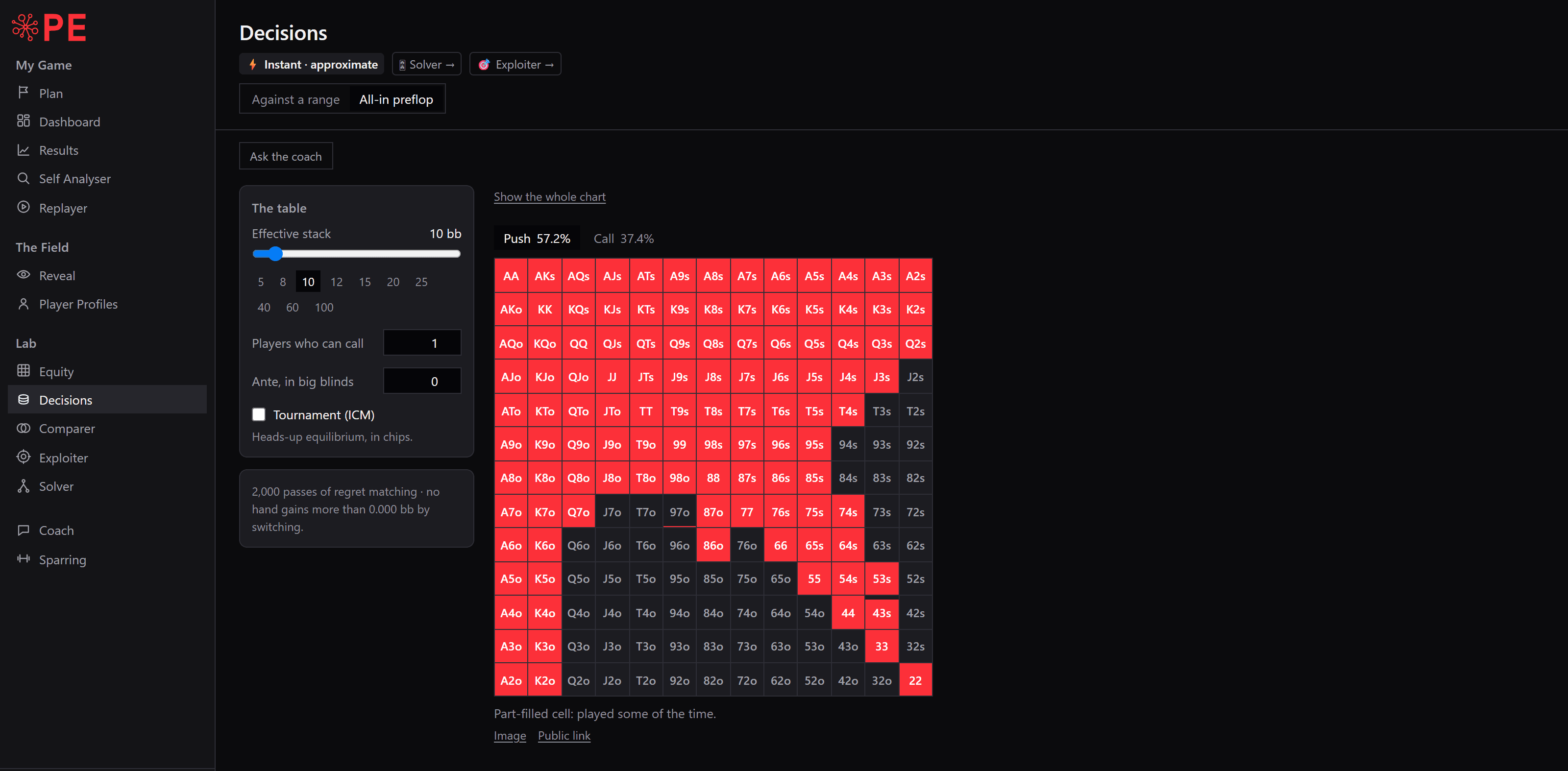
One example computed with Poker Exploit shows how ICM changes short-stack dynamics. In that same nine-player table, the 12 bb small blind against the 15 bb big blind shoves 52.4% of hands in chips, while the big blind calls 32.9%. With ICM, the big blind calls tighter than in chips.
That is a huge difference.
It shows two things at once:
- the short stack often has to push very wide because waiting is expensive,
- the caller, especially when covered, tightens hard because busting is costly.
7) Short-handed play near the end
Once players start busting, the final table becomes short-handed.
That changes the geometry of the table and the value of every orbit. Fewer players mean your blinds come around faster, so waiting is more expensive and pushes you to play more hands. At the same time, position matters even more because there are fewer players left to wake up behind you.
What changes short-handed:
- late-position opens become more important,
- blind steals matter more,
- calling ranges stay tighter than your stealing ranges,
- stack coverage matters even more, because one bust can change the whole payout landscape.
A lot of players make the same mistake here: they feel the table is short-handed and think they can finally call wider. Often the opposite is true. You can open more, but you still need to be careful when your stack can be punished by the payout ladder.
Short-handed final table poker is not about playing every hand. It is about choosing where your chips have maximum leverage.
8) Heads-up for the title
When only two players remain, the final table changes again.
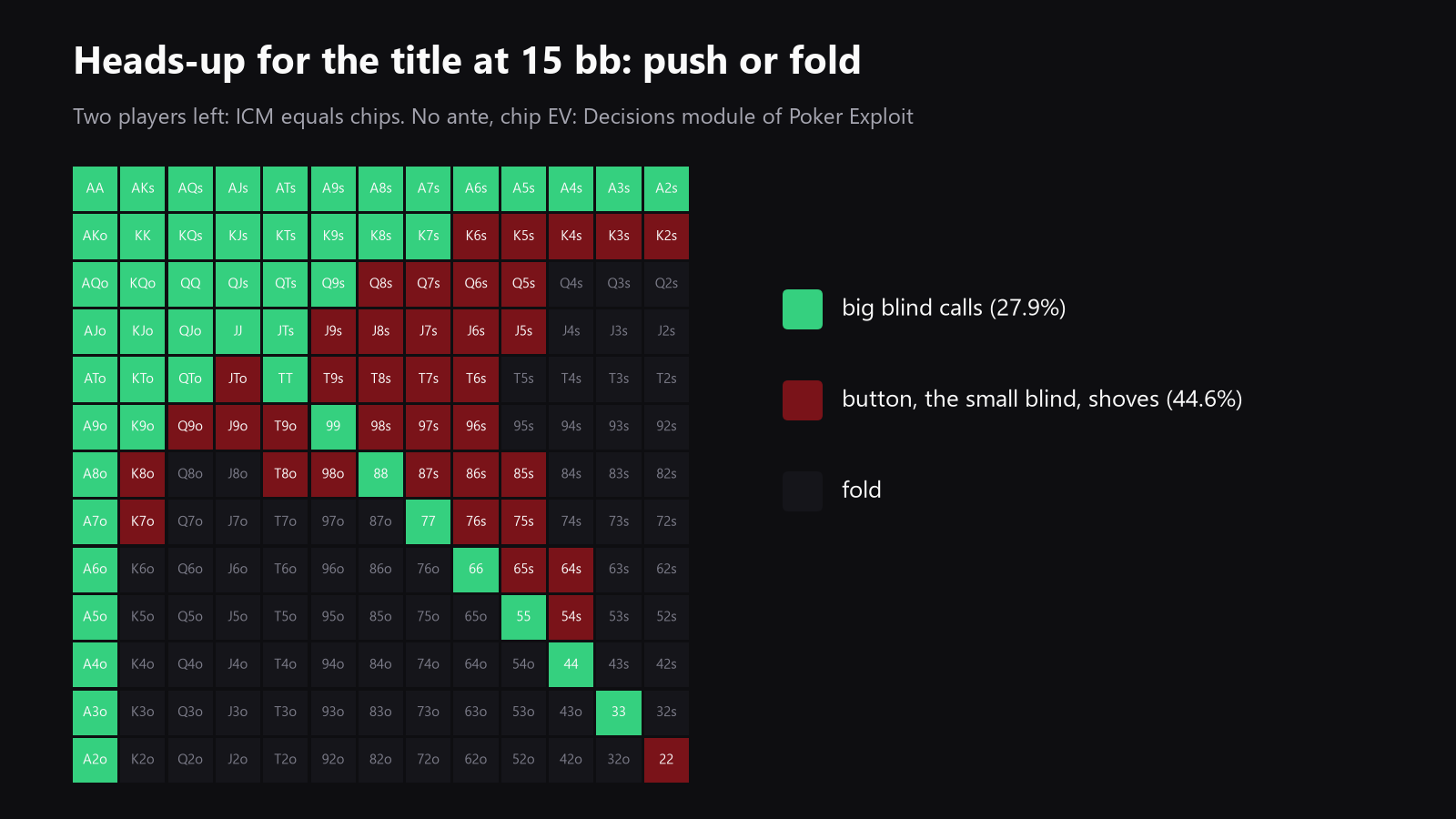
Now the game is exactly proportional to chips. The ICM pressure that controlled most of the table is gone. With two players left, chip EV and prize EV are the same, so there is no ICM pressure left at all.
That means:
- opening ranges widen,
- blind defense matters a lot,
- postflop play becomes more important,
- stack depth dictates how aggressive you can be.
Heads-up rewards adaptation. If you keep playing like it is a 9-handed final table, you leave money on the table. If you overcorrect and start punting every chip, you throw away edge.
The best heads-up players know how to change gears fast.
9) Common final table mistakes
These are the errors that cost the most money:
- Calling too wide as a medium stack
- Treating every chip leader as a maniac
- Forgetting that covering someone gives you leverage
- Forgetting that being covered makes your call much more expensive
- Turning a good laddering spot into a bad all-in
- Playing too passively as a short stack and blinding away
- Playing too loose when only one elimination stands between you and a much bigger pay jump
A final table is not won by fear, but it is often lost by impatience.
10) How to study final tables away from the table
Final-table work is best done away from the table, hand by hand.
A simple study process is:
- Identify who covers whom.
- Estimate how the pay jump changes the call.
- Ask who gains most from confrontation.
- Compare the chip-EV answer with the tournament-EV answer.
If you want software for that kind of study, the Decisions module gives push/fold spots, and the Exploiter module includes ICM. The Reveal module is built for tournaments too, with stacks in big blinds, bubble spots, final tables, PKOs, and Spins. Your Results page can also show ROI and ITM, which is useful when you want to know whether your late-game decisions are really improving your tournament results.
The important thing is this: study the spot away from the table, then go back to the table with a plan.
Final table strategy in one sentence
Final table strategy is not about playing scared.
It is about knowing when chips are worth more than survival, when survival is worth more than chips, and which stack at the table gets to force the money problem onto everyone else.
Do it on your own hands.