
A single-table Sit & Go looks simple. You register, wait for nine or six players, and play until the prizes are gone. In practice, it is one of the clearest games for learning tournament poker, because every stage asks something different from you.
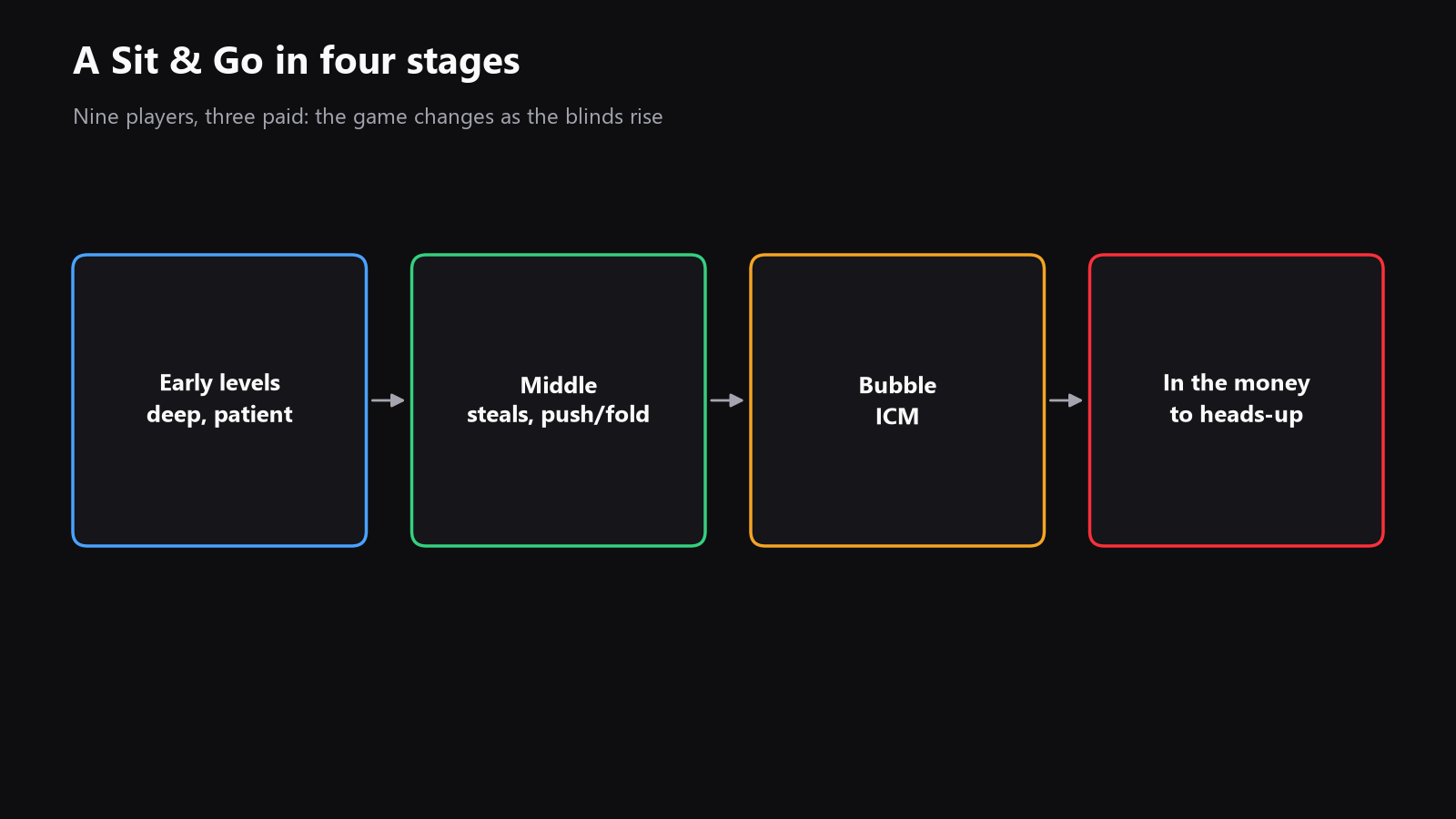
In the early levels, you can still play poker the usual way, with stacks deep enough to make postflop decisions matter. As the blinds rise, the game becomes a race for remaining chips. On the bubble, chip value changes sharply because busting costs you much more than one chip at a time. Once you are in the money, you stop playing only for survival and start balancing pressure against ladder value again.
If you want to improve at Sit & Gos, you need to understand those phases, and you need to know whether your results are actually good or just a lucky run.
What makes Sit & Gos different
A Sit & Go is not a cash game. In a cash game, every chip is essentially worth the same amount of money. In a Sit & Go, that is not true.
Why not? Because of the payout ladder.
If only the top three players get paid, then the value of your stack depends on where you are relative to the field, not just on how many chips you have. The chip count matters, but it is not a direct money count. This is why tournament players talk about ICM, the model that turns chip stacks into prize pool shares.
The practical result is simple:
- Early on, chips are close to money, roughly. With three paid, ICM applies from the first hand, but its effect is small while everyone is deep and far from the money.
- Near the bubble, chips are much less linear than your stack size suggests.
- Once prizes are locked in, chip value starts to behave more like chip EV again, but the ladder still matters.
That is the heart of Sit & Go strategy.
Early levels: build a stack, but do not confuse aggression with spew
In the early levels, blinds are small and stacks are deep. That means you have room to play hands with postflop equity, position matters a lot, and a single mistake is not yet a disaster.
Your main goals are:
- Play solid ranges from early position.
- Use position aggressively.
- Win small pots often, especially from late position.
- Avoid big, unnecessary coin flips against stacks that can hurt you later.
In a regular Sit & Go, early levels matter more because you have more hands before the blinds become painful. In a turbo, this stage is shorter, so you should already be thinking about stack pressure and steal spots sooner.
A useful rule is this: in the early stage, you want to accumulate chips without creating a big risk for no reason. You are not trying to win the Sit & Go in the first ten hands. You are trying to arrive at the middle stage with a stack that can still apply pressure.
Middle levels: the blinds catch up
Sooner or later, the blinds stop being background noise. They start shaping every hand.
This is where many Sit & Go players lose the plot. They keep thinking in terms of starting hands only, when they should be thinking in terms of stack depth, fold equity, and position.
At this stage:
- Stealing blinds becomes important.
- Open-raising from late position gains value.
- Restealing and reshove spots appear.
- Limping and calling too often become costly.
- Stack size relative to the blinds starts to matter more than raw hand strength.
In a 9-man Sit & Go, the middle game can still feel spacious. In a 6-max Sit & Go, it arrives faster, because the orbit is shorter and the blinds come round more often.
The key idea is that you are no longer just playing hands, you are playing pressure. A medium stack wants spots that grow the stack without risking its tournament life. A short stack wants the right shove or fold decisions. A big stack can put others in awkward places.
The bubble: chips are not money anymore
The bubble is the most important stage to understand if you want to beat Sit & Gos.
This is the moment when the next player out wins nothing, and everyone else is close to a payout or close to busting. That changes the value of every decision.
Here is the reason in plain language:
If you bust now, your prize equity drops to zero. If you win chips now, those chips do not all convert into prize money one for one. The ladder makes extra chips less valuable than the chips you needed just to survive.
That is why ICM matters so much on the bubble.
An example
Take a 9-player Sit & Go, 1,500 chips each, so 13,500 chips in play. Three places pay, at 50%, 30% and 20%.
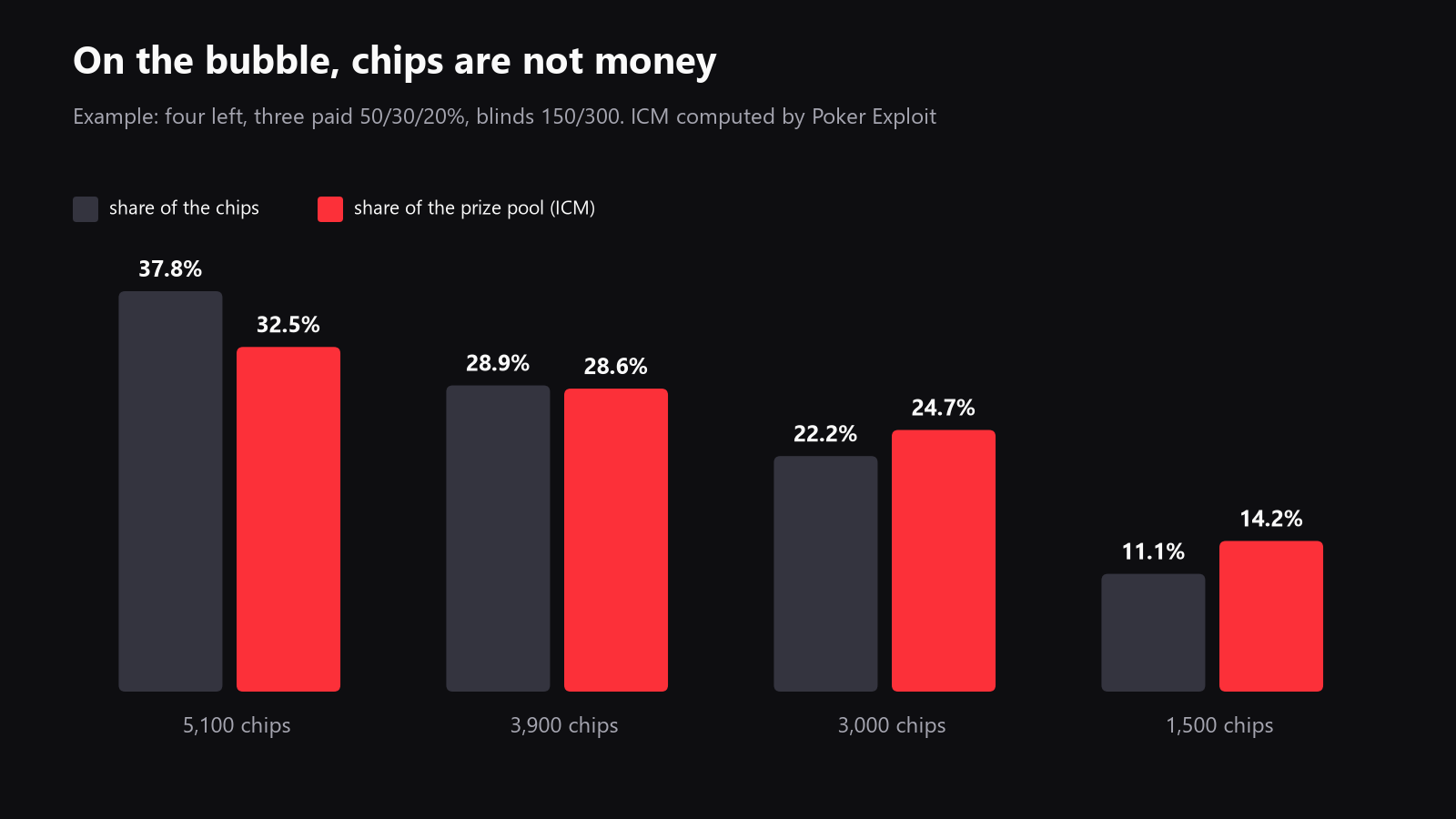
On the bubble with four players left, blinds are 150/300, and the stacks are 5,100, 3,900, 3,000 and 1,500 chips.
Computed with Poker Exploit, ICM gives them 32.5%, 28.6%, 24.7% and 14.2% of the prize pool.
If you looked only at chips, those stacks would represent about 37.8%, 28.9%, 22.2% and 11.1% of the chips. ICM changes the picture, because the payout ladder makes survival matter.
What that means in practice
On that bubble, the equity needed to call an all-in is not just a chip question, it is an ICM question. The calling thresholds below leave the blinds aside and compare against 50% in chips.
Computed with Poker Exploit, the calling thresholds are:
- 3,900 calling 3,000: 62.1%
- 5,100 calling 3,000: 58.6%
- 3,000 calling 1,500: 54.6%
- 5,100 calling 1,500: 53.5%
- 3,900 calling 5,100: 71.8%
That is why a play that would be fine in chips can be wrong on the bubble.
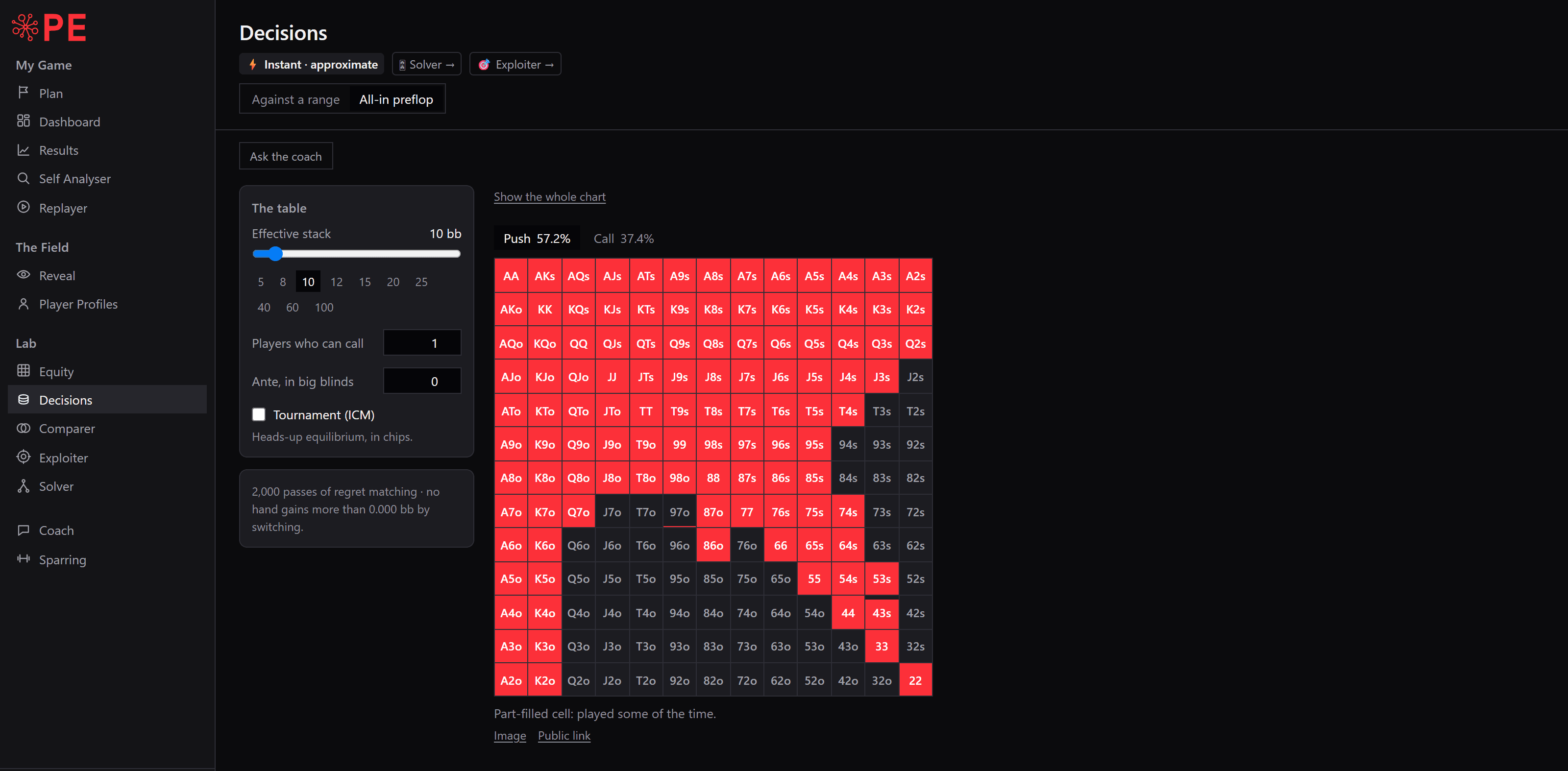
The most striking example is a small blind versus big blind spot with 10 big blinds against 13 big blinds. On that bubble, with ICM, the small blind shoves 100% of hands and the big blind calls only 2.3%. In chips, the same spot is 57.2% shove and 37.4% call.
With ICM the small blind shoves wider because the big blind calls far tighter. This comes from a model where the only choices are all in or fold, folded to the small blind, so it does not say whether a shove beats a limp or a small raise.
That is the bubble effect in one glance.
How to think on the bubble
- If you are short, you cannot fold your way into the money; you have to shove often when folded to.
- If you are medium stacked, you are often the one under the most pressure.
- If you are big stacked, you can attack stacks that cannot comfortably call off.
- If you are the chip leader, your job is often to make the others fold more than they want to.
Do not think, "I have a hand." Think, "What does my stack mean compared with theirs?"
In the money: pressure changes again
When the bubble bursts, the game changes again.
You are no longer one bust away from zero prize equity, so some players relax too much. That is a mistake. The ladder still exists, and every jump still has value.
What changes is that you can widen up a bit, especially if you have been under pressure on the bubble. You can open more hands, contest more pots, and stop over-fearing elimination. But you should not suddenly play as if all chips are equal money. They still are not.
In the money, strong Sit & Go players tend to do three things well:
- Keep stealing when stack depths allow it.
- Pressure players who are now trying to ladder too hard.
- Avoid giving up too much value when they are the one with the leverage.
This is especially true in short-handed poker, where ranges widen fast and the edge can move quickly from one stack to another.
Heads-up: chips are money
When you reach heads-up, the whole tournament is now about first and second place.
At that point, chip EV and money EV are exactly proportional to chips: the second prize plus the gap between first and second, multiplied by your chip share, gives your payout share.
A good heads-up player does not wait for premiums. They attack blind structures, use position relentlessly, and adjust to stack depth.
If you only learned one lesson from the earlier stages, make it this one: the same chip stack can mean very different things depending on how many players are left and what prize jumps remain.
How to know whether your Sit & Go game wins
You do not judge your Sit & Go results by one final table, one bubble, or one hot run. You judge them by sample, profit, and tournament economics.
The two simplest numbers are:
- ROI, your return on investment.
- ITM, your in-the-money rate.
ROI means:
(prizes won minus everything paid to enter, fee included) / everything paid to enter
So if you enter 100 Sit & Gos at $10 + $1, your total cost is $1,100. If you win $1,210 in prizes, your ROI is:
(1,210 - 1,100) / 1,100 = 10%
That is the kind of number that tells you whether your game is actually making money.
ITM tells you how often you cash. It matters, but it is not enough on its own, because two players can cash the same amount of the time and still have very different ROI depending on how often they go deep.
You also need to look at variance. A Sit & Go can run cold for a long time even if your decisions are good. That is why you should look at the profit curve, not just the latest results.

A practical study routine
If you want to improve fast, study Sit & Go strategy in this order:
- Learn opening ranges for deep stacks.
- Learn how stack depth changes steal spots.
- Learn push or fold basics for short stacks.
- Learn bubble pressure and ICM.
- Review heads-up play separately.
The short-stack part is especially important, because many Sit & Gos are decided there.
If you want a structured way to study those spots off the table, the Decisions module gives push, fold or call answers for short stacks, and the Results module shows ROI and ITM by format, including Sit & Go. That makes it easier to track your results by format.
The takeaway
A Sit & Go is not won by one style alone.
You need to play the early levels with discipline, the middle levels with pressure, the bubble with ICM awareness, and the in-the-money stage with an eye on the ladder all the way to heads-up.
If you remember only one sentence, make it this one:
In Sit & Gos, chips are important, but prize equity decides what those chips are really worth.
Do it on your own hands.