
Heads-up cash is poker with the volume turned up.
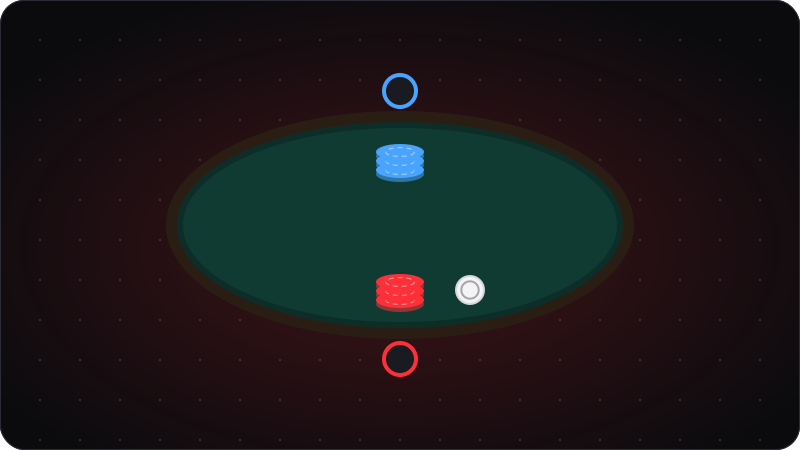
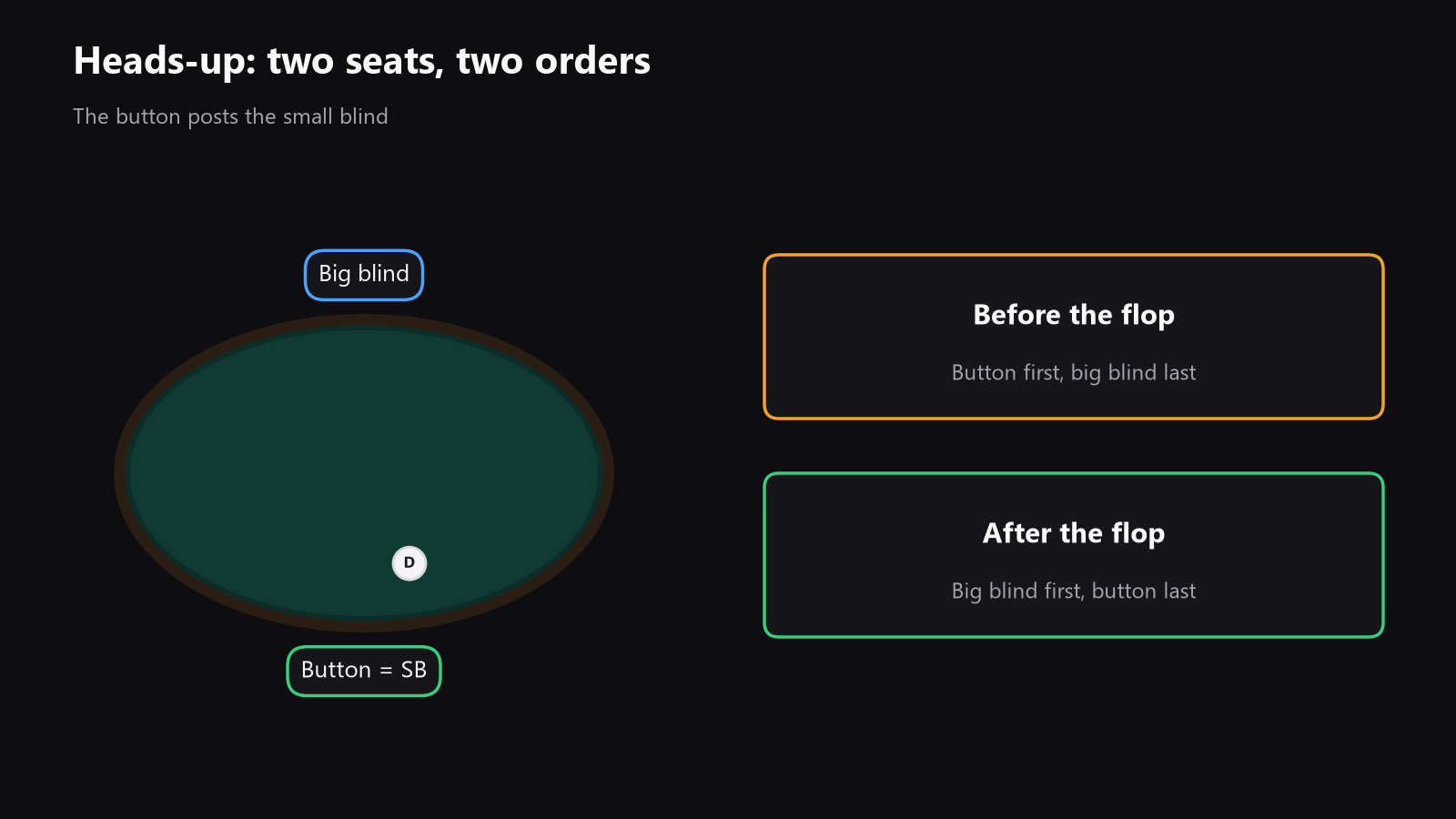
There is no hiding, no waiting for premium hands, and no long stretch of folding while the table passes you by. You are in the blinds every hand. The button posts the small blind, acts first before the flop, then last on every street after it. The big blind acts last before the flop and first after it. That one detail changes everything.
It changes ranges, because you are paying blinds every orbit and cannot wait forever.
It changes aggression, because one player can pressure the other constantly.
It changes postflop play, because both players arrive at the flop with much wider ranges than in six-max or full ring.
It also changes study, because you face the same opponent over and over, which means every leak becomes valuable very quickly.
Why heads-up ranges get so wide
In heads-up cash, the blinds are already costly. You are not trying to protect a giant stack of folded hands, you are trying to win a pot that starts small and grows fast.
That is why ranges widen so much.
When the button is the small blind, the opener has position after the flop and has already invested only half a blind. The big blind is getting a good price to continue, but is out of position after the flop. That combination forces both players to play more hands than they would in a normal ring game.
There is another reason ranges widen: the same cards gain value when only one opponent can punish them. A hand like K9 suited, A5 offsuit, or 76 suited may be marginal in full ring, but in heads-up it can be perfectly reasonable because:
- you often win the pot immediately with a raise,
- you can flop pair, draw, or blocker value,
- and your opponent will miss the flop a lot.
That does not mean every hand becomes playable. It means the border between "trash" and "playable" shifts a lot wider.
Rake matters too. In heads-up cash, small pots are a bigger part of the game, so rake bites harder. If the rake is heavy, marginal calls and thin opens lose value. That is one of the first things to check before you copy any neat-sounding strategy.
Preflop: how wide to open, defend, and 3-bet
Think in broad strokes, not in magic numbers.
When you are on the button
As the button, you want to raise a very wide range, because you have position after the flop and because the big blind must defend from out of position.
A practical way to think about it:
- strong hands obviously raise,
- hands with decent playability raise,
- hands with blockers often raise,
- and weak hands that cannot realize equity well enough are the ones you cut first.
In other words, you are not opening only premiums. You are opening a mix of value hands, suited hands, connected hands, blocker hands, and hands that can continue reasonably well if the big blind fights back.
If your opponent overfolds, you can widen further.
If your opponent 3-bets well and plays aggressively postflop, you should tighten to hands that continue better against pressure.
A simple mistake in heads-up is to open too tight because the hand looks ugly in isolation. In this format, many "ugly" hands are fine because they gain value from position, fold equity, and board coverage.
When you are in the big blind
The big blind should defend much wider than in a normal game, because the price is good and the opener is wide.
Use the math to stay honest.
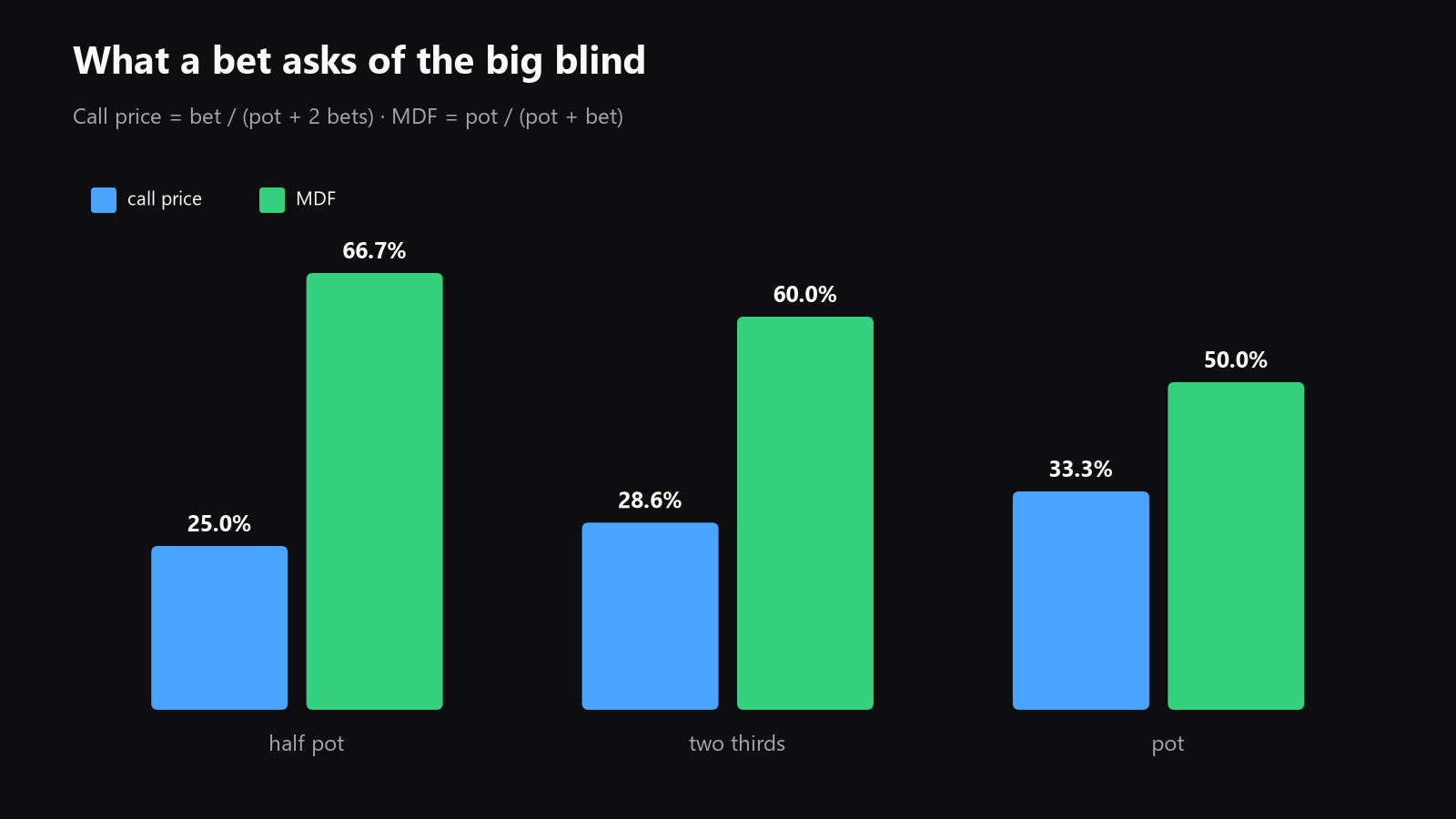
If you face a bet of size B into a pot of size P, the price of a call is:
B / (P + 2B)
The minimum defense frequency is:
P / (P + B)
A few useful examples:
- Half-pot bet: call price 25%, MDF 66.7%
- Two-thirds pot bet: call price 28.6%, MDF 60%
- Pot-sized bet: call price 33.3%, MDF 50%
These are not a script for every spot, but they are a good sanity check. If a player is betting very large and you are defending far less than MDF with no adjustment, you may be giving away too much.
Out of the big blind, you continue with a wide mix of:
- strong made hands,
- good pairs,
- suited hands,
- broadways,
- and some hands that are not pretty but still defend well enough versus the opener's range.
The key point is this: because you are closing the action preflop, you do not need to be scared of defending wide. But because you are out of position after the flop, you still need a hand class that can actually realize equity.
3-betting in heads-up
Heads-up is one of the spots where people are too value-heavy or too bluff-heavy.
The better answer is balance by function:
- some 3-bets are for value,
- some are for blockers,
- some are for hands that can continue well versus a 4-bet or a call.
A 3-bet is not just "aces and kings." In heads-up, a wide opener creates room for many more profitable 3-bets than people expect.
At the same time, do not turn every semi-playable hand into a 3-bet bluff. If your bluff 3-bets cannot survive a 4-bet, or cannot realize equity well when called, they may be burning chips.
A good rule is to choose bluff 3-bets that either:
- block the top of villain's continuing range,
- or play well enough postflop to keep their value if called.
Postflop when both ranges are wide
Heads-up postflop is not about waiting for the nuts.
It is about understanding which range connects better with the board, who has the stronger top pairs, who has the stronger draws, and who can credibly apply pressure.
Board texture matters more than memorized lines
A few examples help:
- Dry high boards, like A-7-2 rainbow or K-8-3 rainbow, often favor the preflop aggressor. The caller misses a lot, so small c-bets can work well.
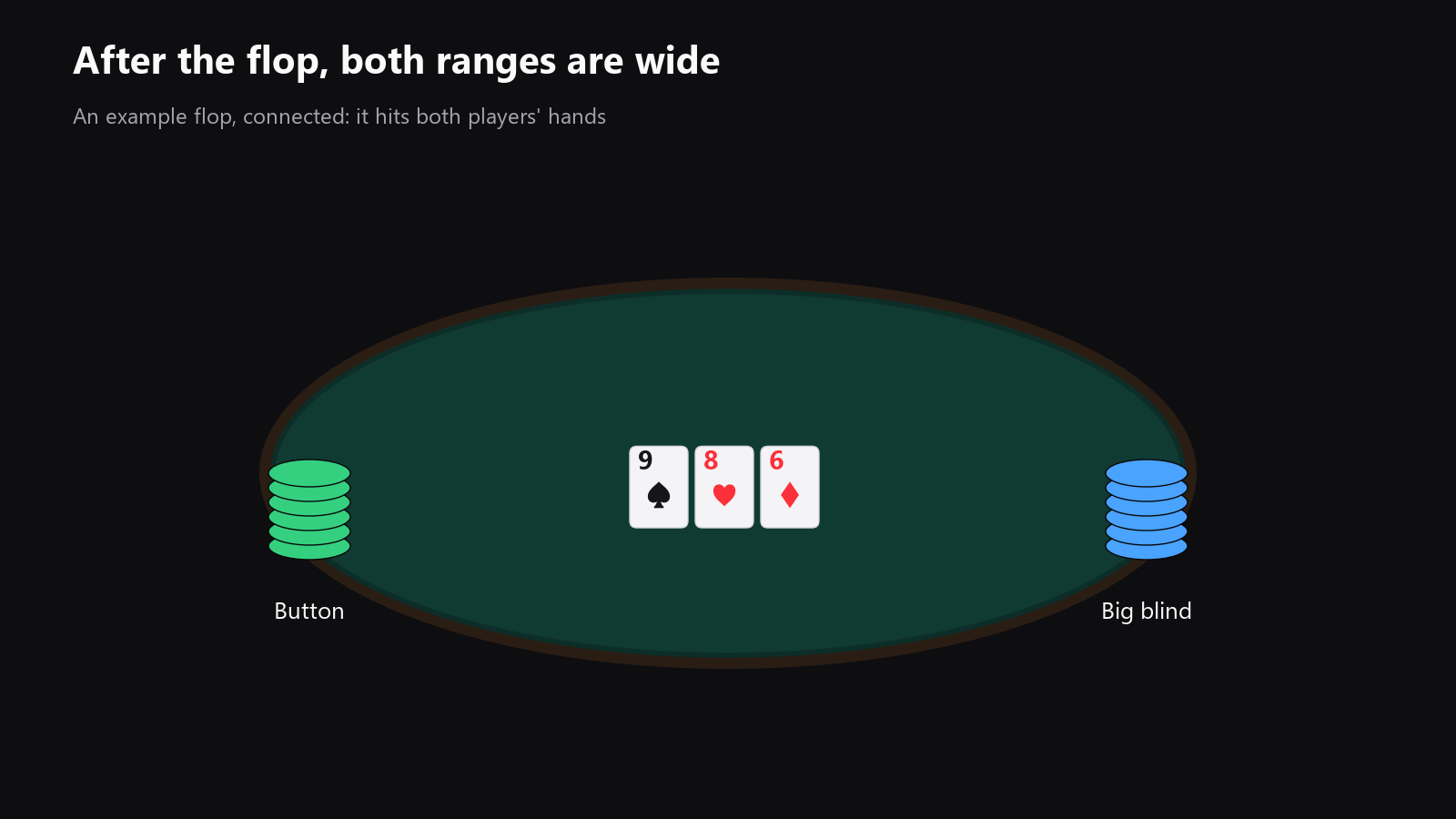
- Low connected boards, like 9-8-7 two-tone or T-9-6, favor the player who defended wide. These boards create more pair plus draw and straight-draw density.
- Paired boards, like Q-Q-5 or 8-8-2, often reduce the number of strong made hands in both ranges, so smaller bets, delayed aggression, and careful bluff selection matter more.
- Monotone boards require more caution, because made flushes and strong draws cluster differently than on rainbow flops.
The preflop aggressor does not automatically get to fire every flop. If the board belongs more to the big blind, checking back or using a tighter betting range becomes much more attractive.
What "wide ranges" mean after the flop
When ranges are wide, one pair is not always a big hand.
Top pair can be strong, but not always stack-off strong.
Second pair can be a bluff catcher.
Overpairs can remain excellent, but they are not invincible on dynamic boards.
And missed hands are not always pure trash, because blockers and backdoors matter.
This is where many players make their biggest heads-up mistake: they keep thinking in hole-card categories instead of range categories.
Ask yourself:
- What strong hands does my range have here?
- What strong hands does my opponent have here?
- Which hands can bet for value?
- Which hands can bet as bluffs?
- Which hands should just check and realize equity?
If you answer those questions board by board, heads-up gets much easier.
Aggression is not random
Aggression in heads-up cash should be pressure with a purpose.
Good aggression does at least one of these:
- earns immediate folds,
- charges worse draws,
- builds the pot with a strong value hand,
- or sets up profitable turns and rivers.
Bad aggression does none of those.
That is why size selection matters. Small bets can attack capped ranges and deny equity cheaply. Bigger bets can punish draws and force tougher bluff-catches. Checks can protect weak parts of your range and induce mistakes from over-aggressive opponents.
A simple practical rule: on boards that favor your range, bet more often and often smaller. On boards that favor the defender, check more and choose your betting hands more carefully.
How to adjust to one opponent you see every hand
This is one of the biggest edges in heads-up cash.
You are not playing a population, you are playing one person.
That means your adjustment speed matters a lot.
Look for the big leaks
The most useful heads-up leaks are usually simple:
- folds too much to opens,
- folds too much to 3-bets,
- overcalls preflop or postflop,
- c-bets too often,
- gives up too often on turns,
- bluffs too much on rivers,
- or value bets too thin or too big.
Once you know which of those is true, you can adapt fast.
If villain overfolds
Widen your opens.
Widen your 3-bets.
Increase flop c-bets on boards that miss them.
Apply more pressure on turns and rivers.
If they are giving up too much, the money comes from forcing folds, not from showing down fancy hands.
If villain calls too much
Tighten your pure bluffs.
Value bet thinner.
Use bigger sizings with your strongest hands.
Stop trying to get every pot to fold.
Against a calling station, value is the whole story.
If villain 3-bets too much
Open with hands that continue better.
Use more 4-bets with value and blocker-driven bluffs.
Avoid spamming weak opens that hate pressure.
Let the opponent hang themselves when they overplay the re-raise.
If villain is balanced or unknown
Play solidly, stay wide where the price is good, and keep notes.
The biggest gift in heads-up is information. You do not get a dozen opponents. You get one. Every showdown tells you something useful.
A practical study plan for heads-up cash
If you want to improve heads-up away from the table, study it in layers.
1. Start with preflop
Build your understanding from the blinds outward:
- button open versus big blind defense,
- big blind 3-bet versus button open,
- 4-bet ranges at your stack depth,
- and how rake changes those spots.
Do not try to memorize a giant chart before you understand why the chart exists.
2. Study by board class
Group flops by texture:
- high and dry,
- low and connected,
- paired,
- monotone,
- and middling two-tone boards.
Then ask how each texture changes:
- range advantage,
- nut advantage,
- c-bet frequency,
- sizing,
- and turn plans.
3. Review your own hands
The best heads-up study is not abstract theory, it is your own hands.
Find the spots where you are:
- opening too tight,
- defending too loosely,
- giving up too often,
- value betting too small,
- or bluffing where you have no story.
That is where a tracker and review tools help, because the leaks show up very fast when you are only facing one opponent.
4. Use a solver away from the table
If you want a clean answer to a spot away from the table, the Solver module computes the equilibrium strategy for two players on any board. It shows the 169 starting hands in a grid coloured by action, with the result figures next to it. It computes only when you ask it to, and it refuses hands from the session in progress.
That makes it useful for checking whether your intuition about a heads-up spot is actually sound.
For example, you can compare:
- a dry flop versus a connected flop,
- a single-raised pot versus a 3-bet pot,
- a deep stack versus a shallow stack,
- or a spot where you think one player is overfolding.
The point is not to copy a grid blindly. The point is to understand the structure behind it.

Heads-up cash, in one sentence
Heads-up cash rewards the player who is widest where the price is good, tightest where rake and position punish mistakes, and most aggressive where the opponent gives up too much.
If you remember only that, you are already thinking in the right direction.
And if you want to study it properly, start with your own hands, then compare them with what the field actually does, and only then ask the Solver module to check the spot away from the table.
Do it on your own hands.