
Deep stack poker changes the game more than most players expect.
At 100 big blinds, many decisions can be simplified into: do I like this pair, this draw, this bluff, this stack-off spot? At 200 big blinds and more, that shortcut breaks down. You still care about range advantage, position, and board texture, but the extra depth creates a different economy. You have more streets to play, more room for mistakes, more room for skill, and much bigger pots at stake when the hand finally gets serious.
If you want to play deep stack cash games well, you need to think in terms of stack-to-pot ratio, implied odds, reverse implied odds, and hand classes that can win big pots without being crushed when the money goes in.
What changes when you go from 100bb to 200bb?
The key idea is the stack-to-pot ratio, or SPR.
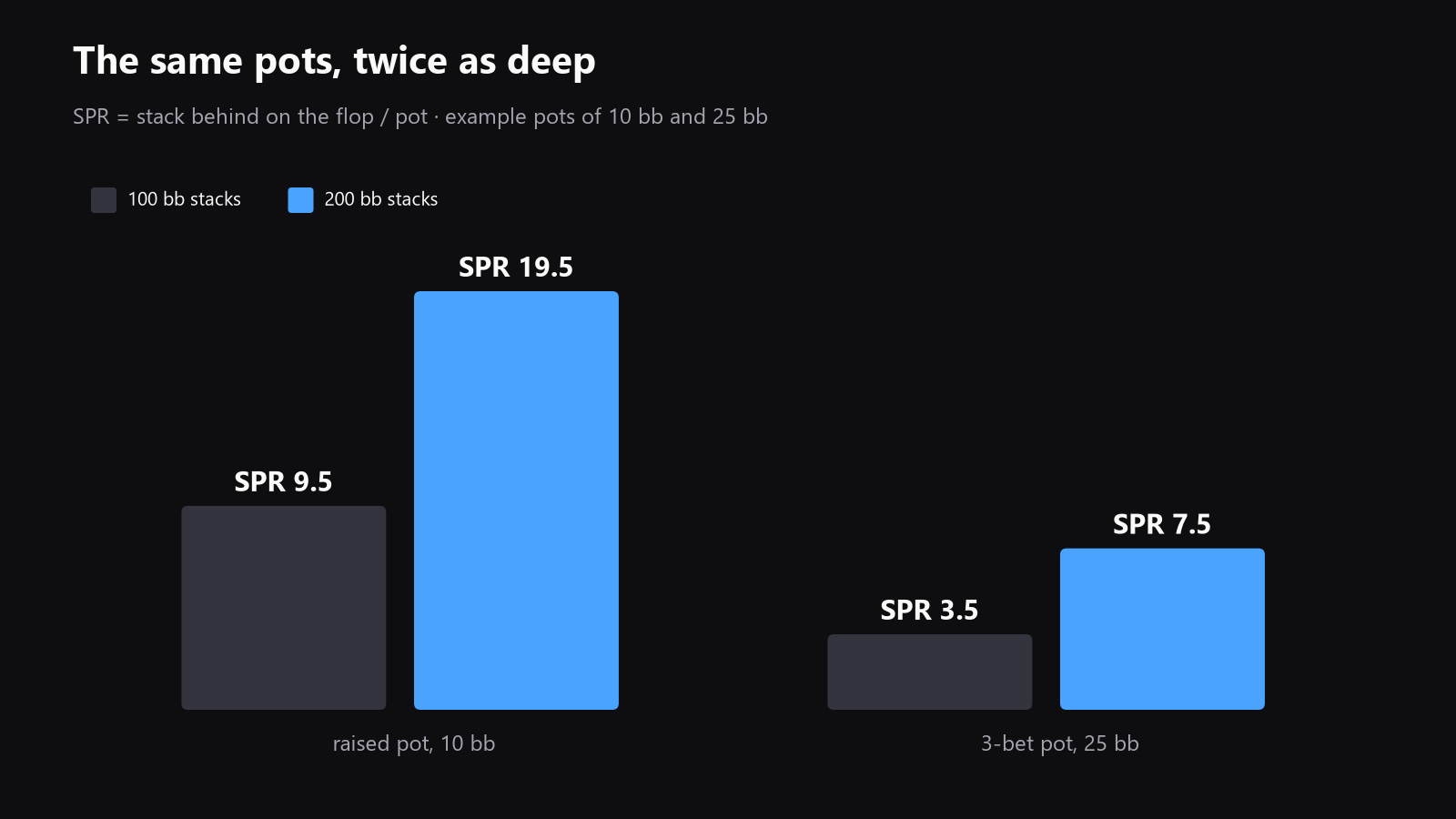
SPR is the effective stack divided by the pot on the flop. If the pot on the flop is 10bb and the effective stack is 200bb, the SPR is about 19.5, because there are roughly 195bb behind on the flop. If the pot is 25bb, the SPR is about 7.5, because there are roughly 188bb behind on the flop. The bigger the SPR, the more streets you must navigate before stacks can go in.
That changes everything:
- Your one-pair hands lose value.
- Your speculative hands gain value.
- Position matters more.
- Preflop sizing matters more.
- Postflop mistakes cost more, because there is more money behind.
At 100bb, top pair or an overpair can often be close to a stack-off hand in the right spot. At 200bb, the same hand is much more fragile. You may still bet for value, but you should be much less eager to put in all the chips unless the board and action clearly support it.
Deep stack poker is not just "the same game but bigger." It is a game where your hand must stand up over more streets, not just one.
Implied odds get better, reverse implied odds get worse
When you play deep, implied odds matter more.
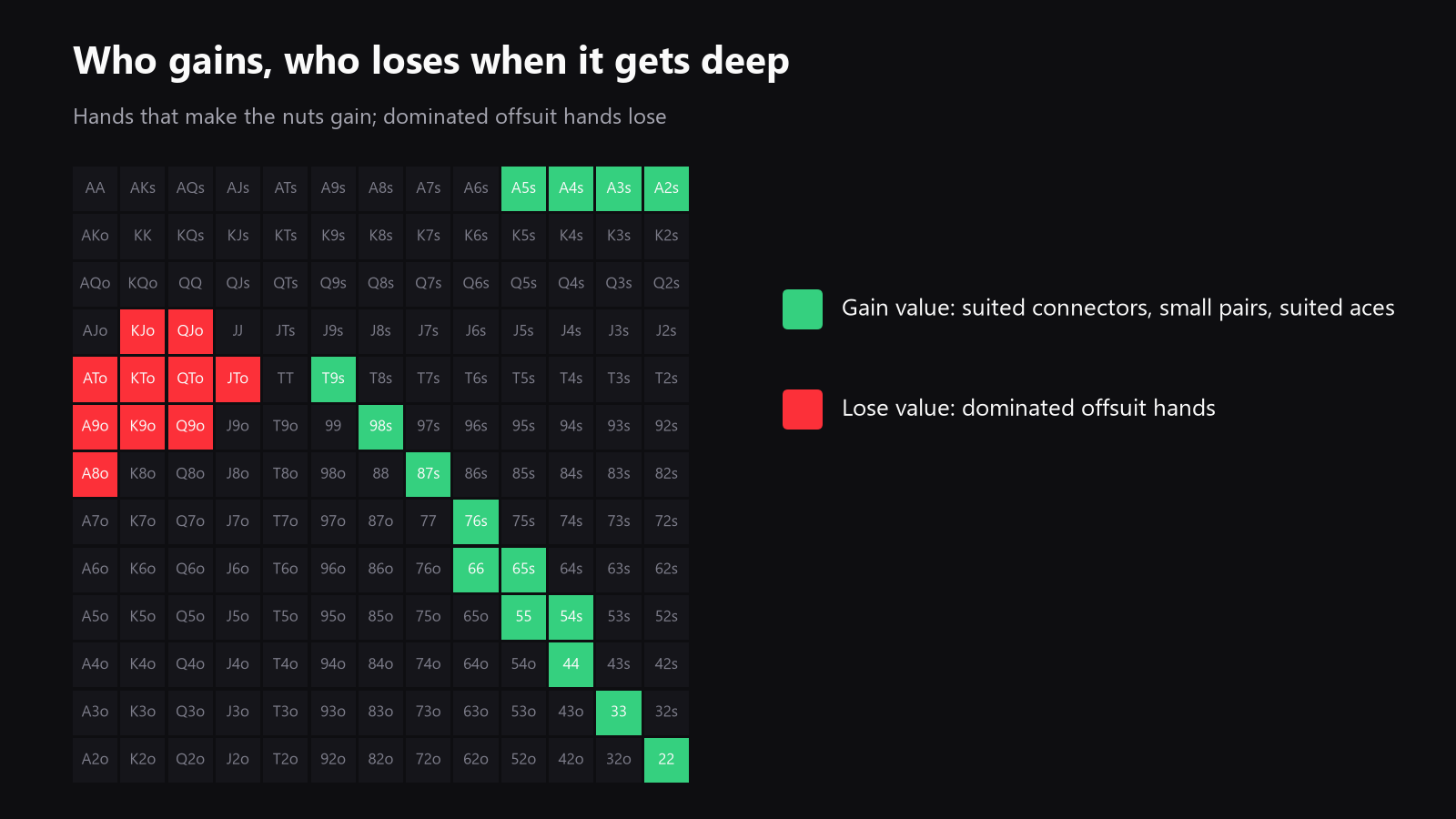
Implied odds are the extra money you can win later when you hit a strong hand. This is why small pairs, suited connectors, and suited aces gain value. They do not win often on the flop, but when they hit hard, they can win a large stack.
That means hands like:
- small pairs,
- suited connectors,
- suited aces,
all improve relative to shallow stack play, especially when you are in position and can realize their equity well.
But the other side of the coin is just as important. Reverse implied odds get worse too.
Reverse implied odds are the money you lose when you make a hand that looks good but is still second best. This hurts dominated offsuit hands and many one-pair hands. A hand like top pair with a good kicker can still be valuable, but it is no longer a hand you can automatically pile money in with. Deep stacks mean you are more likely to pay off a better top pair, a better kicker, two pair, a set, or a disguised straight or flush.
That is why hands such as:
- offsuit broadways that make second-best top pair often,
- weak ace-x offsuit,
- hands that dominate nothing and get dominated a lot,
go down in value as the stacks get deeper.
Position matters more when stacks are deep
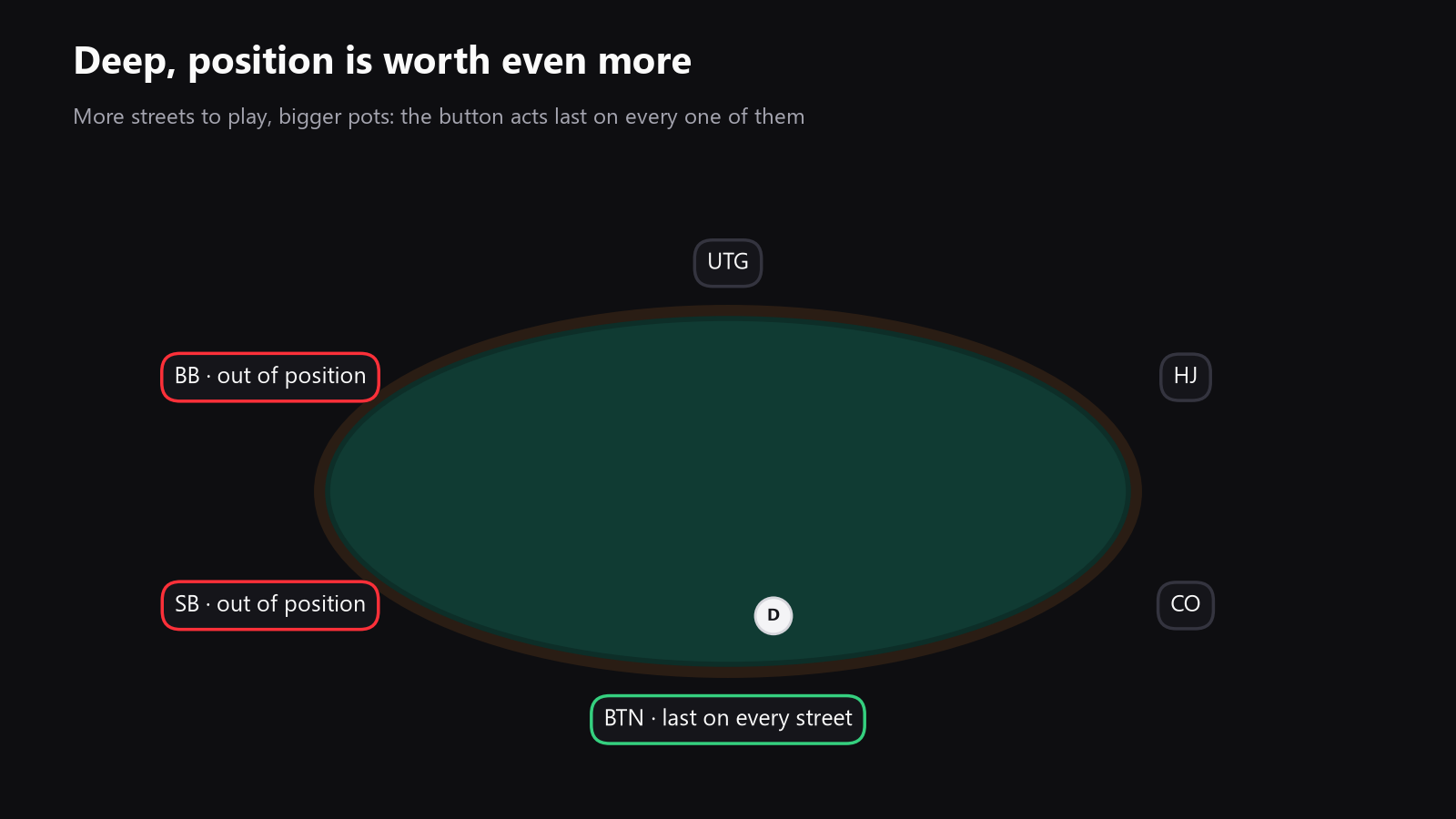
When the stacks get bigger, position becomes even more valuable.
Why? Because deep stack pots are harder to force to a simple conclusion. The player in position gets to see more information before acting, can control pot size better, and can realize equity more efficiently. The player out of position must act first on every street and is more likely to face difficult river decisions in large pots.
This means that deep stack poker rewards hands and lines that play cleanly when you have position. It also punishes loose calls from out of position with hands that make one pair and then guess.
A simple way to think about it:
- In position, you can lean more on playability and disguise.
- Out of position, you need stronger hands, better discipline, and tighter ranges.
That is one reason why a hand like a suited connector gets much better on the button than in the blinds. The hand itself did not change. The ability to realize its value did.
Bigger stacks call for better preflop sizing
If the stacks are deeper, your preflop sizes should usually grow too, but not blindly.
You do not want to make every raise huge just because the stacks are 200bb. If you bloat the pot too much with medium-strength hands, you make your own life harder. If you size too small, you give the other player a cheap way to realize equity and keep too many hands in.
The right idea is balance, not exaggeration.
A few practical principles:
- Out of position, use bigger sizes more often.
- Against callers who like to see flops, price them properly.
- When you expect a lot of postflop play, think about how your size affects the SPR.
- With very strong hands, size for value and for stack geometry, not just to keep them in.
The deeper the stacks, the less useful tiny preflop sizes become. A small open or small 3-bet can invite too many calls and create awkward postflop geometry. But a huge preflop size can also make your range too face-up and too expensive.
At 200bb, the sizing goal is usually to create a pot that gives you room to play, without letting your opponent realize equity for free.
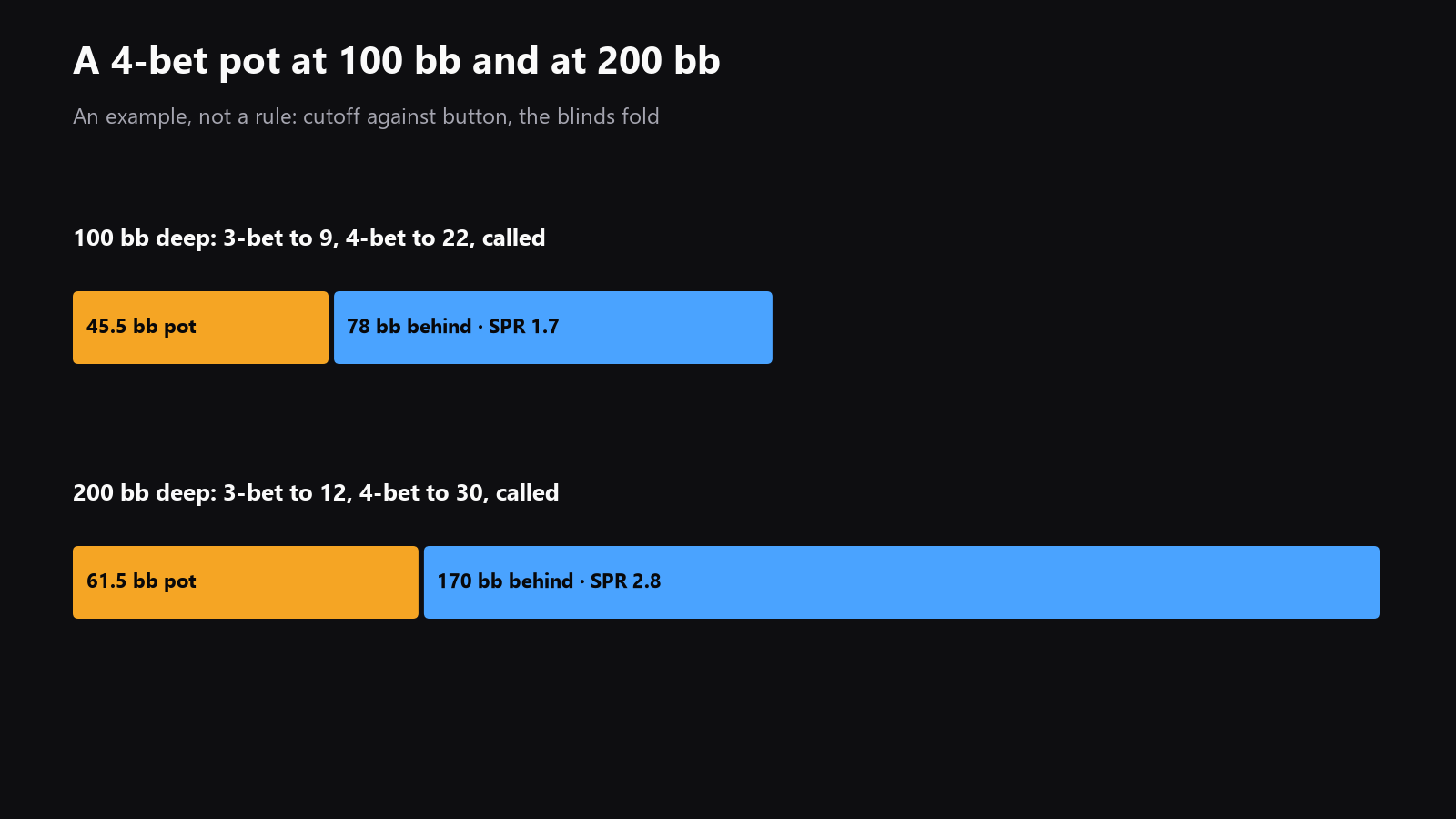
Which hands gain, and which hands lose?
This is the question most players really care about.
Hands that gain
These hands tend to gain value as stacks get deeper:
- small pocket pairs,
- suited connectors,
- suited one-gappers,
- suited aces,
- hands with nut potential and strong draw potential.
Why? Because they can make hands that win big pots, not just small ones. A small pair can make a set. A suited connector can make a straight or a disguised two pair. A suited ace can make the nut flush, and when that happens deep, the payoff can be huge.
These hands also benefit from implied odds. You are not buying immediate showdown value, you are buying the chance to win a larger pot later.
Hands that lose
These hands tend to lose value as depth increases:
- dominated offsuit broadways,
- weak top-pair type hands,
- one-pair hands that look prettier than they really are,
- hands that make a strong but not nutty made hand too often.
The deeper you are, the less comfortable you should feel stacking off with a hand that is often good but rarely great. Top pair top kicker is still a real hand, but it stops being a hand you can treat casually.
A good deep stack rule is this: the more often your hand makes second-best one pair, the more it should lose value as stacks grow.
When to play for stacks, and when not to
Deep stack poker is not about avoiding big pots. It is about choosing the right big pots.
You usually want to play for stacks when:
- you have nut advantage,
- the board is favorable to your range and to your value hands,
- the SPR is already low enough,
- your hand can continue against the value part of villain's range,
- there are enough turns and rivers left that your hand can improve or protect itself.
You usually do not want to play for stacks automatically when:
- you hold one pair on a dynamic board,
- the opponent's range is strong and uncapped,
- the SPR is still high,
- the stack-off line relies on villain making mistakes that you do not actually see often enough,
- your hand is too bluff-catcher heavy.
At 200bb, you should think much harder before you commit a whole stack with just one pair. Sometimes the right play is to bet, call once, then slow down. Sometimes the right play is to keep the pot manageable until you know more. Deep stack poker rewards restraint almost as much as aggression.
More streets means more planning
One of the biggest deep stack mistakes is to think street by street.
When the stack is 200bb or deeper, your flop decision should often include a turn plan and a river plan. If you bet the flop, ask yourself what happens on:
- good turns,
- bad turns,
- cards that improve your opponent's range,
- cards that give you equity but no showdown value,
- river cards that change who can value bet.
This matters especially in pots where both players can still have strong hands. Deep stacks create more complicated turn and river trees, so your flop line should usually be chosen with the rest of the hand in mind.
How to study deep stack spots
If you study deep stack cash games the wrong way, you will blur your results together and miss the real leak.
A 200bb spot is not the same as a 100bb spot. A button open at 200bb is not the same as a button open at 100bb. A blind defense, a 3-bet pot, and a single-raised pot all behave differently as depth increases.
So when you study, separate your hands by:
- effective stack depth,
- position,
- pot type,
- board texture,
- action tree,
- whether you were in position or out of position.
That is where stack depth awareness becomes useful in your review. If you do not isolate deep hands somehow, you will misread the evidence and average together spots that play very differently.
You can also use the Solver module away from the table to study a spot on any board. It shows the equilibrium strategy of the spot as a 13x13 grid of starting hands, which is useful when you want to understand how a deep spot is structured without guessing from memory. It refuses hands from the session in progress.

A practical deep stack checklist
Before you enter a 200bb pot, ask yourself:
- Can this hand win a big pot, or does it mostly make second-best one pair?
- Am I in position?
- How does the SPR change if I continue?
- What part of my range is strongest on this board?
- If I bet now, what are my turn and river plans?
- Am I calling because the price is good, or because I am hoping to get lucky later?
- Would this hand be fine at 100bb, but too fragile at 200bb?
If your answer is unclear, slow down. Deep stack poker punishes automatic decisions.
The short version
Deep stack cash games at 200bb and beyond are about leverage, not just chips.
The hands that gain are the hands with implied odds, nut potential, and strong playability. The hands that lose are the ones that make dominated one-pair hands too often. Position becomes more important. Preflop sizing matters more. And stack-off decisions should be tighter, because one pair is no longer enough in many spots.
If you study these hands properly, you will stop treating deep pots like oversized 100bb pots. That is when your game starts to make sense at 200bb and beyond.
Do it on your own hands.