
If you search for exploitative poker, you are usually looking for the same thing:
- how to adjust beyond “standard” strategy,
- how to punish common mistakes,
- how to make more money against the players at your limits.
That is the right instinct.
In real online poker, you do not face a perfect opponent. You face a pool. That pool has habits. It overfolds here, calls too much there, bluffs too little on rivers, and makes the same preflop mistakes over and over. If you can spot those patterns and respond well, you can win more than by playing a generic strategy into everyone.
Exploitative poker is the art of doing exactly that.
What exploitative poker means
An exploitative strategy is a strategy that is built to make the most money against the way people actually play.
That sounds simple, but there is an important difference between:
- a balanced strategy, which tries to avoid being easy to counter,
- and an exploitative strategy, which deliberately moves away from balance because the opponent or the pool is not playing well enough to punish it.
In other words:
- if the pool folds too much to c-bets, you c-bet more,
- if the pool underbluffs rivers, you fold more bluff catchers,
- if the pool calls too wide preflop, you value bet more and bluff less,
- if a player overfolds to 3-bets, you 3-bet more hands.
That is exploitative poker in practice.
It is not guesswork. It is not “I feel he is weak.” It is a response to observable behavior.
Why exploitative poker matters so much in low and mid stakes
At micro stakes and small stakes, many opponents do not defend enough, do not bluff enough, or call too much in spots where they should fold.
That matters because small mistakes repeated thousands of times add up fast.
A solver can tell you the theoretically sound response to a spot. But if your opponents are not close to solver behavior, the best money often comes from something simpler:
- value betting more aggressively,
- bluffing less in bad bluffing spots,
- choosing larger sizes when people call too much,
- attacking obvious leaks repeatedly.
This is one reason exploitative poker is so powerful for online cash games, tournaments, Sit and Gos, and Spin and Gos. In most pools, the edges are not hidden in one magical line. They are hidden in repeated population mistakes.
Exploitative poker is not random poker
A common mistake is to think exploitative play means abandoning structure and “going with your gut.”
That is not what good exploitative poker looks like.
Good exploitative play is built on a baseline. You still need to know:
- how ranges work,
- what board textures favor which player,
- which hands are value bets, bluffs, or bluff catchers,
- what the natural frequencies should look like.
Without that baseline, you do not exploit. You just improvise.
A better way to think about it:
- Start from a solid default strategy.
- Observe how the pool differs from that baseline.
- Adjust only where the difference is large enough to matter.
- Keep checking that the read still holds.
This is the core of real exploitative poker.
The big question: when should you deviate?
You should deviate when all of these are true:
- the tendency is real,
- the sample is large enough to trust,
- the exploit gives more value than the risk of being countered,
- and the adjustment does not damage too many other spots.
That last point is important. A small exploit can be profitable in one spot and harmful overall if you apply it too broadly.
For example:
- folding too much to flop c-bets can make you easy to punish,
- but folding too little in a pool that rarely bluffs can cost even more.
The goal is not to be “exploitative” everywhere. The goal is to be exploitative where the money is.
A simple framework for exploitative poker
Here is a practical way to think about any adjustment.
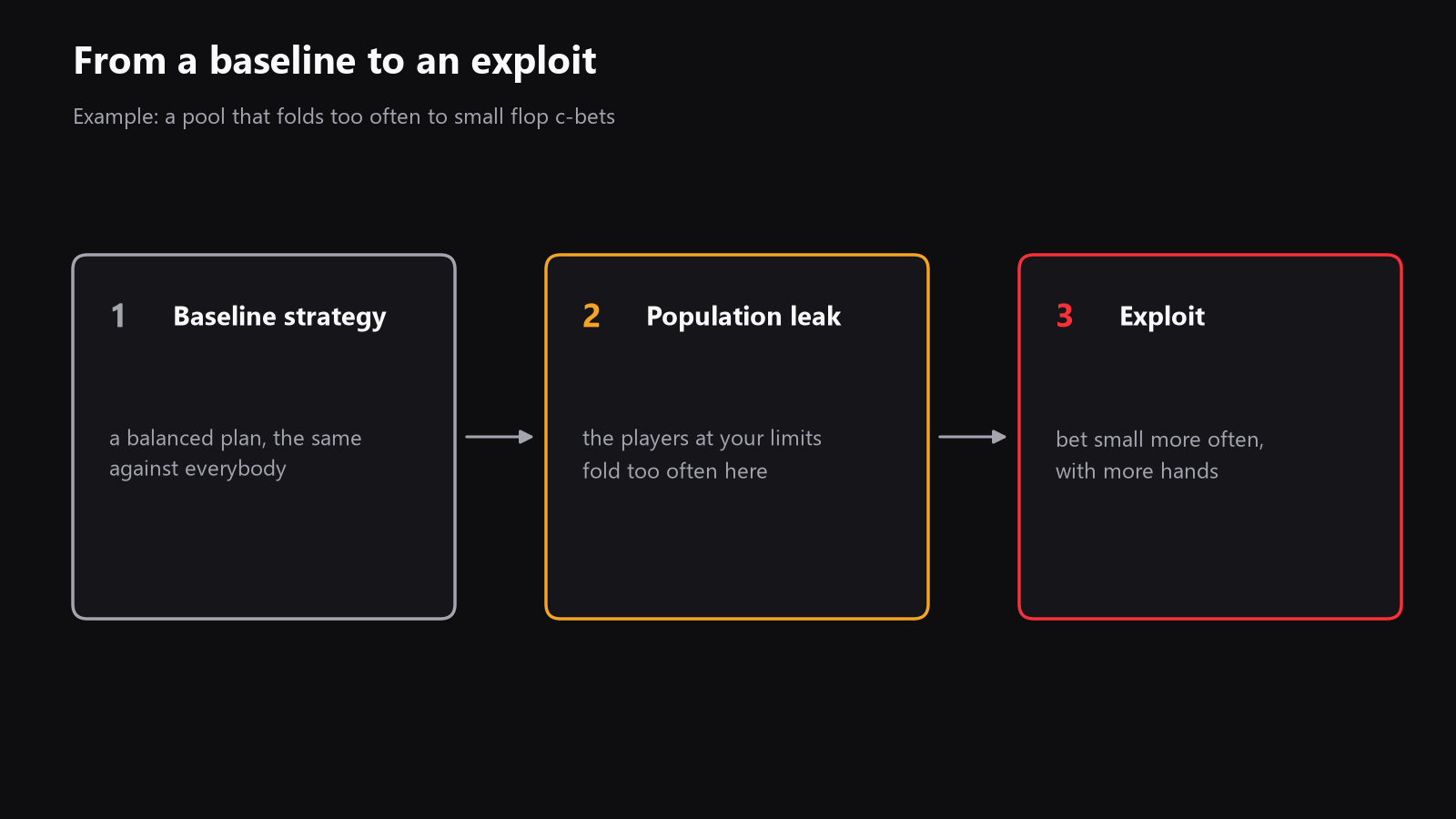
1. Know the baseline
Ask: what would I do against a competent, balanced opponent?
This gives you a reference.
2. Identify the population tendency
Ask: what do the players at my limits actually do here?
Examples:
- fold too much to 3-bets,
- check back too often on the flop,
- call turn too much but river too little,
- overvalue one pair on wet boards,
- underbluff missed draws.
3. Estimate how big the leak is
A tiny leak does not always justify a big strategic shift.
If players fold 2% more than expected, that may not matter much. If they fold 20% more, that can be huge.
4. Choose the exploit
Now adjust:
- widen value ranges,
- widen bluff ranges,
- size up,
- size down,
- check more or less,
- fold more or less.
5. Reassess
Pool tendencies change.
Your adjustment should be reviewed regularly, especially if you move stakes, rooms, or formats.
Preflop exploitative poker
Preflop is one of the easiest places to exploit because the mistakes are frequent and repeated.
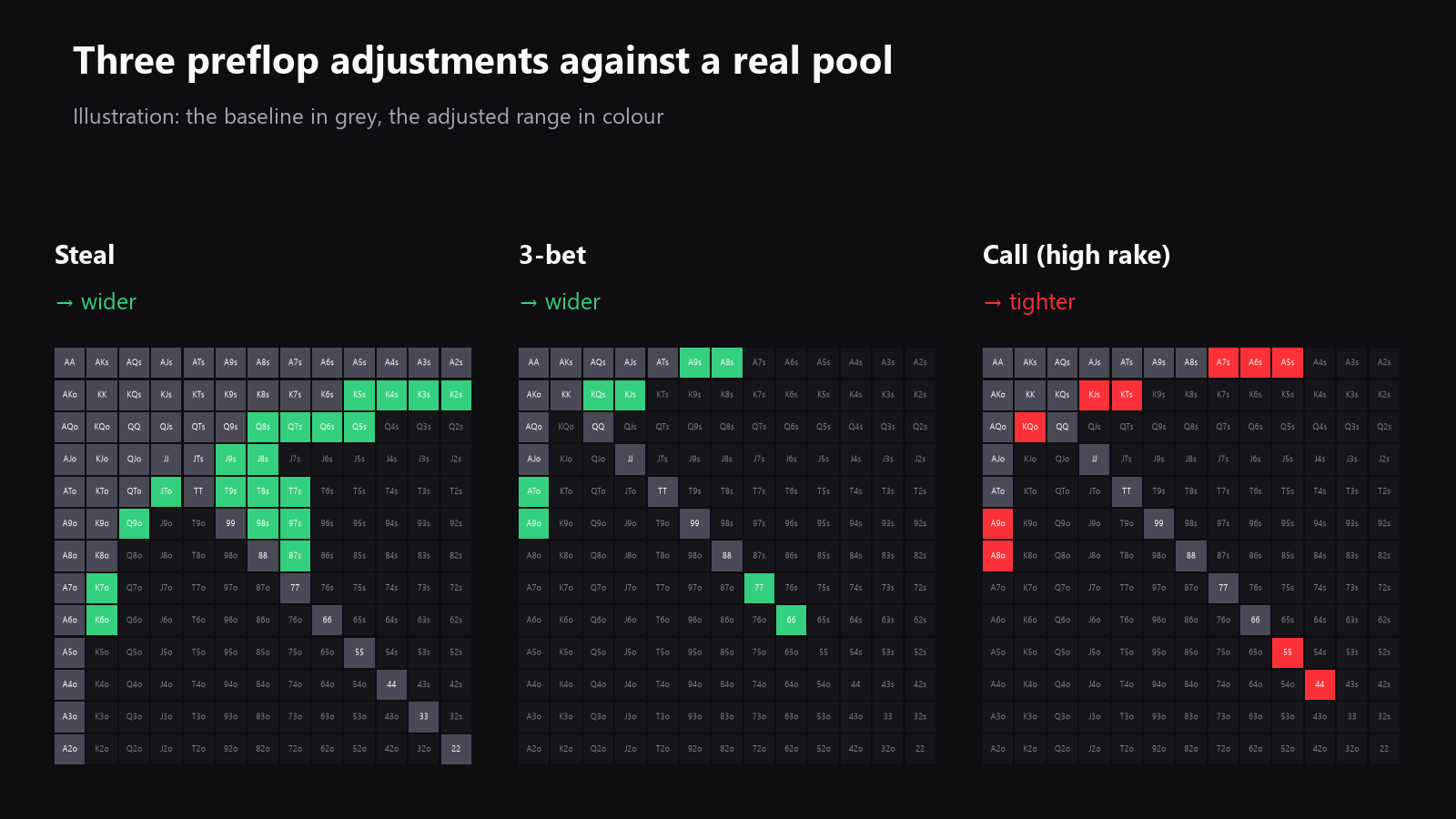
1. Attack players who fold too much to 3-bets
If a player opens and then folds too often to 3-bets, you can 3-bet more hands, especially hands that play decently when called and hands that block strong continue ranges.
This does not mean you 3-bet every trash hand. It means your bluff 3-bets become more profitable.
Typical adjustment:
- value 3-bet a bit wider,
- add more semi-bluffs,
- reduce flat calls that do not play well postflop.
2. Value bet wider against stations
Some pools call too much preflop and continue too loosely postflop.
Against those players:
- widen your value range,
- reduce pure bluffs,
- prefer hands that make strong top pairs and better value holdings,
- isolate them more aggressively when they limp or open small.
The mistake to avoid is bluffing into someone who simply does not fold.
3. Steal more from players who overfold blinds
If blinds overfold to opens, you can open wider from late position.
This is one of the cleanest exploits in poker. You do not need to win a huge pot. You just need to pick up blinds more often.
That means:
- steal more from the button and cutoff,
- punish passive blinds,
- open size with intent, not habit.
4. Be careful with rake
At micro stakes, rake changes the value of many preflop spots.
A hand that looks playable in theory may become less profitable if rake is heavy and the pool does not create enough postflop mistakes to compensate.
Exploitative poker is not only about opponent leaks. It is also about the environment. Rake, stack depth, and format all matter.
Postflop exploitative poker: where the money really moves
Postflop is where population tendencies become most valuable, because people do not just make one mistake. They chain mistakes across streets.
1. C-bet more when the pool overfolds
If players fold too often to flop continuation bets, your c-bets become more profitable.
That means:
- more small c-bets on favorable boards,
- more range-betting on boards that miss the caller,
- more pressure on players who give up too easily.
But do not make the mistake of c-betting every board. Board texture still matters.
For example, high connected boards hit callers more often than dry boards. On coordinated textures, the value of a bluff c-bet can drop sharply.
2. Bluff less when the pool overcalls flop and underbluffs later streets
Many pools are curious on the flop but passive later.
That creates a strong exploit:
- value bet thinly,
- bluff less on early streets,
- and apply more pressure when the range becomes capped and the opponent still shows weakness.
If a player calls flop and turn too often but folds river too much, your best exploit may be a delayed bluff, not a flop stab.
3. Overfold bluff catchers against underbluffing pools
This is one of the biggest leaks many players make themselves.
If the pool does not bluff enough on the river, then bluff catchers lose value. You should fold more often than theory would suggest in some spots.
Many players hate folding when they “have something.” But against a population that rarely turns missed draws into bluffs, your medium-strength hands are often not worth the call.
That is uncomfortable, but profitable.
4. Value bet thinner against calling stations
If the field calls too much, your value range expands.
Hands that might check back in a balanced strategy can become value bets:
- top pair with a decent kicker,
- second pair in good spots,
- overpairs on safe runouts,
- thin value on rivers when worse hands still call.
This is one of the clearest signs of good exploitative poker: you stop trying to “protect” your range and start trying to get called by worse hands.
5. Use bigger sizes against sticky opponents
When people call too much, sizing up becomes one of the strongest exploits in poker.
Larger bets:
- win more when you have value,
- charge draws more heavily,
- and make weak bluff catchers suffer.
Of course, you should not just size up everywhere. But if the pool is sticky, small bets can leave money on the table.
Turn and river exploits
Many players think exploitative poker is mostly about the flop. It is not.
The turn and river are often where the biggest mistakes appear.
Turn
On the turn, many players start to reveal their real range.
They either:
- continue too honestly,
- call too wide,
- or give up too much after floating the flop.
Useful exploits include:
- barreling when their range weakens,
- checking back more when they continue strongly,
- value betting hard when draws miss and worse hands still call.
River
The river is the purest exploit street.
By the river, most players have a capped range, a clear tendency, or both.
Common population patterns:
- underbluffing,
- overfolding to big bets,
- calling too much with bluff catchers in some pools,
- making “hero folds” too rarely or too often depending on stake and player type.
The best river exploit is often the simplest one:
- bluff less against calling stations,
- bluff more against overfolders,
- and value bet when the line says they can still pay you off.
The most common population leaks you should look for
If you want to become better at exploitative poker, learn to recognize these leaks first.
Players fold too much to aggression
You can bluff more, especially in high fold-to-c-bet and high fold-to-3-bet pools.
Players call too much preflop
You should tighten your bluffs and widen your value range.
Players continue flop but not turn
This is a great spot for delayed aggression.
Players do not bluff rivers enough
You should overfold bluff catchers and stop paying off thinly in bad spots.
Players overvalue top pair and one pair
You can extract more with stronger value hands and bigger sizings.
Players underdefend blinds
Steal more, especially from late position.
Players play passively out of position
You can apply pressure more often and deny equity with aggressive lines.
A real-world example
Imagine you open the button and the big blind calls.
The flop comes something like Q-J-7, a board that hits the caller reasonably well.
A solver-based line might mix bets and checks. But if your pool at this limit folds too much to small c-bets and rarely raises as a bluff, you may have an exploitative reason to bet more often.
Now imagine the opposite: the pool at your stake calls flop very wide, then underbluffs the turn and river.
In that case, your flop bluffing frequency should often go down, not up. You still value bet. You still pressure weak ranges. But you stop burning chips on auto-bluffs that do not get enough folds.
That is the key point: the same board can require a different exploit depending on the people you face.
How to build better population reads
You do not need to guess the pool forever.
You can study it.
Look at your own hand histories
Your own hands are the best source of information because they reflect the exact games you play.
Track:
- fold to c-bet,
- fold to 3-bet,
- turn barrel frequency,
- river aggression,
- showdown value tendencies,
- sizing patterns by street,
- position-based behavior.
Separate by pool, format, and stake
A strategy that works in one room or one stake may not work in another.
For example:
- tournament players may defend differently near the bubble,
- cash game players may call differently under high rake,
- spin pools can be much tighter or more aggressive depending on the stage.
Focus on frequencies, not anecdotes
Do not build your strategy around one weird hand.
One player slowplaying quads means nothing. A pool that rarely raises rivers means a lot.
Exploitative poker becomes much better when you stop collecting stories and start collecting patterns.

The biggest mistake in exploitative poker: overfitting
This is the trap.
You see one player fold to a flop c-bet three times, and suddenly you think the entire pool overfolds.
Or you watch one opponent snap-call every river, and suddenly you stop bluffing everyone.
That is not good exploitative poker. That is overfitting.
To avoid it:
- use enough hands before changing your strategy,
- distinguish a single player from the whole pool,
- keep notes, but verify them,
- update your reads when the sample grows.
A strong exploitative player is not the one who reacts fastest. It is the one who reacts accurately.
Exploitative poker and game theory: friends, not enemies
A lot of players treat GTO and exploitative poker as opposites.
That is a mistake.
Game theory gives you the baseline. It tells you what a robust strategy looks like. Exploitative poker tells you how to move away from that baseline when the pool gives you a reason.
Think of it this way:
- GTO keeps you from making obvious mistakes,
- exploitative play helps you win more when opponents are not playing close to perfect.
You need both.
If you only play balanced, you may leave money on the table against weak pools.
If you only exploit, you may become easy to counter or make fragile assumptions.
The best players combine both.
How to study exploitative poker more efficiently
If you want to improve faster, do not just ask “What is the right play?”
Ask these questions instead:
- What does the pool do here?
- How often do they fold?
- How often do they call worse?
- How often do they bluff?
- What happens on later streets?
- What is the cost of being wrong?
- How big is the edge if I adjust?
That is how you turn poker theory into money.
A tracker that compares your own hands to the field can make this process much easier, because it shows where the pool actually differs from a baseline instead of forcing you to rely on memory. For example, the Reveal module in Poker Exploit is built to read real tendencies from your hand histories, while the Plan module helps you focus on the leaks that cost you the most. Used together, they make exploitative work much more concrete.
A practical cheat sheet for exploitative poker
Here is the short version you can keep in mind at the tables:
- If they fold too much, bluff more.
- If they call too much, value bet more.
- If they bluff too little, fold more.
- If they overdefend one street and underdefend the next, shift pressure to the weak street.
- If they make the same mistake often, punish it often.
- If the sample is small, stay cautious.
- If the pool changes, update your strategy.
That is exploitative poker in one page.
Final takeaway
Exploitative poker is not a trick. It is a method.
You start with a solid baseline, observe what the pool really does, and then adjust in a way that makes more money against those habits.
At small stakes especially, this is often the fastest path to improvement, because the pool gives away information all the time. The players are telling you, through their actions, exactly where the money is.
Your job is to listen, measure, and respond better than they do.
That is how you stop playing poker in the abstract and start playing the game you actually face.
Do it on your own hands.