
A float and a delayed continuation bet are two ways to win a pot without having the best hand right now.
A float is when you call a flop bet in position with the intention of taking the pot later, usually when the bettor gives up too often on the turn.
A delayed c-bet is when you were the preflop raiser, you checked the flop, and you bet the turn instead. You did not miss the c-bet by accident. You chose to delay it because the turn is a better street to attack.
These lines look similar because both use later streets to make the pot yours. But they are not the same play.
- A float attacks a player who c-bets too wide and does not continue enough.
- A delayed c-bet attacks a player who checks the flop too often, then folds too much on the turn.
If you remember only one thing, make it this: these plays are not about being tricky. They are about attacking a range that is too weak, too capped, or too honest on the next street.
1. The basic idea behind both plays
Poker players often talk about these spots as if they were fancy bluffs. They are not.
They are range attacks.
When a player bets the flop and then slows down too much, their line often says, "I have a wide range, but not enough hands that want to keep betting." That is a good float target.
When a player checks the flop and then checks again on the turn, their line often says, "I did not trap very often, and I do not have many strong hands here." That is a good delayed c-bet target.
The important word is capped. A capped range is a range that is missing some of its strongest hands because of the line the player took. You do not need to know the exact math to exploit it. You only need to know that the line often narrows their range more than yours.
2. The arithmetic that sits under the bluff
Before you think about fancy reads, think about price.
If you face a half-pot bet and you want to continue, you need 25% raw equity to call if you will realize it perfectly.
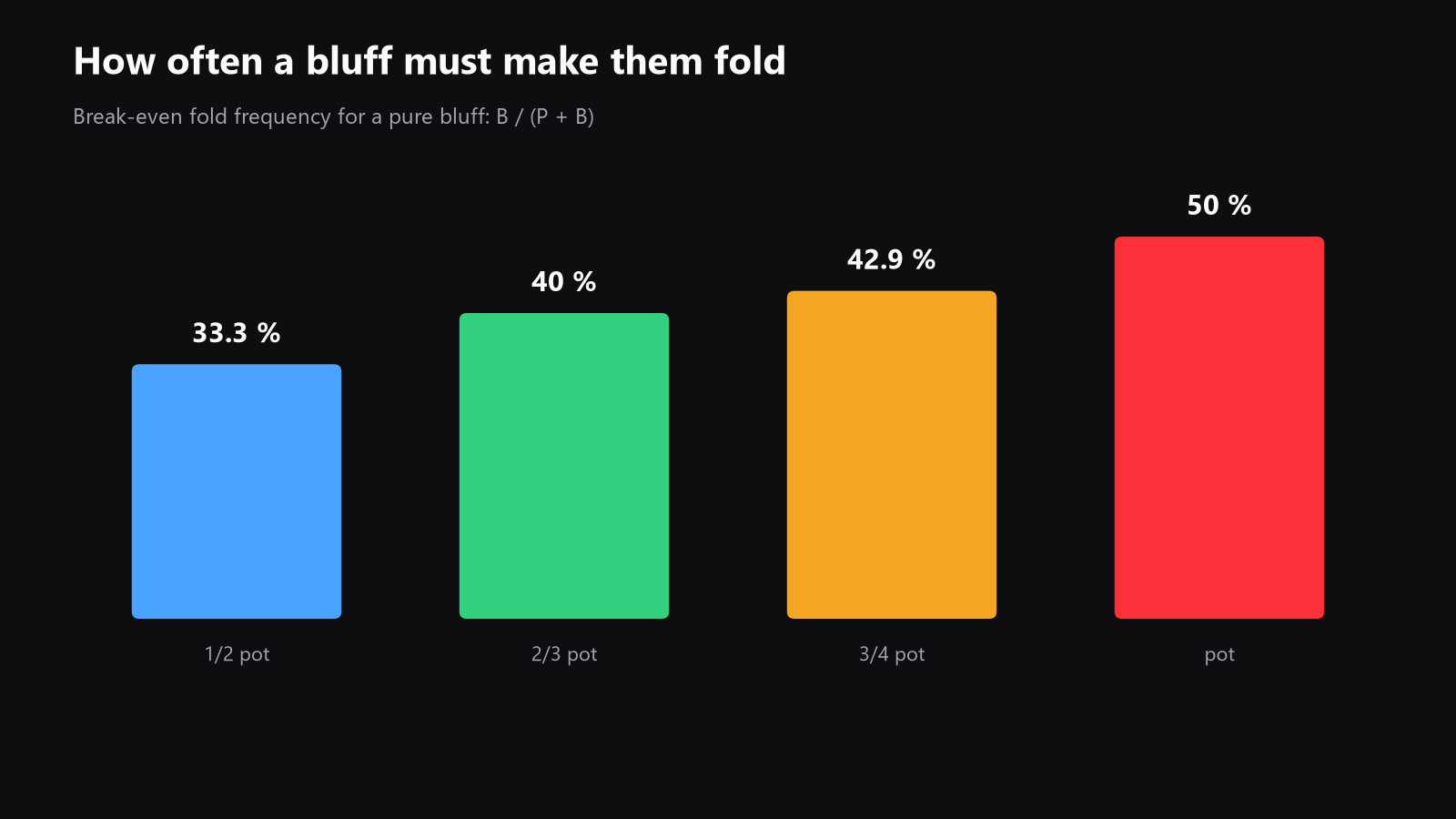
If you make a bluff yourself, the break-even fold frequency is simple:
- Bet 1/2 pot, you need folds about 33% of the time
- Bet 2/3 pot, you need folds about 40% of the time
- Bet 3/4 pot, you need folds about 43% of the time
- Bet pot, you need folds 50% of the time
That is only the starting point. In real poker, your hand can improve, your blocker can matter, and your position can let you realize more equity than the raw number suggests.
So the real question is not, "Can I call?" or "Can I bluff?" The real question is, "Will this line win more often than the plain, honest line?"
3. What makes a good float
A good float has three ingredients.
1. Position
You want to act after villain on later streets. Without position, the float loses a lot of its power because you cannot punish weakness as cleanly.
2. Some way to improve or threaten
The best float hands are not complete garbage. They often have:
- backdoor flush draws
- backdoor straight draws
- overcards
- blockers to strong value hands
- some showdown value
You do not need a monster. You do need a hand that can still win sometimes if villain checks down, or a hand that can credibly represent strength later.
3. A villain who gives up too much
This matters more than the cards themselves.
A float is good against a player who:
- c-bets often
- barrels the turn too little
- folds to turn probes too much
- plays fit-or-fold poker after the flop
A float is bad against a player who:
- c-bets and keeps firing
- check-raises turns aggressively
- calls too much once they have put money in
- does not fold one-pair hands often enough
A practical example
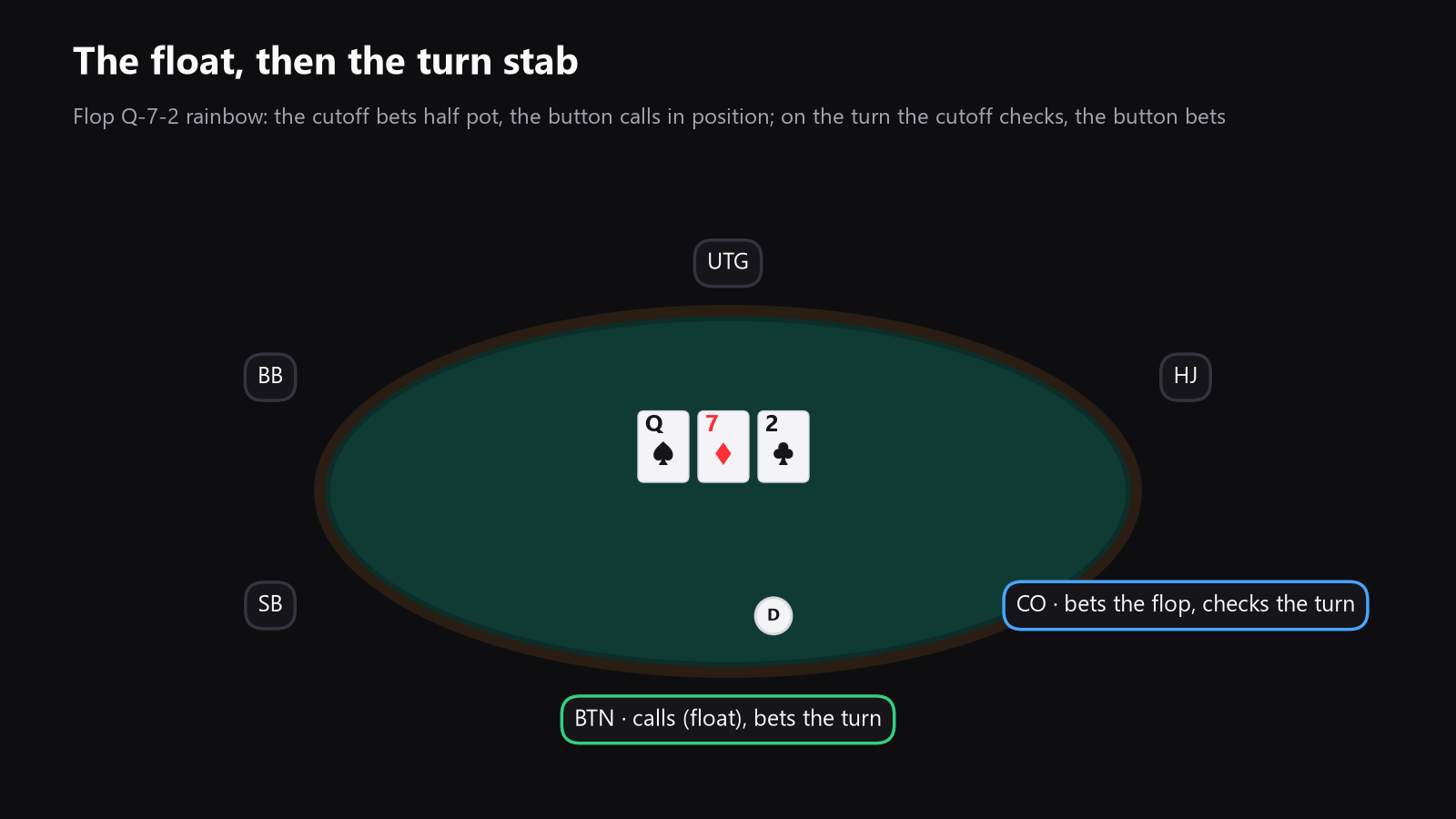
Suppose villain c-bets half pot on a dry flop like Q-7-2 rainbow.
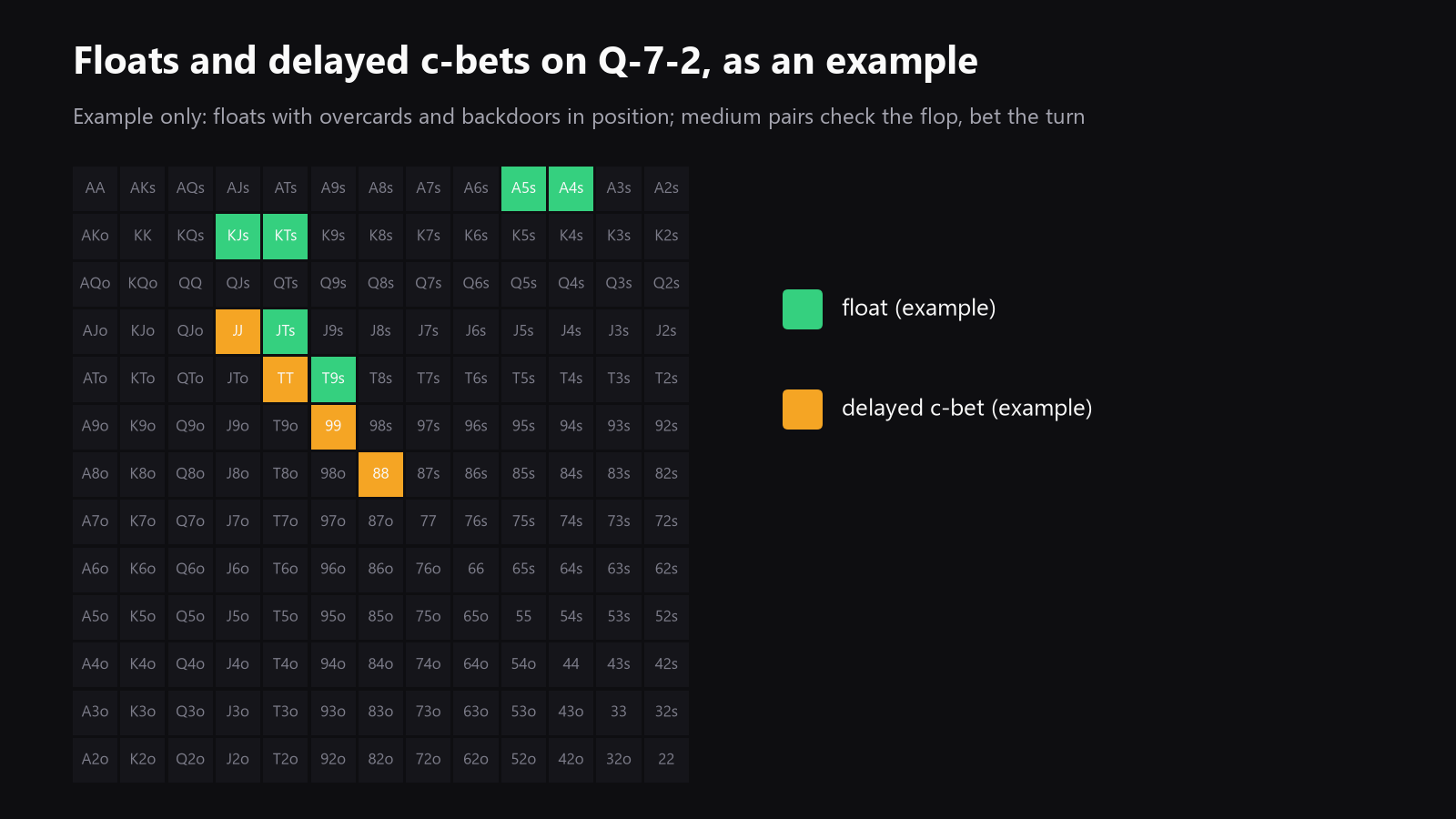
You are on the button with A5 suited. Why can this be a decent float?
- You have position.
- You have backdoor equity.
- You block some strong ace-high continuations.
- If villain is the kind of player who fires once and then gives up, you can take the pot when they check the turn.
That does not mean every A5 suited is a float. It means the hand has the ingredients a float needs.
4. When floating works best
Floating works best when the flop bettor is much better at betting than they are at continuing.
That often happens with players who:
- use a small c-bet as a routine
- overestimate how much fold equity they have on the flop
- underdefend their turn checking range
- think too much about the first bet and not enough about the next one
It also works better on boards where their story gets awkward on the turn.
For example, on many dry boards, a turn blank does not improve their range much, but it gives you a chance to stab if they show weakness. On dynamic boards, by contrast, turn cards can strengthen their range, strengthen their draw density, or make your bluff look less credible.
A good float is not just "call and see what happens". It is a line with a turn plan.
5. When floating is a mistake
Do not float just because you are in position and annoyed.
Floating gets expensive when:
- villain barrels the turn a lot
- villain underbluffs rivers
- villain does not fold one pair
- the board is too connected and their turn aggression is credible
- your hand has no backdoors and no blockers
If you call a flop bet with complete air against a player who does not surrender later, you are not floating. You are donating.
6. What makes a good delayed c-bet
A delayed c-bet starts with a flop check.
That flop check can mean several things:
- you have showdown value and want to control the pot
- you expect villain to stab too often and want to induce
- you think the turn will be a better street for your range
- you have a hand that can profit more from a turn bet than from a flop bet
The best delayed c-bets usually come from one of these situations:
- your flop checking range is still strong enough to represent value
- the turn card helps your perceived range
- villain checked a range that is capped or too weak
- you have blockers to the hands that continue most often
Good delayed c-bet candidates
- overcards that missed the flop but picked up equity on the turn
- hands with a blocker to top pair or two pair
- medium-strength hands that prefer not to face a flop raise
- strong draws that are happy to turn the pot into a bluff or semi-bluff
- thin value hands that wanted to keep worse hands in on the flop
A delayed c-bet is not a default. It is a turn decision.
7. When delayed c-betting works best
Delayed c-bets work best against players who:
- check too much on the flop
- play too honestly after checking
- fold too often to turn stabs
- do not check-raise the turn enough to punish you
They also work well when the turn card changes the story in your favor.
For example:
- a high card that improves your range
- a scare card that interacts better with your likely preflop raising range
- a card that completes a line you can credibly represent
If you checked back a flop with a hand that can still represent top pair, overpair, or a strong draw, the turn gives you a second chance to take the pot.
8. When delayed c-betting is a mistake
Do not turn every flop check into a turn bluff.
Delayed c-betting gets worse when:
- villain continues too wide on the turn
- villain check-calls the flop with a range that does not fold later
- villain likes to spring turn check-raises
- the turn improves their range more than yours
- your hand has no reason to bet other than "I checked flop, so now I should bet"
That last one is a common leak.
A flop check is not a promise to bet the turn. It is a choice about where your equity and fold equity are best realized.
9. Float or delayed c-bet? A quick comparison
| Opponent type | Float the flop? | Delayed c-bet? | Why |
|---|---|---|---|
| One-and-done c-better | Yes | Sometimes | They bet wide, then give up too much |
| Sticky caller | Rarely as a bluff | Only for value or strong draws | They do not fold enough |
| Aggressive turn barreler | Only with real equity | Selectively | You need more than hope |
| Player who checks flop too often | Less relevant | Yes | Their flop check may be weak or capped |
| Player who check-raises turns a lot | Cautiously | Cautiously | Your turn bet can get punished |
| Tight fit-or-fold reg | Often yes | Often yes | They are a good target for both lines |
This table is not a chart of truth for every pool. It is a starting point. The real answer depends on the player in front of you and the texture on the table.
10. Board texture matters more than most players think
Some boards are better for floating. Some are better for delayed c-betting. Some are bad for both.
Boards that often work well for floats
You usually want boards where:
- the flop bettor can c-bet a lot of air
- the turn does not help their range much
- you can credibly attack after they slow down
Boards that often work well for delayed c-bets
You usually want boards where:
- your flop check-back is believable
- the turn improves your story
- villain’s range after a check is not strong enough to continue comfortably
Boards that are awkward for both
Connected, dynamic boards can be dangerous if you do not have real equity. On those textures, one bet often leads to another, and a weak bluff can get punished quickly.
The key is not "dry board good, wet board bad". The key is whether the turn card and the villain’s line make your story credible.
11. The two lines share the same hidden skill
Both plays depend on the same skill: you must think beyond the current street.
A lot of players only ask:
- "Do I like my hand right now?"
- "Do I have enough to continue?"
Better questions are:
- "How often does villain keep betting?"
- "What does their turn range look like after this action?"
- "What does my range look like if I take this line?"
- "What turn cards help me?"
- "If I get called, what is my river plan?"
If you cannot answer those questions, your float or delayed c-bet is probably too thin.
12. The biggest mistakes
Mistake 1: floating without a turn plan
If you call the flop but do not know which turns you will attack, you are hoping, not playing.
Mistake 2: delayed c-betting every time the flop checks through
A flop check-back does not automatically create a profitable turn bluff.
Mistake 3: ignoring showdown value
Some hands are better as bluff-catchers than as bluffs. Do not turn a hand with decent showdown value into a worse bluff for no reason.
Mistake 4: using the same size every time
Your size should match your purpose.
Smaller sizes are often enough when you just need folds from weak one-pair hands. Bigger sizes make more sense when you are attacking a capped range or representing a very strong part of your range.
Mistake 5: forgetting population tendencies
At many stakes, the pool does not react the same way everywhere.
Some groups c-bet too much and give up too much. Some groups check back too much and then fold too much to turn pressure. Some groups call far too much.
If you do not know which one you are facing, you are guessing.
13. A simple decision framework you can use
Before you float or delayed c-bet, ask yourself these five questions:
- Does villain fold too much on the street I am attacking?
- Is their range capped or weak after the line they took?
- Do I have blockers, backdoors, or showdown value?
- Does the turn card help my story more than theirs?
- If I get called, can I still win on the river sometimes?
If the answer to most of these is no, the bluff is probably too ambitious.
If the answer to most of these is yes, the line starts to make sense.
14. How to study these spots in Poker Exploit
This is exactly the kind of spot where your own pool matters.
The Reveal module shows what real players at your limits actually do from your own hand histories. That is useful because float and delayed c-bet both depend on population habits, not just abstract theory.
If you want to compare two lines or ask which one is worth more in a given spot, the Comparer module is the right place to look.
If you want to test a specific turn spot away from the table, the Solver module can compute the spot when you ask it to, outside the session in progress.
And if you want to know whether your own game is leaking money in these spots, the Plan and Self Analyser modules can show where the cost is coming from.

15. The short version
Use a float when:
- you are in position
- villain c-bets too wide
- villain gives up too often on the turn
- your hand has at least some equity, blockers, or future pressure
Use a delayed c-bet when:
- you checked the flop as the preflop aggressor
- villain’s flop check is weak or capped
- the turn improves your story
- the opponent folds too much to turn stabs
Do not use either line just because it sounds advanced. Use them when the player in front of you makes them profitable.
Do it on your own hands.