
A flop check-raise is one of the most useful moves in poker. You check, your opponent bets, and you raise. The shape is simple. The logic is not.
Used well, it lets you:
- get more money in with strong hands,
- attack c-bets that are too wide,
- make hands with equity realize their value before the board changes.
Used badly, it costs chips very fast.
The goal is not to check-raise because you have a decent hand. The goal is to know which hands belong in the line, which boards support it, how big to make it, and how to continue when someone check-raises you.
1. What a check-raise is really doing
A check-raise is a range move, not just a hand move.
When you check, you let your opponent bet into you. When you raise, you say one of two things:
- "I have a hand that wants value now."
- "I have a hand that can win now, or keep improving if you continue."
That second point matters a lot. Many good flop check-raises are not pure bluffs. They are semi-bluffs, which means they have equity when called. That equity is what makes the bluff part possible.
If your hand has no equity and no blockers, a bluff check-raise needs a very good reason. Most of the time, that reason does not exist.
2. When to check-raise for value
A value check-raise is a hand that is happy to get called, and often happy to keep building the pot.
Typical value hands include:
- sets,
- two pair,
- straights,
- strong top pair hands on some boards,
- overpairs on coordinated boards,
- strong made hands with redraws.
But the board matters more than the hand label.
Top pair can be a great value check-raise on one board and a poor one on another. On a dry board, top pair may prefer to call and keep worse hands in. On a wet board, the same top pair may want to raise for protection and value.
Boards where value check-raises make a lot of sense
These are the flops where strong hands appear often enough to justify pressure:
- low and connected boards,
- two-tone boards with many draws,
- paired boards when you can credibly have trips or full houses,
- boards where the caller has many strong draws and made hands.
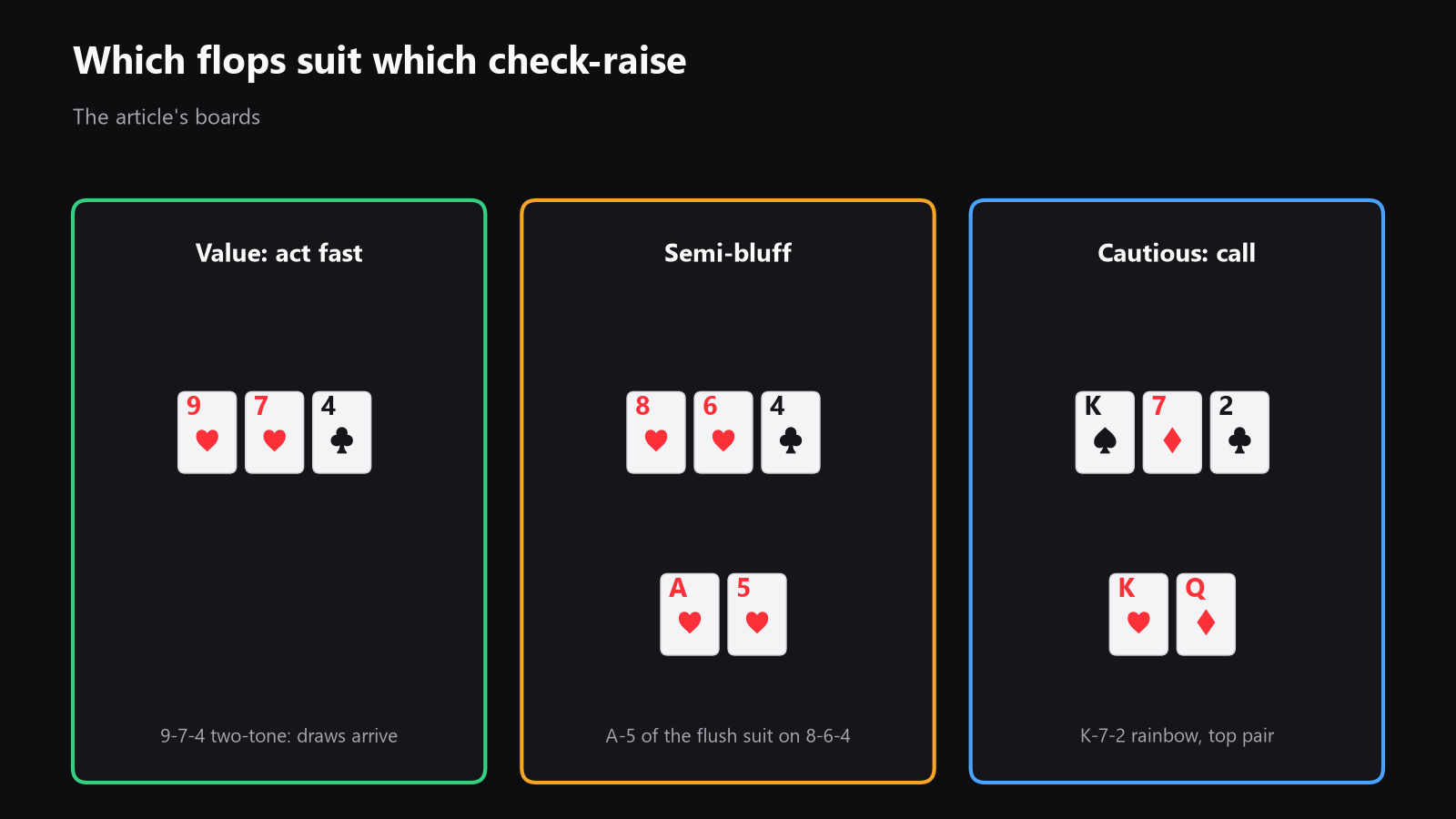
On a board like 9-7-4 with two suits, your strong hands often want action fast. If you wait too long, the turn can complete obvious draws or reduce action.
When value check-raises should stay smaller or disappear
On dry, static boards, many strong but non-nut hands do better by calling.
Think of a board like K-7-2 rainbow. If you have a hand like top pair with a strong kicker, you may not need to blow the pot up unless your opponent is betting too wide or too thin. Many worse hands can continue, but many better hands are already there too.
So do not turn every strong one-pair hand into a raise. Ask:
- what worse hands call?
- what better hands continue?
- what happens on the turn?
If the answer is "not much changes, and I only get action from better hands," calling is often better than raising.
3. When to check-raise as a bluff
The best flop bluffs are usually semi-bluffs.
That means hands like:
- nut flush draws,
- combo draws,
- open-ended straight draws,
- gutshots with strong backdoors,
- pair plus draw,
- high-card hands with blockers and backdoor equity.
These hands are strong because they can win in two ways:
- your opponent folds now,
- or you get called and still have equity.
What makes a good bluff check-raise
A good bluff check-raise usually has some combination of these traits:
- it blocks strong continuing hands,
- it has real equity when called,
- it can improve on many turns,
- it fits the story your line tells.
That last point matters. Your bluff should make sense for the board and the action.
If the board is 8-6-4 two-tone and you check-raise with A-5 of the flush suit, that hand can work well because you have a strong draw and a natural reason to apply pressure. If you check-raise with complete air on the same board, your line becomes much harder to defend.
Pure bluffs
Pure bluffs exist, but they should be rare.
They work best when:
- the board heavily favors your perceived range,
- your opponent overfolds,
- your hand blocks the strongest continues,
- your hand has very little showdown value.
A pure bluff with no blockers and no equity is usually just a donation.
A practical rule
If you are asking yourself, "Do I have enough hand here to continue against a re-raise?", that is often the wrong bluff candidate.
A better question is, "If I get called, do I still have ways to win?"
If the answer is yes, the bluff starts to look much healthier.
4. Which boards are best for bluff check-raises
Not all flops are equal.
Good bluffing boards
Bluff check-raises work better on boards that:
- connect strongly with your defending range,
- have many turns that change the equity,
- let you represent strong hands credibly,
- give you strong draws or blocker-based pressure.
Examples of board types, as ideas rather than fixed rules:
- T-9-8,
- J-T-7,
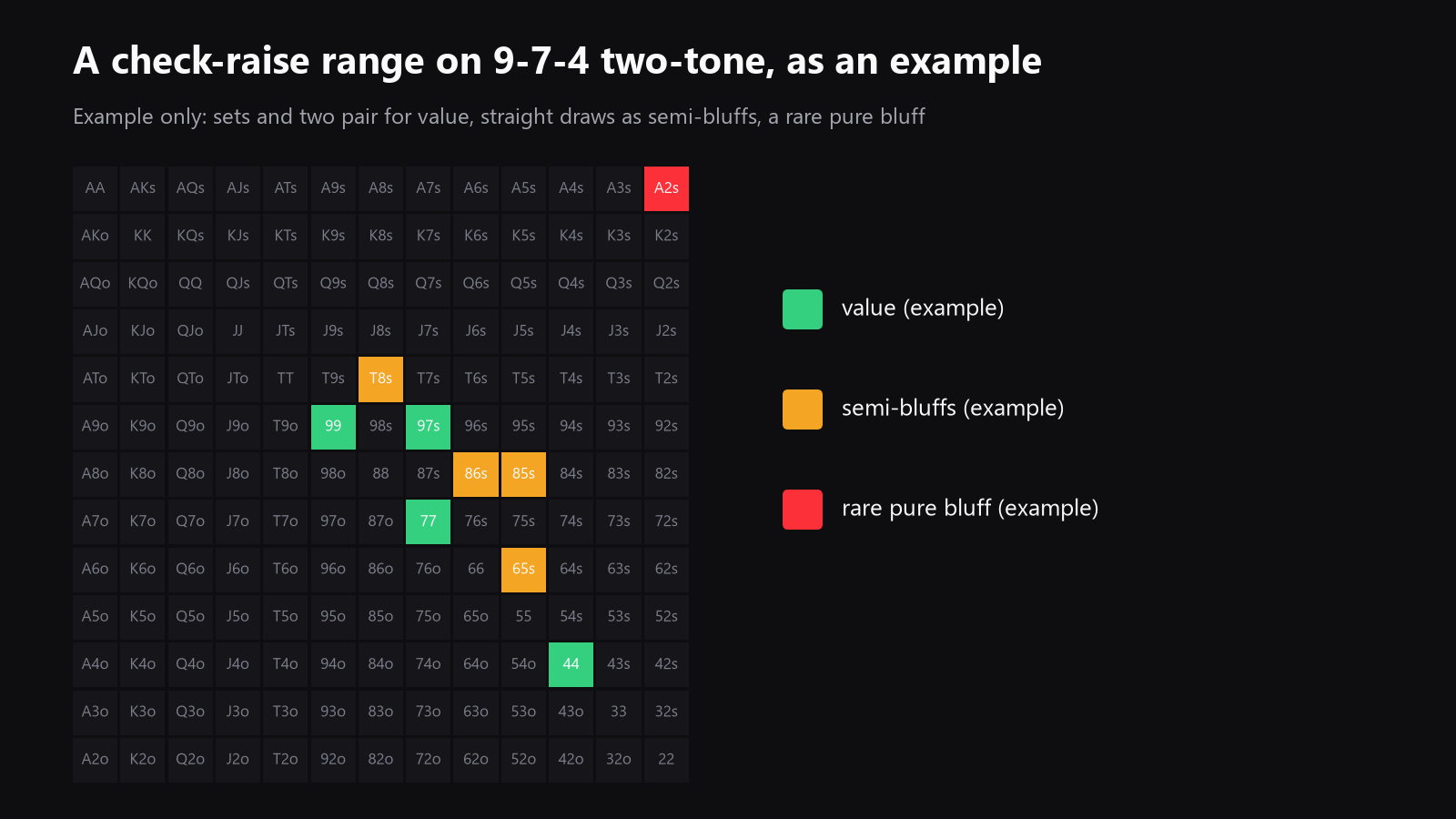
- 9-7-4 two-tone,
- 8-6-4,
- other dynamic flops with straight and flush pressure.
These boards are good for semi-bluffs because the turn and river still matter a lot. If you get called, your hand can often improve or keep forcing difficult decisions.
Bad bluffing boards
Bluff check-raises get worse on boards that are:
- very dry,
- very static,
- easy for the opener to continue with many one-pair hands,
- hard for your range to represent strongly without stretching.
Think of boards like A-K-2 rainbow or K-7-2 rainbow. You can still have bluffs, but your candidates need more care. You want blockers, backdoors, and a believable line.
Multiway pots
In multiway pots, tighten up.
That is true for both value and bluffs. The more players see the flop, the more likely someone has a hand that can continue. So your bluff check-raises should become more selective, and your value check-raises should lean stronger.
5. How big should you check-raise?
Size is not decoration. It changes the decision.
A bigger check-raise:
- puts more pressure on weak continues,
- charges draws more heavily,
- builds the pot for strong value hands,
- makes future streets easier to play when you have the range advantage.
A smaller check-raise:
- keeps worse hands in,
- can get more calls from weaker made hands,
- is often better when you want action, not fold equity,
- works well on dry boards where you do not need to overprotect.
A useful starting point is to think in relation to the bet size you face.
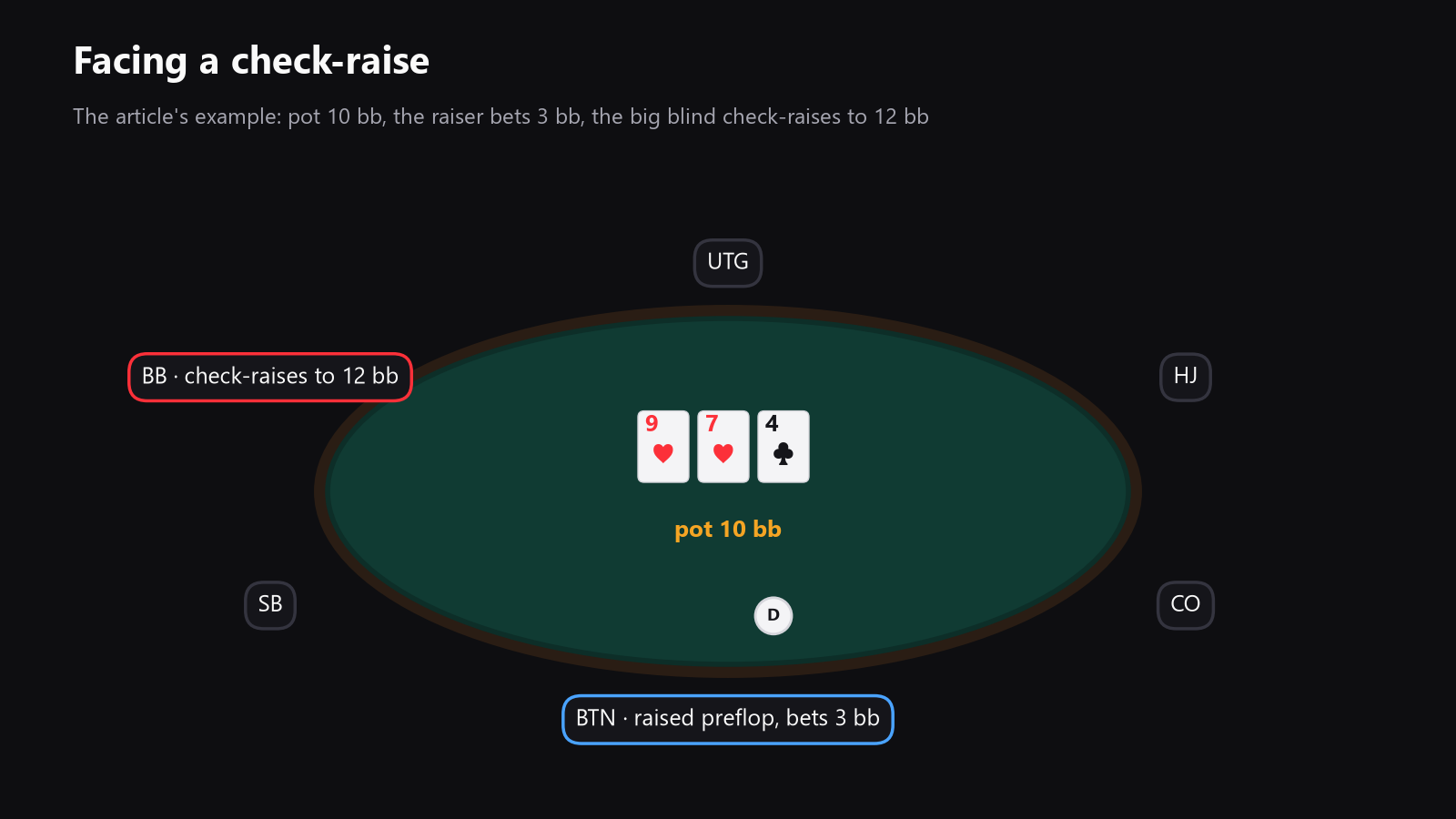
For example, if your opponent bets 3 bb into a 10 bb pot, and you raise to 12 bb total, you are making a raise that is large enough to put pressure on continuing ranges without going all-in. That is just a sizing example, not a universal rule.
The key is this: your size should fit your goal.
- If you want calls from worse, do not make the price absurd.
- If you want folds from hands with equity, size bigger.
- If you want to deny realization on a wet board, size with that in mind.
6. How to react when you get check-raised
This is where a lot of players give away money.
When someone check-raises you, do not react emotionally. Work through it.
Step 1: Count the price
Suppose the pot is 10 bb. You bet 3 bb. Villain check-raises to 12 bb total. You now have to call 9 bb more.
If you call, the final pot will be 34 bb.
That means you need about 26.5 percent raw equity to break even on the call, before future streets and reverse implied odds. This is just pot arithmetic. It is not yet the full decision.
Step 2: Ask what range is raising
What value hands does this player have?
What semi-bluffs does this player have?
What pure bluffs does this player have?
If the player is aggressive and creative, their range is wider. If they are cautious and underbluffing, you should respect the raise more.
Step 3: Look at your own hand honestly
Ask yourself:
- do I beat the bluffs?
- do I dominate part of the value range?
- do I have redraws?
- do I block value or block folds?
- do I play well on turns and rivers?
Hands that look decent at first glance can become bad continues if they do not realize equity well.
Step 4: Choose between fold, call, and 3-bet
Fold
Fold weak bluff-catchers, especially when:
- you have poor equity,
- you block the bluffs, not the value,
- the board is coordinated and ugly for one-pair hands,
- the player pool tends to underbluff this line.
Call
Call when:
- you have enough equity,
- your hand can improve cleanly,
- you have position and can realize well,
- your hand is too strong to fold but not strong enough to jam.
3-bet
3-bet when:
- you have a nutted hand,
- you have a very strong draw,
- you want to charge a lot of equity immediately,
- you expect worse hands and draws to continue.
A lot of players 3-bet too thin after getting check-raised. That can be a leak. If you only get action from better hands and folds from worse, your 3-bet may be too ambitious.
7. The simplest practical framework
If you want one clean way to think about flop check-raises, use this:
- On wet, dynamic boards: value raises and semi-bluffs go up.
- On dry, static boards: value raises get thinner, bluff raises get rarer.
- With strong equity and blockers: bluff check-raises become better.
- Without equity, blockers, or a credible story: do not force it.
- Facing a check-raise: continue with hands that realize equity and withstand pressure, fold the weak stuff, and do not overdefend out of pride.
8. What to study if you want this spot to stop being guesswork
The easiest way to improve at check-raises is to study your own hands, not just theory in the abstract.
The Self Analyser module can show you whether you are overdoing it, underdoing it, or leaking money in specific flop spots. Then the Solver module lets you study the exact spot away from the table, so you can compare ideas instead of guessing.
That is the right way to build a check-raise game:
- first learn the board types,
- then learn the hand classes,
- then study your own database,
- then test the spot away from the table.

9. Final checklist
Before you check-raise, ask yourself:
- Is this value, or am I trying to make a bluff work without enough equity?
- Does the board favor my range enough?
- Does my hand have redraws or blockers?
- Is my sizing doing the job I want?
- Am I trying to win the pot now, or build a pot for later?
Before you continue versus a check-raise, ask yourself:
- What range is my opponent representing?
- How much do I need to continue?
- Does my hand realize equity well enough?
- Am I calling because it is correct, or because I do not want to fold?
If you answer those questions honestly, your flop check-raise game will become much sharper.
And if you want to study the exact spots that keep coming back in your own hands, that is a very good place to start.
Do it on your own hands.