
If you search for a good win rate in poker, you will usually find a number. That is the wrong place to start.
A win rate only makes sense if you know three things:
- what it is measured in,
- how much rake you pay,
- how big the margin is on the sample.
Without those three, “good” is just a word.
bb/100: the number players actually mean
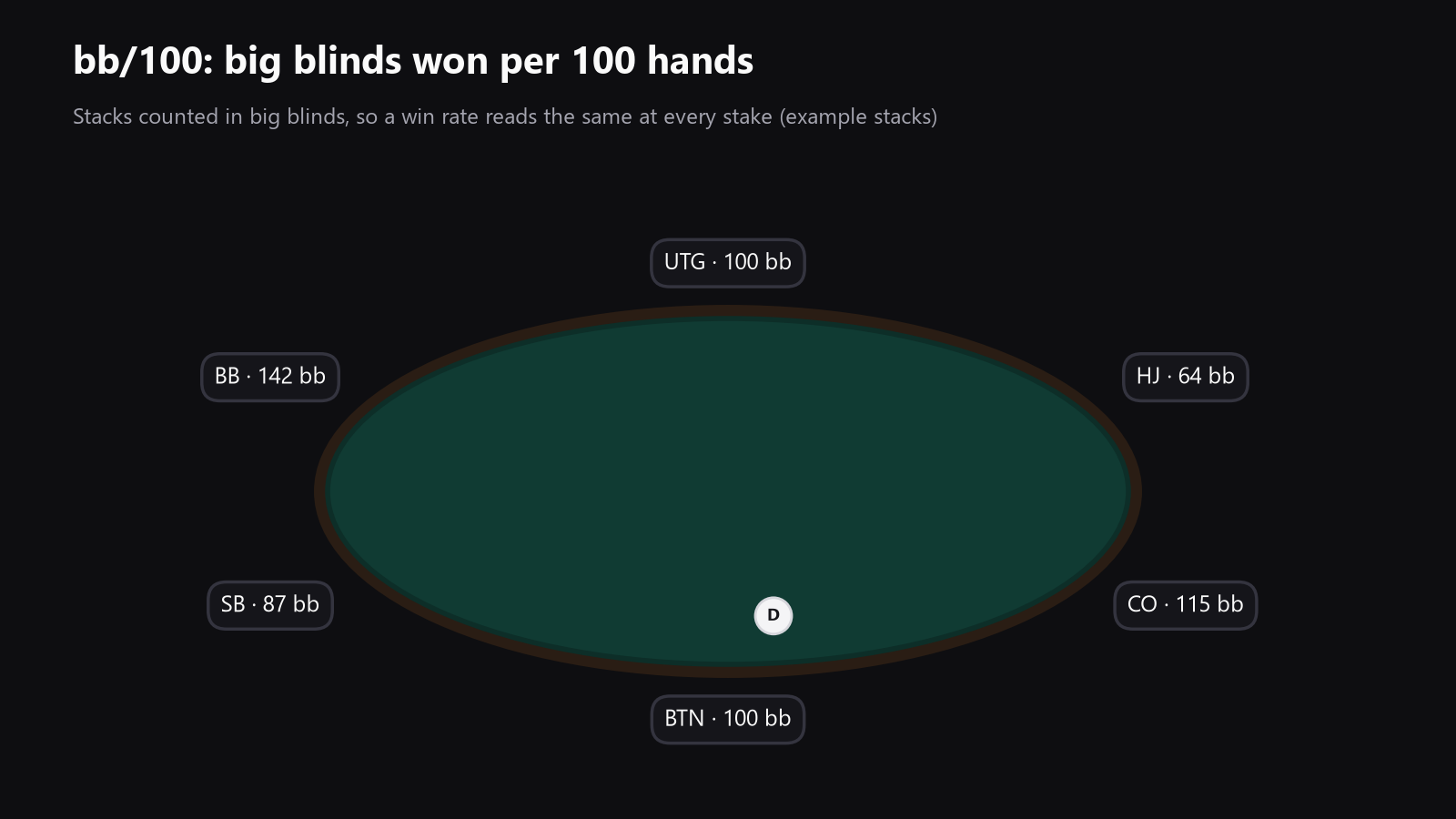
In online cash games, win rate is usually written in bb/100, which means big blinds won per 100 hands.
That makes it easy to compare results across stakes. A player who wins 5 bb/100 at NL10 and a player who wins 5 bb/100 at NL200 are both winning at the same pace relative to the blinds. The money is different, but the rate is comparable.
A simple example:
- you win 500 big blinds over 10,000 hands,
- that is 5 bb/100.
So when players ask, “What is a good win rate?”, they usually mean, “What is a good bb/100 win rate after enough hands that the number is not nonsense?”
Why “good” is not one universal number
A win rate that looks good in one game can be ordinary in another.
It moves with:
- stakes
- format
- rake
- table selection
- player pool softness
That is why players quote ranges, not a single magic line.
For example, in soft microstakes pools, people often call 5 to 10 bb/100 good (about 125,000 hands for 5 bb/100 and about 31,000 hands for 10 bb/100). In tougher small-stakes pools, 2 to 5 bb/100 can already be strong (about 778,000 hands for 2 bb/100 and about 125,000 hands for 5 bb/100). In reg-heavy games, even 1 to 3 bb/100 may be very solid (about 3,100,000 hands for 1 bb/100 and about 346,000 hands for 3 bb/100).
But those are only labels. They are not proof.
A 5 bb/100 player is not automatically beating the game if the sample is tiny. A 2 bb/100 player may be excellent if the games are tough, but the margin still has to be checked.
The part many players miss: rake
There are two win rates you should keep separate:
- gross win rate, before rake
- net win rate, after rake
The rake is not a footnote. It is part of your result.
If you beat the table by 6 bb/100 and pay 2 bb/100 in rake, you keep 4 bb/100.
If you beat the table by 3 bb/100 and pay 4 bb/100 in rake, you are a loser after fees.
That is why a win rate that looks good in theory can look much worse in practice once the room takes its cut. At microstakes especially, rake can eat a big part of your edge.
A practical way to think about it:
- pre-rake, your poker skill creates the edge,
- post-rake, the room decides how much of that edge you keep.
So when you ask what a good win rate is, you should really ask:
How much do I win before rake, how much rake do I pay, and what is left after?
The only win rate that matters is the one with a margin
A win rate without a margin is a guess.
Poker is noisy. Even a strong winner can look ordinary, or even losing, over a short sample. That is why a win rate should always be read with its confidence interval, not alone.
A simple 95% margin rule of thumb is:
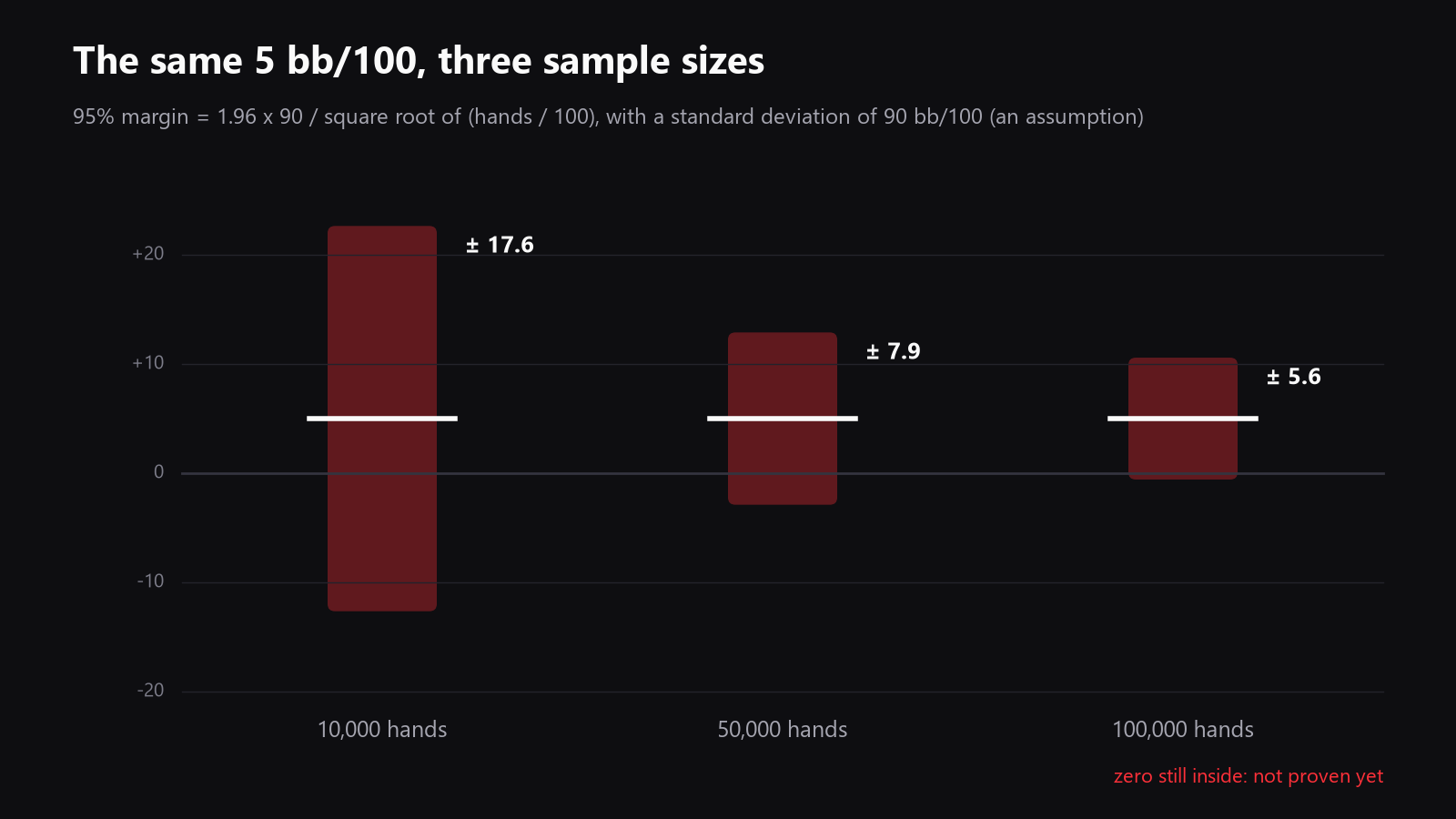
95% margin ≈ 1.96 × standard deviation / square root of (hands / 100)
For a typical 90 bb/100 standard deviation in 6-max No-Limit Hold’em, that gives roughly:
- ±17.6 bb/100 after 10,000 hands
- ±7.9 bb/100 after 50,000 hands
- ±5.6 bb/100 after 100,000 hands
That is the key lesson.
A line like 3 bb/100 over 100,000 hands is not yet proof that you are truly a 3 bb/100 winner, because the margin is still about ±5.6 bb/100.
So your true win rate could still be below zero.
How many hands do you need before a win rate means anything?
If you want to know whether a win rate is different from zero with 95% confidence, the sample has to be large.
Using the same 90 bb/100 standard deviation assumption, it takes about:
| Measured win rate | Hands needed to separate it from zero |
|---|---|
| 2 bb/100 | about 778,000 hands |
| 3 bb/100 | about 346,000 hands |
| 5 bb/100 | about 125,000 hands |
| 10 bb/100 | about 31,000 hands |
That table is why small samples deceive so many players.
A run of 10,000 hands can tell you almost nothing about whether you are a winner or a loser. Even 50,000 hands is often not enough if the edge is modest.
The smaller the edge, the bigger the sample you need.
What “good” usually means in practice
If you want a practical answer, this is the honest one:
- 5 to 10 bb/100 (about 125,000 hands for 5 bb/100 and about 31,000 hands for 10 bb/100) is usually seen as very good in soft games, but you still need a meaningful sample before you trust it.
- 2 to 5 bb/100 (about 778,000 hands for 2 bb/100 and about 125,000 hands for 5 bb/100) can already be strong in tougher pools.
- 1 to 3 bb/100 (about 3,100,000 hands for 1 bb/100 and about 346,000 hands for 3 bb/100) may be excellent in hard games, especially once rake is heavy.
- 0 to 1 bb/100 is not necessarily bad if the games are tough and the rake is high, but it is not a cushion you can rely on.
So “good” depends on the game you are in.
A 4 bb/100 winner in a soft, low-rake environment may be decent. A 4 bb/100 winner in a rake-heavy pool may be excellent. A 4 bb/100 gross winner who gives back 3 bb/100 to the room is left with very little.
How to read your own win rate
When you look at your own results, read them in this order:
1. Check the sample size
If the sample is small, do not overreact.
A 6 bb/100 line over 8,000 hands is not a discovery. It is a hint.
2. Look at the margin, not only the number
If your win rate is 4 bb/100 ± 7 bb/100, the result is still too wide to settle much.
If your win rate is 4 bb/100 ± 2 bb/100, now you are learning something useful.
3. Separate gross from net
If you only look at win rate and ignore rake, you can fool yourself.
The room’s fee can turn a decent player into a breakeven player.
4. Break the result down by context
Your overall number may hide the truth.
Look at:
- stake,
- room,
- table size,
- position,
- hour,
- and, if relevant, format.
A single global win rate can blur important leaks and good spots.
5. Watch the curve, not just the final line
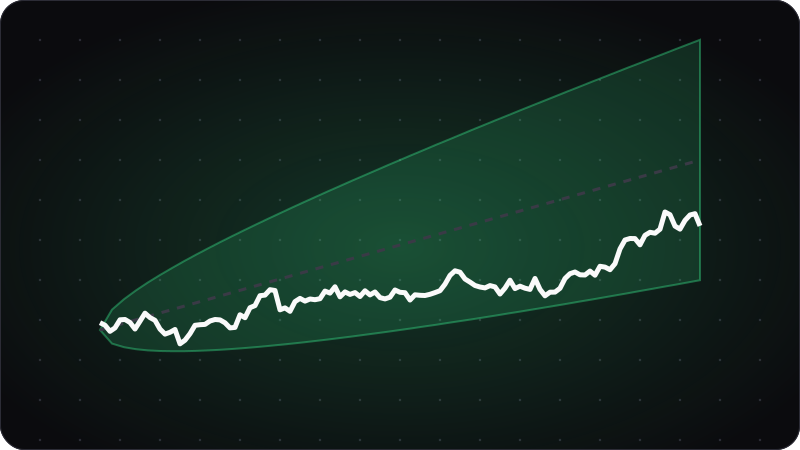
A profit graph inside a wide variance band tells a much truer story than a raw end number.
If the line is still inside the cone, the sample probably does not settle much yet.
That is one reason players benefit from tools that show both the result and the margin, instead of a bare number with no context.

A simple rule of thumb
A good win rate in online cash games is not just a positive number.
It is a rate that is:
- positive after rake,
- large enough that the margin does not swallow it,
- and measured over enough hands to be believable.
That is the difference between a number that flatters you and a number that teaches you.
The short answer
If you want the shortest honest answer to “What is a good win rate in poker?” it is this:
- Good depends on the game,
- bb/100 is the right unit,
- rake can cut your edge sharply,
- and sample size decides whether the number means anything yet.
If you want to sanity-check your own results, the free variance band on Poker Exploit, https://poker-exploit.com/en#variance, lets you type a win rate and a hand count, then shows where a player who wins nothing would land after the same sample. It is a quick way to see whether your line is actually telling you something, or just floating inside noise.
Do it on your own hands.