
If you are learning how to use a poker HUD, VPIP and PFR are the two numbers you should understand first.
They are not flashy. They do not solve a hand for you. But they tell you a lot about how loose or tight a player is, and how often that player enters pots with raises rather than calls. Read together, they give you a fast preflop picture of the table, and that picture helps you make better decisions before the flop.
If you know how to read VPIP and PFR properly, you can quickly answer questions like:
- Is this player a tight regular or a loose recreational player?
- Does this opponent like to limp and call, or raise first in?
- Is this a player you can pressure preflop?
- Who is likely to overfold, overcall, or 3-bet too much?
This article explains what VPIP and PFR mean, how to interpret them together, and what they tell you about the players in your game.

What VPIP means
VPIP stands for Voluntarily Put Money In Pot.
In plain English, it tells you how often a player puts money into the pot preflop by choice, not because they are in the blinds.
So if someone calls a raise, limps, or raises, that counts as VPIP. If they fold, it does not.
What VPIP tells you
VPIP is a measure of how loose or tight a player is preflop.
- Low VPIP means the player enters few pots.
- High VPIP means the player enters many pots.
A player with a VPIP of 10% is usually much tighter than a player with a VPIP of 35%.
What VPIP does not tell you
VPIP alone does not tell you how the player enters pots.
A player can have:
- a high VPIP because they limp and call a lot
- a high VPIP because they open-raise aggressively
- a low VPIP because they are disciplined, or because they are card dead in a small sample
That is why VPIP must be read together with PFR.
What PFR means
PFR stands for Preflop Raise.
It tells you how often a player raises preflop, whether by opening the pot, 3-betting, or 4-betting, depending on how the HUD defines the stat.
Most often, when people talk about PFR in a HUD, they mean how often the player raises before the flop instead of limping or calling.
What PFR tells you
PFR is a measure of how aggressive a player is preflop.
- Low PFR means the player rarely raises.
- High PFR means the player raises often.
A player with PFR 3% is almost never taking the aggressive line preflop. A player with PFR 22% is raising a lot more frequently.
What PFR does not tell you
PFR alone does not tell you whether the player is:
- opening from early position
- 3-betting light
- squeezing often
- just playing a narrow but aggressive range
Again, you need VPIP next to it.
Why you should read VPIP and PFR together
VPIP and PFR are most useful when you compare them.
The gap between them tells you something important:
- Small gap = the player raises a lot of the hands they play
- Large gap = the player plays many hands passively, by limping or calling
That gap is one of the fastest ways to classify opponents.
Example: same VPIP, different style
Two players can both have VPIP 28%.
- Player A has PFR 24%
- Player B has PFR 6%
These are completely different opponents.
Player A is entering pots mostly with raises. That usually suggests an aggressive, more structured range.
Player B is entering pots mostly by calling or limping. That usually suggests a loose-passive profile, or at least a player who is not using raises much preflop.
So if you only looked at VPIP, you would miss the difference. PFR completes the picture.
The most common VPIP and PFR profiles
Here is the fastest way to read the two stats together.
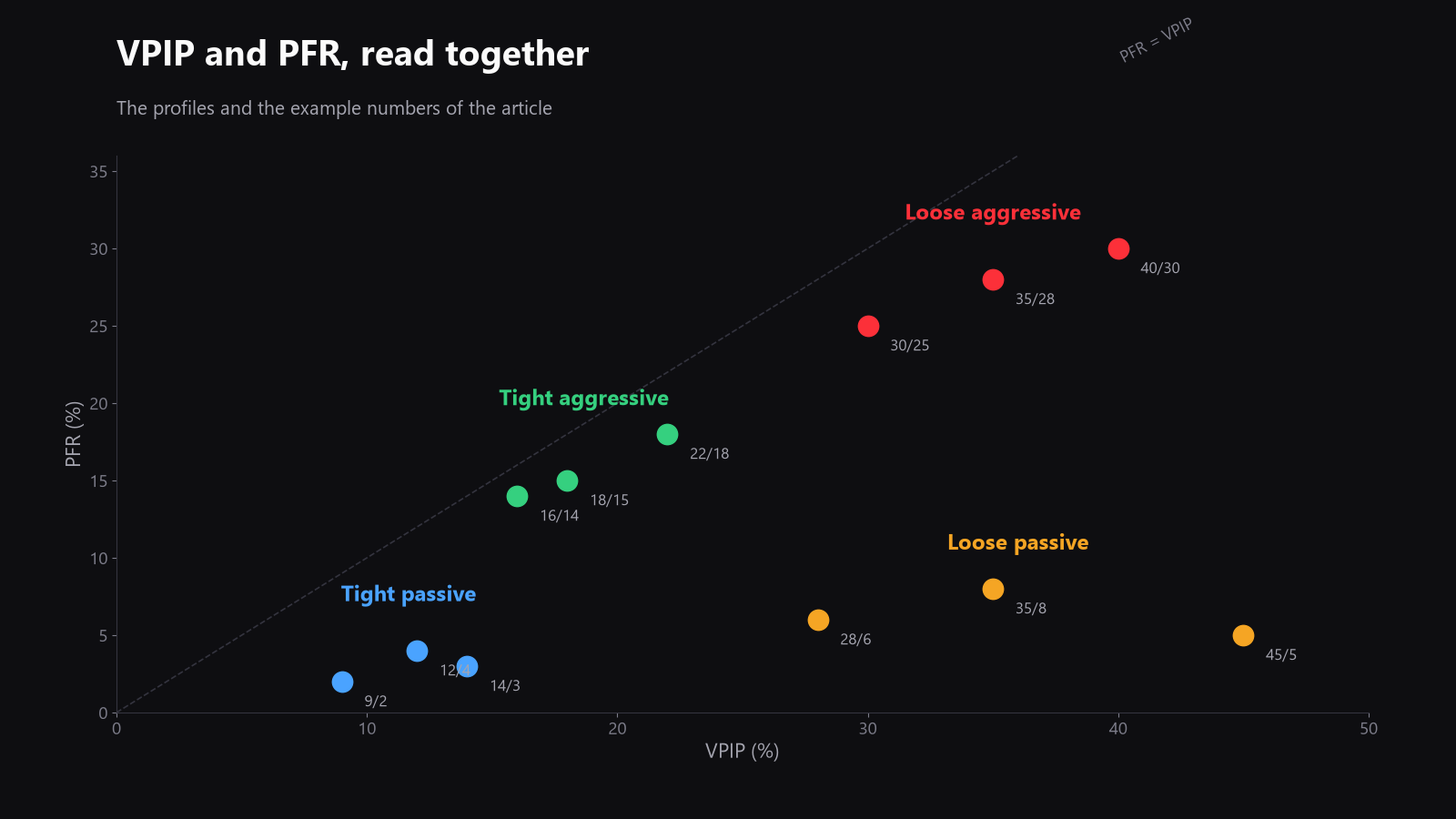
1. Tight aggressive: 18/15, 22/18, 16/14
This player enters a moderate number of pots and raises most of the hands they play.
Typical traits:
- folds a lot preflop
- opens fairly often
- often understands position
- usually not a big calling station
How you often play against them:
- respect their stronger ranges
- bluff selectively
- look for spots where their ranges are capped or positionally weak
2. Loose aggressive: 30/25, 35/28, 40/30
This player plays many hands and raises a lot of them.
Typical traits:
- wider opening ranges
- more pressure preflop
- more 3-bets and squeezes
- can be strong, but also can overreach
How you often play against them:
- defend intelligently
- do not overfold too much
- trap more when they overbluff
- value bet thinner when they call too wide
3. Loose passive: 35/8, 45/5, 28/6
This player enters many pots, but rarely raises.
Typical traits:
- lots of limping and calling
- weaker preflop discipline
- often recreational
- can call too much postflop
How you often play against them:
- value bet more
- punish limps with raises
- do not bluff too much when they call flop and turn
- pay attention to stack depth, because loose-passive players often create multiway pots
4. Tight passive: 12/4, 14/3, 9/2
This player plays few hands and raises very little.
Typical traits:
- extremely cautious
- often underplays strong hands
- can be easy to read preflop
- may overfold
How you often play against them:
- steal more when they show weakness
- respect their raises
- be careful bluffing when they continue strongly
5. Unknown or distorted profile
Sometimes VPIP and PFR are not enough to classify a player yet.
This happens when:
- the sample size is small
- the player has changed tables or seats
- the player is short-stacked
- the player is in a very specific tournament phase
- the player is forced into unusual spots
A player might show 28/20 over 40 hands, but that does not mean the profile is fully reliable yet.
How to interpret the gap between VPIP and PFR
A very useful shortcut:
- VPIP close to PFR = more aggressive, fewer passive calls
- VPIP much higher than PFR = more passive, more limps and calls
Useful examples
24/22
This player plays 24% of hands and raises almost all of them.
That usually means:
- mostly aggressive preflop action
- fewer weak flats
- a fairly assertive player
24/12
This player plays the same number of hands, but raises only half of them.
That means:
- a mix of raises and passive calls
- likely more limps or flat calls
- less aggressive than the first player
38/6
This player plays a lot of hands, but almost never raises.
That is often a classic loose-passive profile.
11/10
This is a tight player who raises almost every hand they play. Small gap, clear aggressive style.
What VPIP and PFR can tell you at the table
When you look at a player’s VPIP and PFR in your HUD, you are not trying to label them for fun. You are trying to make better decisions.
1. Should you isolate this player?
If a player has a high VPIP and a low PFR, they are often a good target for isolation raises.
Why?
- they enter lots of pots
- they do not fight back aggressively enough
- they often continue with weaker ranges
This is especially useful when they are in late position and limp too much.
2. Should you respect this player’s open?
If a player has a low VPIP and a relatively high PFR, they are usually playing a tighter, more serious range.
That does not mean they always have it. But it does mean you should be more careful with marginal calls and light 3-bets, especially out of position.
3. Can you steal their blinds more often?
A player with very low VPIP and low PFR may defend their blinds less often, especially if other stats support it.
That can create profitable steal spots.
4. Is this opponent likely to call too much?
A high VPIP with a low PFR often means the player likes to see flops and continue with a wide range.
That usually means:
- more value betting
- fewer fancy bluffs
- more discipline with marginal hands
VPIP and PFR in cash games vs tournaments
The stats mean the same thing in both formats, but the interpretation changes with context.
In cash games
VPIP and PFR are often very informative because stack depth is usually stable enough to see patterns.
You are mainly looking for:
- open frequencies
- calling tendencies
- aggressive preflop tendencies
- who is loose-passive or tight-aggressive
In tournaments
Stack depth changes constantly, so the same numbers can mean something different depending on blinds, antes, and stack sizes.
For example:
- a player with 20 big blinds may have a lower VPIP than usual because they are constrained
- a short stack may raise or shove more often, which changes PFR behavior
- late tournament pressure can distort the numbers
So in tournaments, use VPIP and PFR with even more context:
- stack size
- stage of the event
- position
- antes
- ICM pressure
What sample size do you need?
This matters a lot.
A VPIP or PFR number from:
- 20 hands is barely a hint
- 100 hands is more useful, but still noisy
- 500 hands starts to be meaningful
- 1,000+ hands is much more dependable
That said, even small samples can still help if you use them carefully.
Good rule
Treat early stats as clues, not truths.
If a player is 0/0 over 15 hands, that means nothing. If they are 45/5 over 300 hands, that means a lot more.
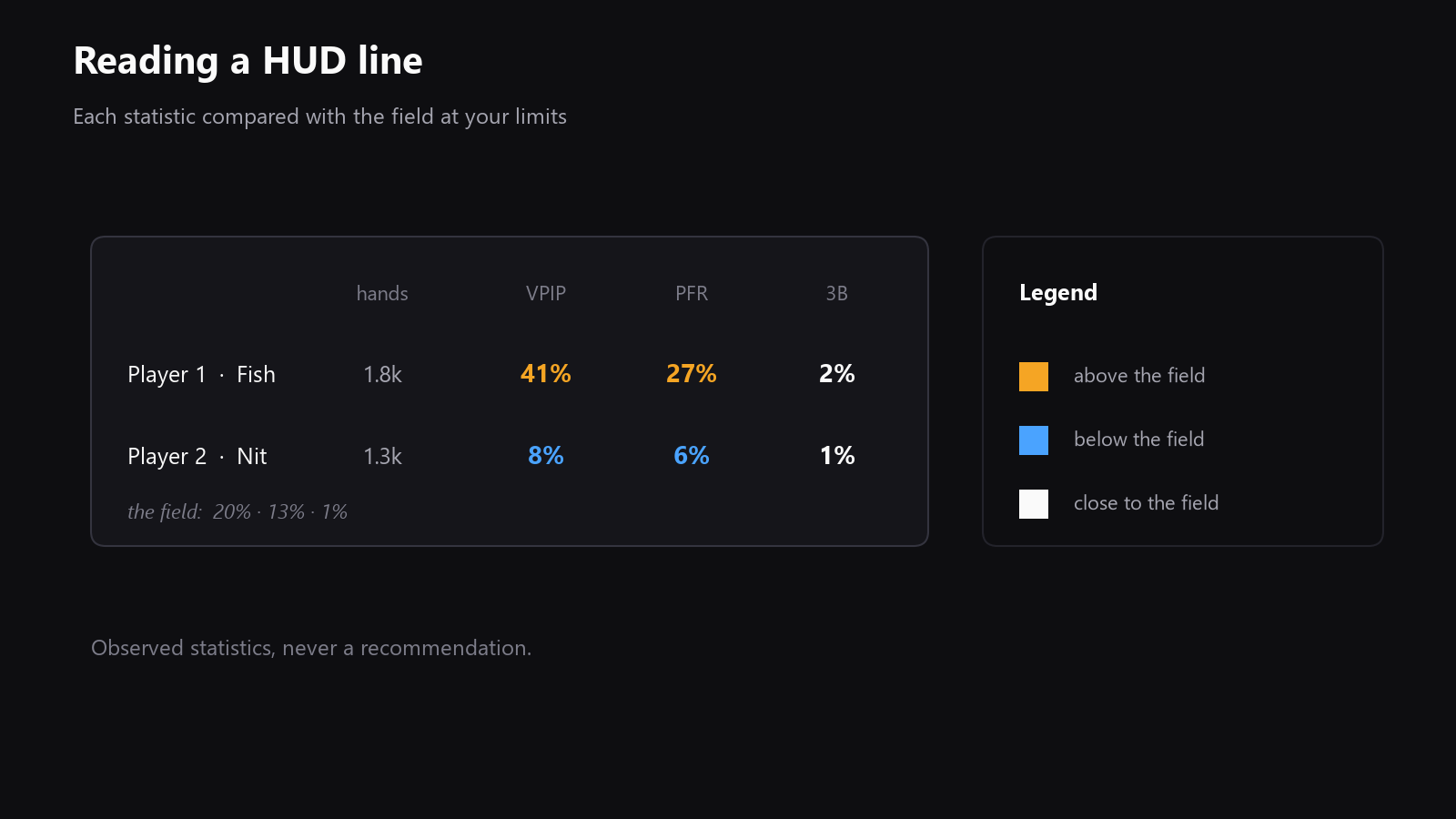
Your HUD module should help you stay honest about this by showing observed statistics, not pretending that a tiny sample is a full profile.
What VPIP and PFR do not show you
These two stats are useful, but they are not the whole story.
They do not tell you:
- how the player reacts postflop
- how often they c-bet
- how often they fold to aggression
- whether they 3-bet light
- whether they bluff rivers
- whether their line is strong in a specific spot
So do not overread them.
A player with 28/20 can still be a huge winner or a huge loser depending on how they play after the flop.
That is why VPIP and PFR are only the start of your HUD reading, not the end.
A practical way to use VPIP and PFR during a hand
Before you act, ask yourself three questions:
1. How many hands does this player enter?
That is VPIP.
Low VPIP usually means more folding and more strength when they continue.
High VPIP usually means wider ranges and more weak holdings in their range.
2. How often do they raise the hands they play?
That is PFR.
If PFR is close to VPIP, they are more aggressive preflop.
If PFR is much lower than VPIP, they are often passive.
3. What does the gap say?
The gap tells you whether the player prefers:
- raising
- calling
- limping
- some mix of all three
That gap is often what makes the difference between a loose aggressive player and a loose passive one.
A quick cheat sheet
Use this as a fast reference.
VPIP high, PFR high
- loose aggressive
- plays many hands
- raises often
- can be wide and aggressive
VPIP high, PFR low
- loose passive
- plays many hands
- calls and limps a lot
- often a good target for value betting
VPIP low, PFR high
- tight aggressive
- selective, but active
- usually stronger ranges
- often solid preflop discipline
VPIP low, PFR low
- tight passive
- very selective and cautious
- can overfold
- may be easy to pressure
Common mistakes when reading VPIP and PFR
Mistake 1: Looking at VPIP alone
A player can have the same VPIP as another player and still be completely different if PFR is different.
Mistake 2: Ignoring position
A 20 VPIP button player and a 20 VPIP under-the-gun player are not the same type of opponent.
Mistake 3: Ignoring sample size
A stat from 30 hands is not enough to build a strategy around.
Mistake 4: Thinking every high VPIP player is a fish
Some good players have high VPIP and high PFR. High volume does not automatically mean weak.
Mistake 5: Thinking a low PFR always means weakness
Some players trap, some play very selectively, and some simply have a narrow range.
Why these are usually the first two HUD stats
VPIP and PFR are the first stats most players learn because they answer the most basic preflop questions:
- Does this player play many hands?
- Do they raise those hands or call with them?
- Are they passive or aggressive?
Before you learn more advanced stats, you need to be able to read this first layer quickly.
That is why every serious HUD begins here.
And if you want to see these numbers on your own hands, in a HUD that sits next to your tables and updates from your hand histories, Poker Exploit’s HUD module is built for that kind of reading.
FAQ: VPIP and PFR
What is a good VPIP in poker?
There is no single “good” VPIP. It depends on format, stakes, position, stack depth, and style. What matters is whether the number fits the player type and the situation.
What is a good PFR in poker?
Again, there is no universal good number. A strong player usually has a PFR that makes sense relative to their VPIP and their overall strategy.
Is VPIP the same as playing too many hands?
Not necessarily. A high VPIP means the player enters many pots, but that can be good or bad depending on how they do it and what happens postflop.
Can you bluff more against low VPIP players?
Sometimes, but be careful. Low VPIP players often continue with stronger ranges, especially when they show aggression.
Can you value bet more against high VPIP, low PFR players?
Often yes. These players tend to call more and raise less, which usually makes value betting more profitable.
The short version
If you remember only one thing, remember this:
- VPIP tells you how often a player puts money in the pot voluntarily.
- PFR tells you how often they raise preflop.
- Together, they tell you whether a player is tight or loose, passive or aggressive.
That is why they are the foundation of every poker HUD.
Once you can read them fast, you will start seeing the table more clearly: who is entering too many pots, who is raising too much, who is calling too much, and who is giving you room to attack.
And if you want those reads on your own tables, from your own hands, the HUD module in Poker Exploit is built to show them where you can use them.
Do it on your own hands.