
If you search for what is GTO in poker, the short answer is this: GTO, or game theory optimal, is a strategy that cannot be exploited in a heads-up spot by a perfect opponent. It is the poker version of a balanced, self-protecting plan.
That does not mean it is always the most profitable line against real players. In fact, one of the biggest misunderstandings about GTO poker is thinking that "unexploitable" means "best against everyone". It does not. It means something narrower, and more important to understand if you want to study poker seriously.
GTO poker, in plain English
In poker, a strategy is GTO when it forms an equilibrium, usually a Nash equilibrium. At that point, neither player can improve their result by changing strategy alone, assuming the other player stays perfect too.
That sounds abstract, so here is the practical version:
- If you bluff too much, your opponent can call more and punish you.
- If you bluff too little, your opponent can fold more and make your value bets weaker.
- If you bet only your strongest hands, your opponent can fold cheaply against you.
- If you call too much, your opponent can value bet wider and print money.
GTO tries to balance these pressures so that each part of your range protects the others. A well built strategy makes your opponent indifferent with some of their marginal hands. That is the heart of it.
A simple example of the math
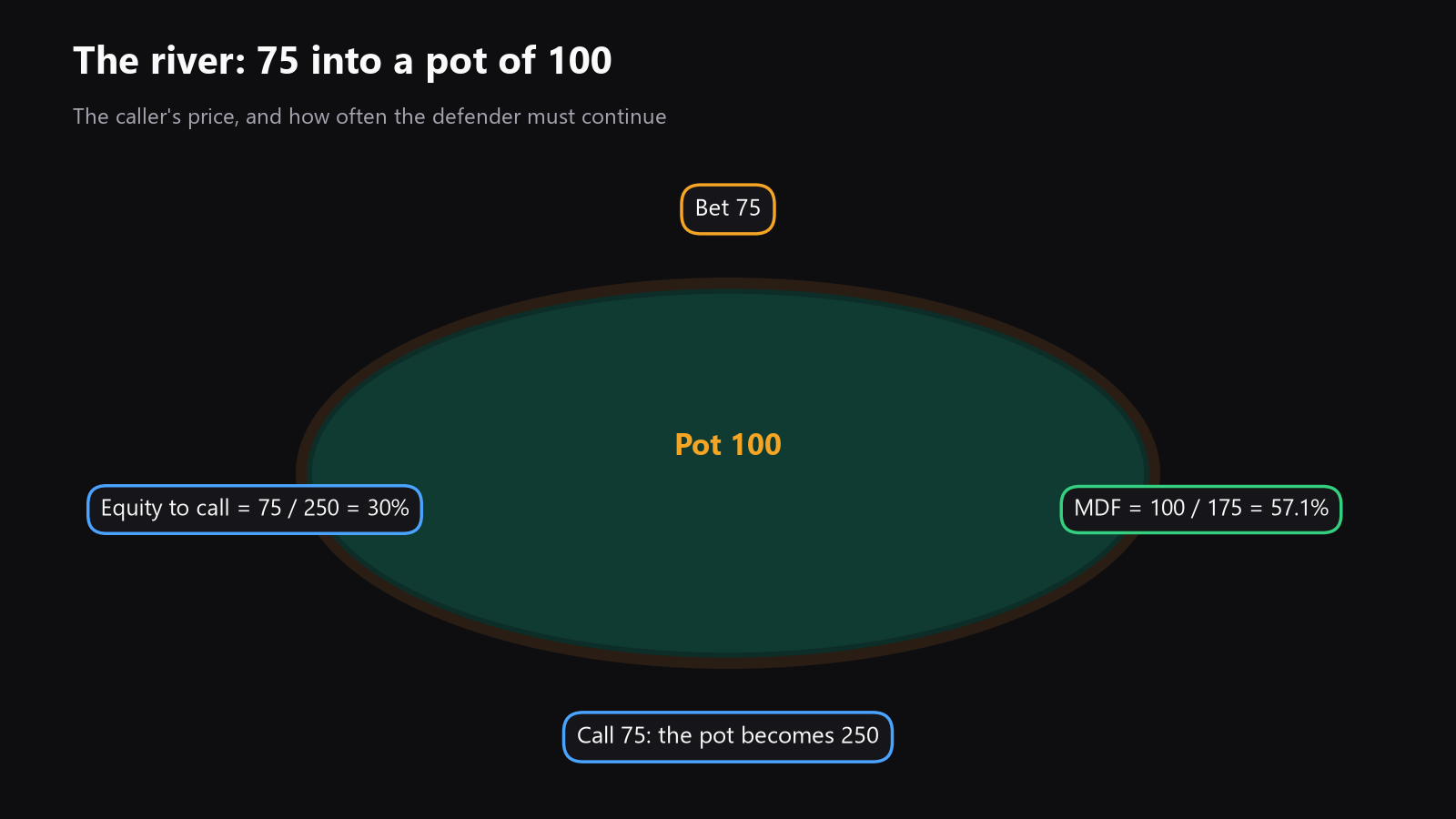
Suppose the pot is $100 and you bet $75.
Your opponent is facing a call of $75 to win a final pot of $250.
Their pot odds are:
- call $75 to win $175
- break even equity needed = 75 / 250 = 30%
So if your opponent has a hand that wins more than 30% of the time against your betting range, calling can make sense. If they win less than that, folding can be better.
The same spot also gives you a useful rule for the defensive side. When someone bets $75 into $100, the minimum defense frequency is:
- MDF = pot / (pot + bet)
- MDF = 100 / 175 = 57.1%
So, in theory, the defender should continue with enough hands to avoid being auto exploited by too many bluffs.
That is what GTO does in practice. It uses arithmetic, range construction, and balance to make easy exploitation impossible.
What GTO guarantees
GTO gives you a very valuable guarantee: no opponent can exploit your strategy in a heads-up spot if you really are playing it correctly.
That matters for three reasons:
- It protects you from unknowns. If you do not know how strong your opponent is, or how they deviate, GTO is a safe default.
- It gives you a reference point. You can compare your real play to an equilibrium baseline and see where you are leaking.
- It makes your decisions coherent. Instead of guessing hand by hand, you learn why certain actions belong in a range.
This is why GTO is such a useful study tool. It is not just about copying frequencies. It is about understanding structure.
What GTO does not guarantee
This is where many players get tripped up.
GTO does not mean:
- the most money against weak players
- the highest win rate in every pool
- the best answer to a clearly flawed opponent
- a shortcut to winning without understanding the game
A strategy can be unexploitable and still leave money on the table if your opponent makes big mistakes.
For example, if a player folds far too often to river bets, an exploitative strategy may bluff more than GTO would suggest. Against that player, the most profitable line is not the balanced line. It is the line that targets the mistake.
That is why GTO is a baseline, not the end goal.
Why GTO is a baseline, not a goal
Think of GTO as the center line on a road.
If you are driving through fog, the center line keeps you safe. It keeps you from drifting into disaster. But if the road is empty and you can clearly see that one side is better, you do not stare at the center line forever. You adjust.
Poker is the same.
Start from equilibrium when:
- you do not know the opponent well
- the pool is mixed
- the spot is complex
- the cost of being wrong is high
Then deviate when:
- you have a strong read
- population tendencies are stable
- the opponent makes a repeatable mistake
That is the real skill. Not worshipping GTO, and not ignoring it. Using it as your default reference, then moving away from it when the evidence is strong enough.
Common misconceptions about GTO poker
1. "GTO means never deviating"
False. GTO is a reference strategy. Real poker skill is knowing when a deviation is justified.
2. "GTO is the same as tight-aggressive"
False again. Tight-aggressive is a style. GTO is a strategic concept. A GTO line can be passive, aggressive, polar, merged, or anything else the spot demands.
3. "If I know GTO, I can ignore population tendencies"
Also false. If the field overfolds, underbluffs, overcalls, or mis-sizes, those mistakes matter. GTO tells you what is safe. Exploitation tells you what is profitable.
4. "A solver gives the one true answer"
Not exactly. Solver output depends on the assumptions you feed it: stack depth, ranges, rake, bet sizes, and whether the spot is heads-up or part of a larger tree. A solver is powerful, but it is still solving a model.
5. "GTO is only for pros"
No. GTO is especially useful for non pros because it gives you a map. If you are still building intuition, a stable baseline is better than random aggression.
Why beginners often misunderstand GTO
A lot of players hear "GTO" and think they need to memorize millions of branches.
That is not how to learn it.
You usually get much more value from asking simpler questions:
- Who has the stronger range?
- Who has more nut hands?
- What hands block value or bluff-catchers?
- What pot odds is the opponent getting?
- What happens if one player overfolds?
Once you understand these building blocks, GTO stops looking like magic. It becomes arithmetic plus range logic.
That is also why studying a solved spot is useful even if you do not memorize the exact output. You learn the why, not just the what.
GTO, exploitative play, and real poker
The best players do not choose between GTO and exploitative play. They use both.
A clean way to think about it is:
- GTO tells you the safe default.
- Exploitative play tells you how to attack mistakes.
- Population reads tell you which deviations are worth making.
- Your own hand history tells you whether you are actually doing the right thing.
That last point matters more than people think. Many players believe they are "balanced" because they know the theory, but their own database says otherwise. They overfold in one spot, overc-bet in another, or miss value in a place where the field pays off too much.
If you want to improve quickly, you need a way to connect theory to your own game. That is where a solver, a tracker, and a leak finder in the same workflow become useful. In Poker Exploit, for example, the Solver module computes the equilibrium for a spot away from the table, while the Plan and Self Analyser modules help you turn study into a concrete next step.
When GTO matters most
GTO matters most when:
- the opponent is strong
- the spot is close
- the ranges are narrow
- the pot is large
- the cost of a mistake is high
- you do not have enough evidence to deviate
It matters less when the pool is clearly doing something wrong and that mistake is easy to attack.
That is why micro and small stakes players should not treat GTO as a religion. At those stakes, you often make more money by fixing the biggest practical leaks first, such as:
- calling too wide preflop
- folding too much versus pressure
- missing value bets
- bluffing in the wrong spots
- ignoring rake
GTO still helps, because it tells you what a solid line looks like. But the money usually comes from the gap between what is theoretically sound and what your pool actually does.
The right way to think about GTO
If you want one sentence to remember, make it this:
GTO is the strategy that protects you from being exploited, not the strategy that always wins the most against mistakes.
That is why it is a baseline. It is the floor, not the ceiling.
Use it to learn structure, protect yourself, and build a reference point. Then use your reads, your database, and your study to move away from it where the money is.

Final takeaway
If you were wondering what GTO means in poker, the answer is not just "play like a computer".
It means:
- balance your ranges
- understand pot odds and defense frequencies
- avoid easy exploitation
- study the why behind the numbers
- deviate when real opponents give you a clear reason to do so
That is the practical value of GTO poker. It keeps your game honest, then gives you a foundation to become more profitable than equilibrium when the table is not playing perfectly.
Do it on your own hands.