
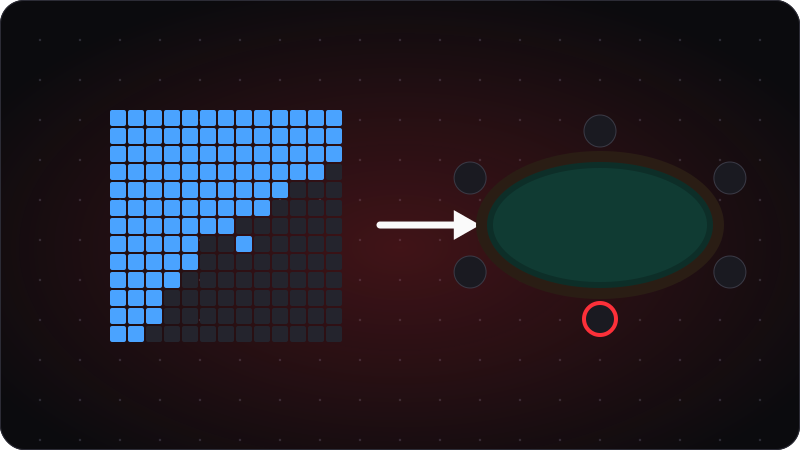
Poker is always a balance between two risks.
If you stay too close to equilibrium all the time, you may miss clear mistakes from the players you face.
If you deviate too quickly, you may create a leak of your own, and a good opponent can use it against you.
That is why the real question is not “GTO or exploitative?” as if you had to choose one forever. The real question is:
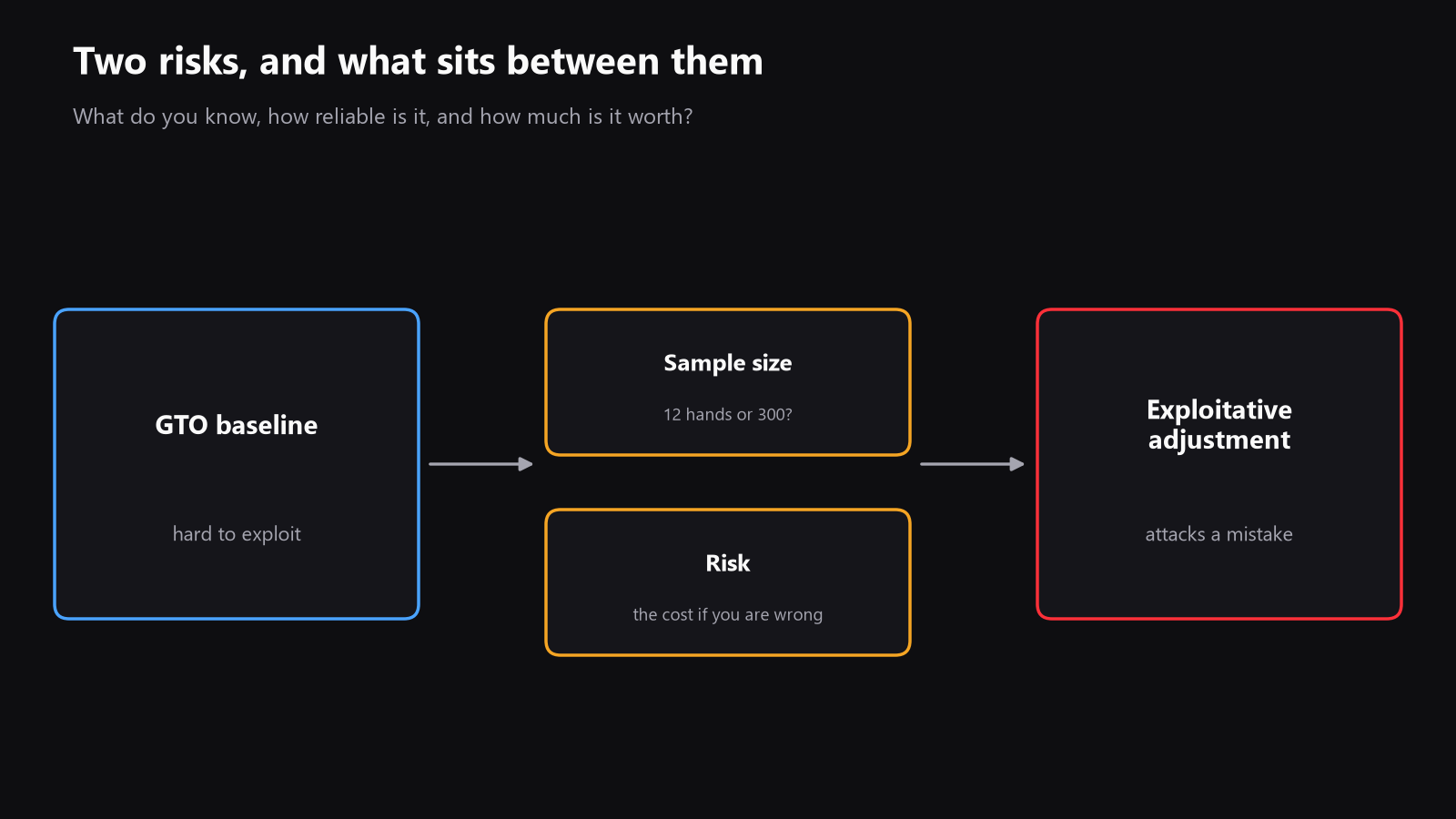
What do you know, how reliable is it, and how much is that information worth?
GTO is your baseline, not your religion
Game theory optimal play, or GTO, is the safest default because it is designed to be hard to exploit.
That does not mean it is automatically the highest earning line against every opponent.
It means that if your read is weak, your sample is small, or the pool is unknown, GTO protects you from making a guess that is worse than the theory.
Think of it this way:
- GTO answers, “What is robust if I do not know much?”
- Exploitative play answers, “What changes if I know something useful?”
That distinction matters because poker is full of false certainty. One player folds to a c-bet twice in a row and suddenly looks like a huge overfolder. One regular takes a strange line once and suddenly looks unbalanced. None of that is enough by itself.
A baseline is not a ceiling. It is a starting point.
What exploitative play really means
Exploitative poker is not “play wild” or “ignore theory.”
It means you adjust your strategy because the opponent, or the player pool at your limit, is not defending in the balanced way that theory assumes.
Examples:
- They fold too much versus flop c-bets.
- They call too wide on the river.
- They 3-bet too rarely preflop.
- They overbluff one street and underbluff another.
- The field at your stakes underdefends certain sizings.
If a leak is real, you should not pretend it is not there.
But there is a second part people forget: once you change your play, you may stop being balanced yourself. Then stronger opponents can adjust.
That is the price of exploitation.
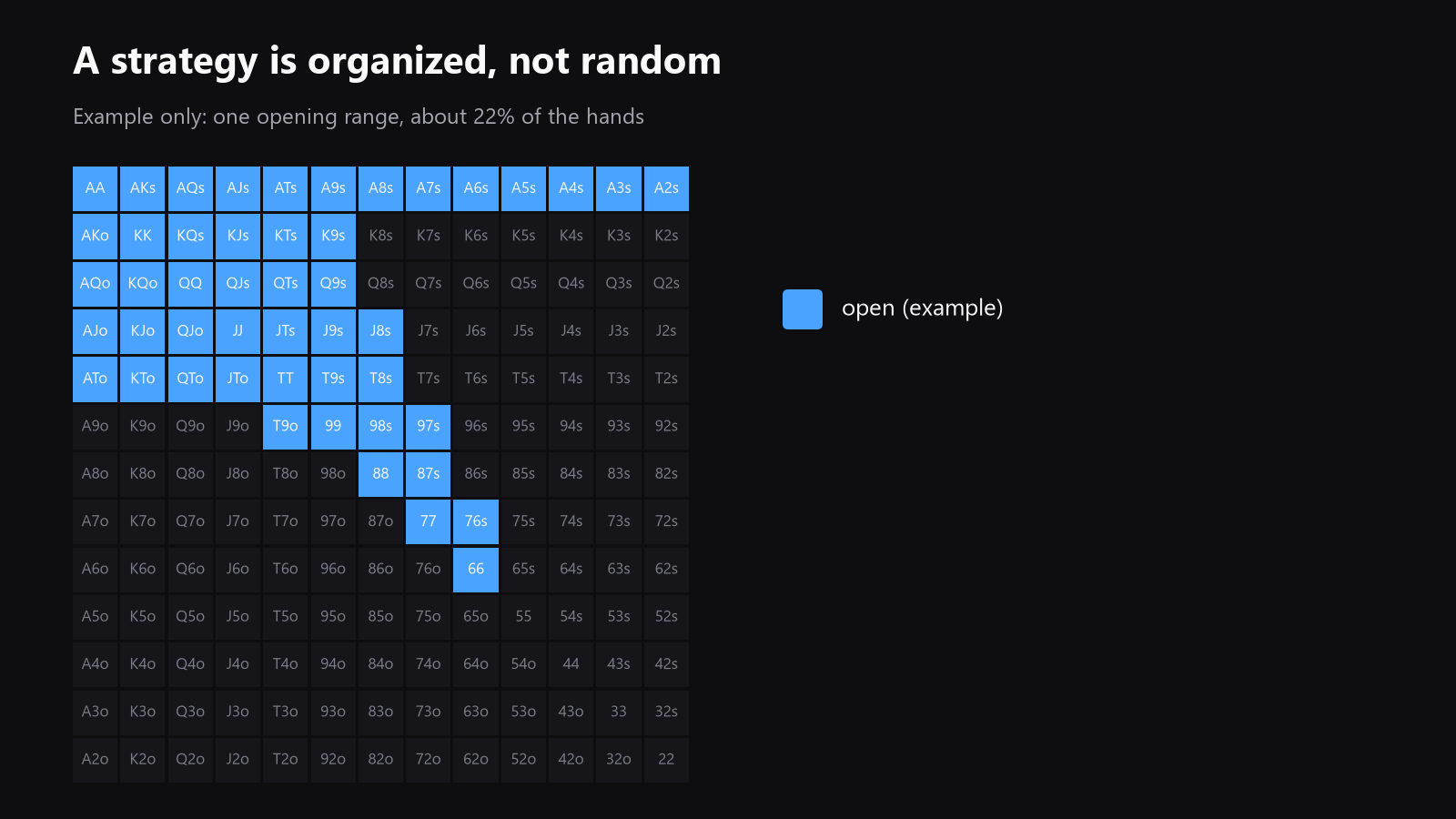
When you should stay close to equilibrium
You should stay closer to GTO when at least one of these is true:
1) Your information is weak
If you have seen very few hands, your read may be noise.
A player who folds 70% to river bets across 10 spots is not necessarily a 70% folder. That number can swing wildly with just a couple of hands.
2) The spot is high impact and the opponent is capable
The more streets remain, the more ways your exploit can backfire.
If you overbluff one street, a good opponent can call wider. If you overfold, they can print with aggression.
3) The pool is mixed or unknown
At the start of a session, against a new table, or in a tougher pool, the safest move is usually to remain near equilibrium until you have something solid to work with.
4) You do not know what the opponent knows
Some players notice patterns. Some do not. Some adjust immediately, some never do. If you cannot tell, do not assume they will fail to punish you.
5) The deviation is small anyway
If the expected gain from a read is tiny, the risk of being wrong can be larger than the benefit.
The important idea is simple: not every possible exploit is worth taking.
When you should deviate
You should start moving away from equilibrium when the evidence is good enough.
That can come from two places:
1) A strong read on one player
If a player has a large enough sample, and the pattern repeats, you can target them directly.
For example, if you know a player overfolds to flop bets, that changes your bluffing frequency. If they overcall, that changes your value betting and bluffing frequencies.
2) A stable population tendency
Sometimes the whole player pool at your limit shares the same leak.
Maybe the field at your stakes folds too often in certain spots. Maybe it underbluffs rivers. Maybe it calls too much preflop but too little on later streets.
If the tendency is stable, you do not need to wait for a perfect read on every single opponent. You can adjust against the pool itself.
That is exploitative play too.
The sample size problem
This is where many players go wrong.
They see a number and immediately act on it.
But a number is only as good as the sample behind it.
Here is a simple example.
Suppose the pot is 10 bb and you consider betting 5 bb.
If you bluff and expect the opponent to fold often enough, your bluff needs folds to show profit.
The break-even fold frequency is:
bet / (pot + bet) = 5 / 15 = 33.3%
So if the opponent folds more than 33.3% of the time, the bluff becomes profitable in a vacuum.
That sounds easy. The problem is not the arithmetic. The problem is the reliability of the data.
If you have seen only a handful of similar spots, a “55% fold rate” may not mean much.
If you have seen hundreds of similar spots, it means much more.
That is why sample size matters so much in exploitative poker. Without enough evidence, you are not exploiting. You are guessing.
Why being too exploitative can backfire
A deviation can be correct against one player and wrong against the next.
For example:
- You bluff more because one opponent overfolds.
- Another player watches, notices, and starts calling wider.
- Now your adjustment is no longer profitable.
This is counter-exploitation.
The same thing happens with value bets:
- If you bet thin for value because the pool calls too much, that is good.
- But if you always do it, you may end up value betting too wide against the players who do not call enough.
The lesson is not “never exploit.”
The lesson is “exploit where the evidence is strong, and keep the rest of your strategy protected.”
That balance is the core of strong poker.
Use theory to find the baseline, then use evidence to leave it
A practical way to think about poker is:
- Start from a baseline.
- Ask what the opponent or pool actually does.
- Measure whether the difference is meaningful.
- Deviate only when the edge is real.
This is where a solver is useful, not as a magic answer, but as a reference point. It gives you the equilibrium strategy of a spot away from the table, so you know what “normal” looks like before you decide to adjust.
Then you compare that baseline to reality.
If reality is close to equilibrium, stay close to equilibrium.
If reality is not close, exploit it.
A useful framework for your decisions
When you face a spot, ask yourself these four questions:
1) What does theory want here?
You do not need an exact number in every spot. You need the shape of the strategy.
Is this a checking spot? A betting spot? A mixed spot? Which hands belong to the aggressive side, and which hands are more comfortable checking?
2) What does the opponent actually do?
Is the opponent folding too much, calling too much, raising too much, or underbluffing?
3) Is the sample large enough to trust?
A trend in 12 hands is not the same as a trend in 300.
4) What is the cost if I am wrong?
If your exploit is small and safe, you can take it earlier. If your exploit is large and risky, you need more proof.
That is the discipline part of exploitative play.
Position changes everything
A lot of exploitative mistakes come from ignoring position.
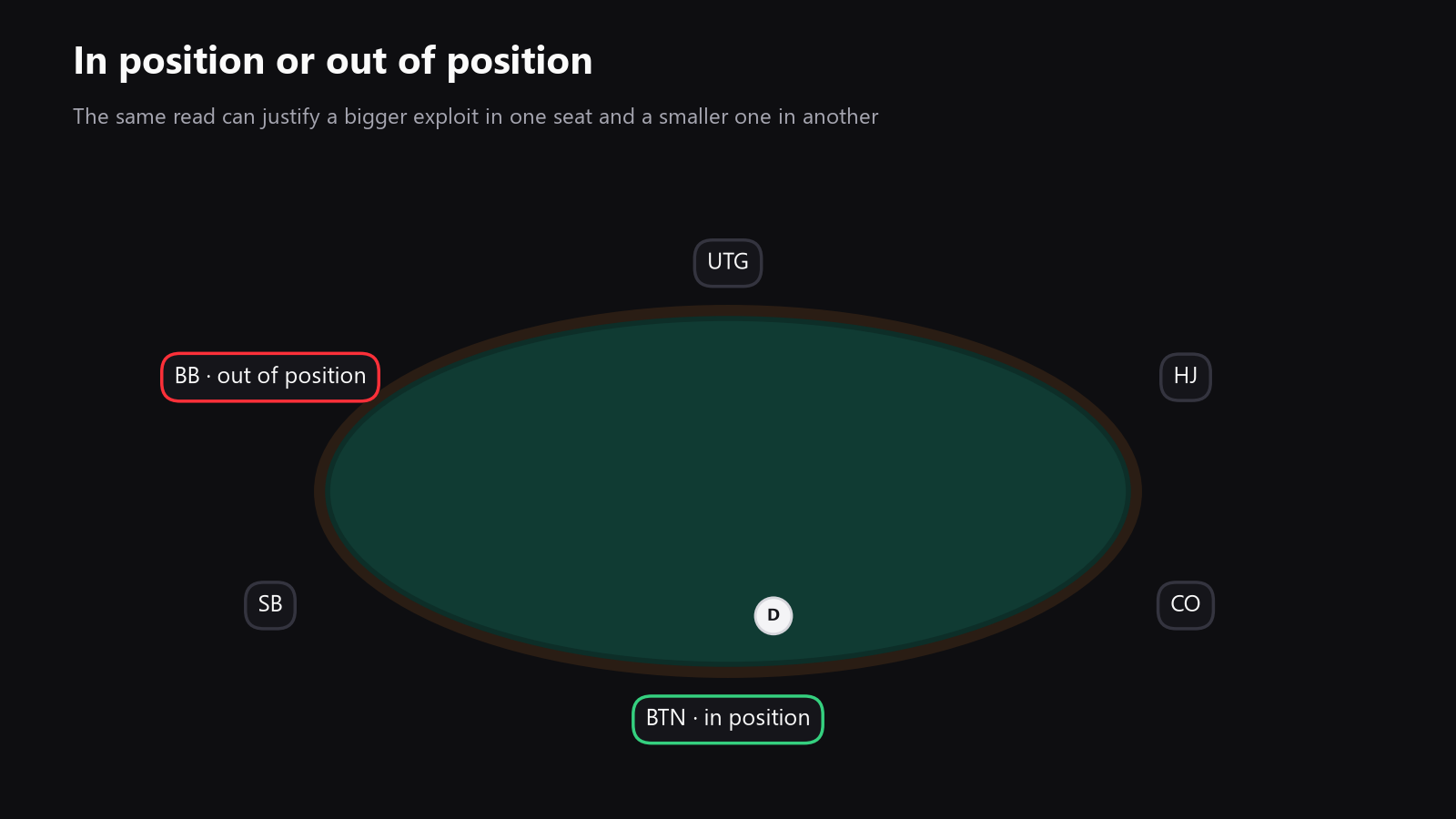
In position, you see more, control more, and can pressure capped ranges more often.
Out of position, your deviations need more caution because your hand is harder to realize and your line is easier to punish.
That means the same population tendency may justify a bigger exploit in one seat and a smaller one in another.
Do not copy a read blindly from one position to the next.
How to think about bluffing and value betting
Exploitative adjustments are often about frequency, not just hand selection.
If people fold too much, you can bluff more.
If people call too much, you can value bet more and bluff less.
The exact balance depends on pot size, bet size, and future streets.
For example, if you bet half pot on the river, the bluff-to-value balance that pressures a defender is different from a pot-sized bet.
The key idea is this:
- bigger bets need more folds to work as bluffs
- smaller bets need fewer folds
- the more a player overfolds, the more profitable your bluffing range becomes
- the more a player overcalls, the thinner your value bets can go
That is poker arithmetic, not magic.
A simple way to avoid leaks in your exploit
A strong exploit usually has three properties:
- it is based on a repeatable pattern
- it is large enough to matter
- it does not open you to a bigger counterattack
If one of those is missing, be careful.
If you want to study that systematically, the Reveal module shows what the players at your limits actually do, street by street and spot by spot. The Dashboard tells you whether your own sample is still too small to call a trend. And the Solver module gives you the equilibrium reference when you want to compare theory with the field.
That combination is useful because exploitative poker is not about guessing more aggressively. It is about adjusting with evidence.
The short version
Use GTO when:
- you do not know enough
- the sample is small
- the opponent is strong
- the risk of being countered is high
Exploit when:
- the leak is real
- the sample is strong enough
- the population tendency is stable
- the gain is worth the risk
That is the whole game.
GTO keeps your strategy resilient.
Exploitation can improve your expectation when the read is real.
Strong poker is knowing when to use each one.
Do it on your own hands.