
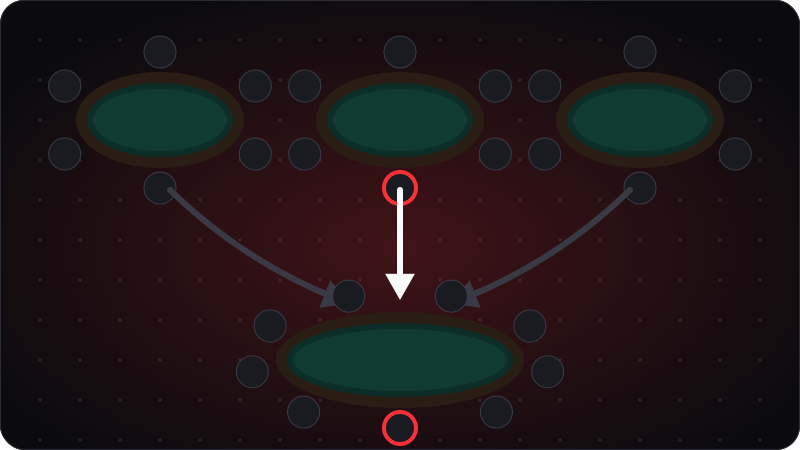
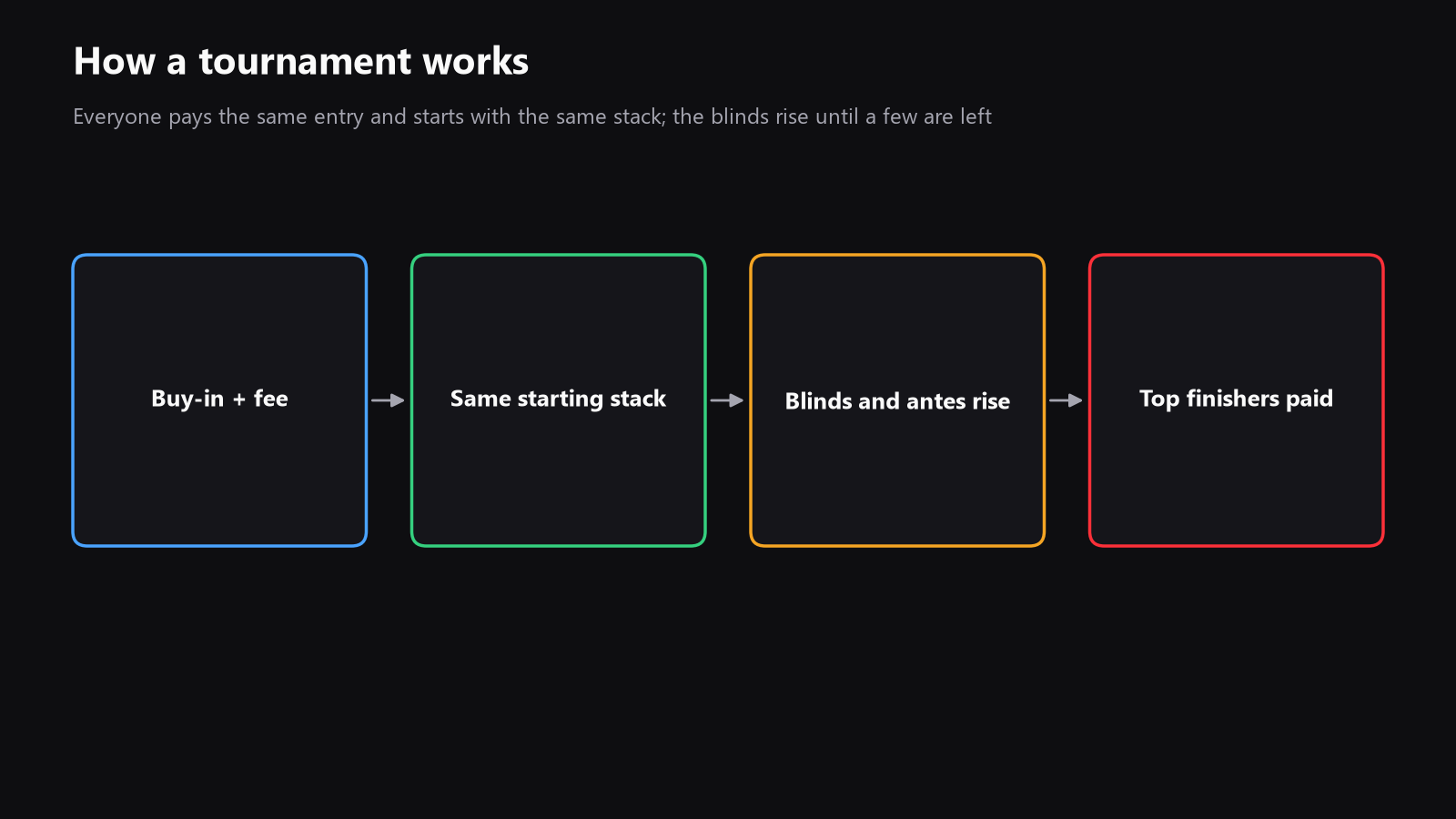
A multi-table tournament, or MTT, looks simple at first: you pay a buy-in, you get a stack, the blinds go up, and the last players alive collect the prizes. In practice, that changing structure is the whole game.
If you come from cash games, the biggest mistake is to treat tournament chips as if they were cash-game chips. In an MTT, one chip won is not worth exactly the same as one chip lost. The reason is not magic. It is the payout structure. Only the top finishers get paid, so your stack is not just a pile of chips. It is a share of the prize pool, and that share changes every time the field shrinks.
1. What an MTT really is
A tournament buy-in usually has two parts:
- the part that goes into the prize pool
- the fee, which goes to the room or organizer
For example, if an event costs $11, that may mean $10 for prizes and $1 in fee. The exact split depends on the site or live event, but the idea is always the same: some of what you pay becomes prize money, and some does not.
You start with a fixed stack. Then the blinds rise at regular intervals, often with antes added later. As the levels climb, the same stack buys fewer and fewer orbits. A stack that felt deep in level 1 can become short very quickly.
That is why MTT strategy is not only about playing hands well. It is also about managing stack depth, survival, pressure, and timing.
A few tournament features matter a lot:
- Starting stack: your opening chip count
- Blinds and antes: the forced bets that make stacks shrink in big blind terms
- Payouts: the prize pool is paid to the top finishers, often very top-heavy
- Bubble: the point just before the money
- Final table: the last table, where pay jumps become large
If you want to understand tournament poker, you need to understand all five.
2. Why chips are not money
In a cash game, a chip is a chip. If you win 100 chips, you have won 100 chips, and each chip has the same cash value all the time.
In a tournament, that is not true.
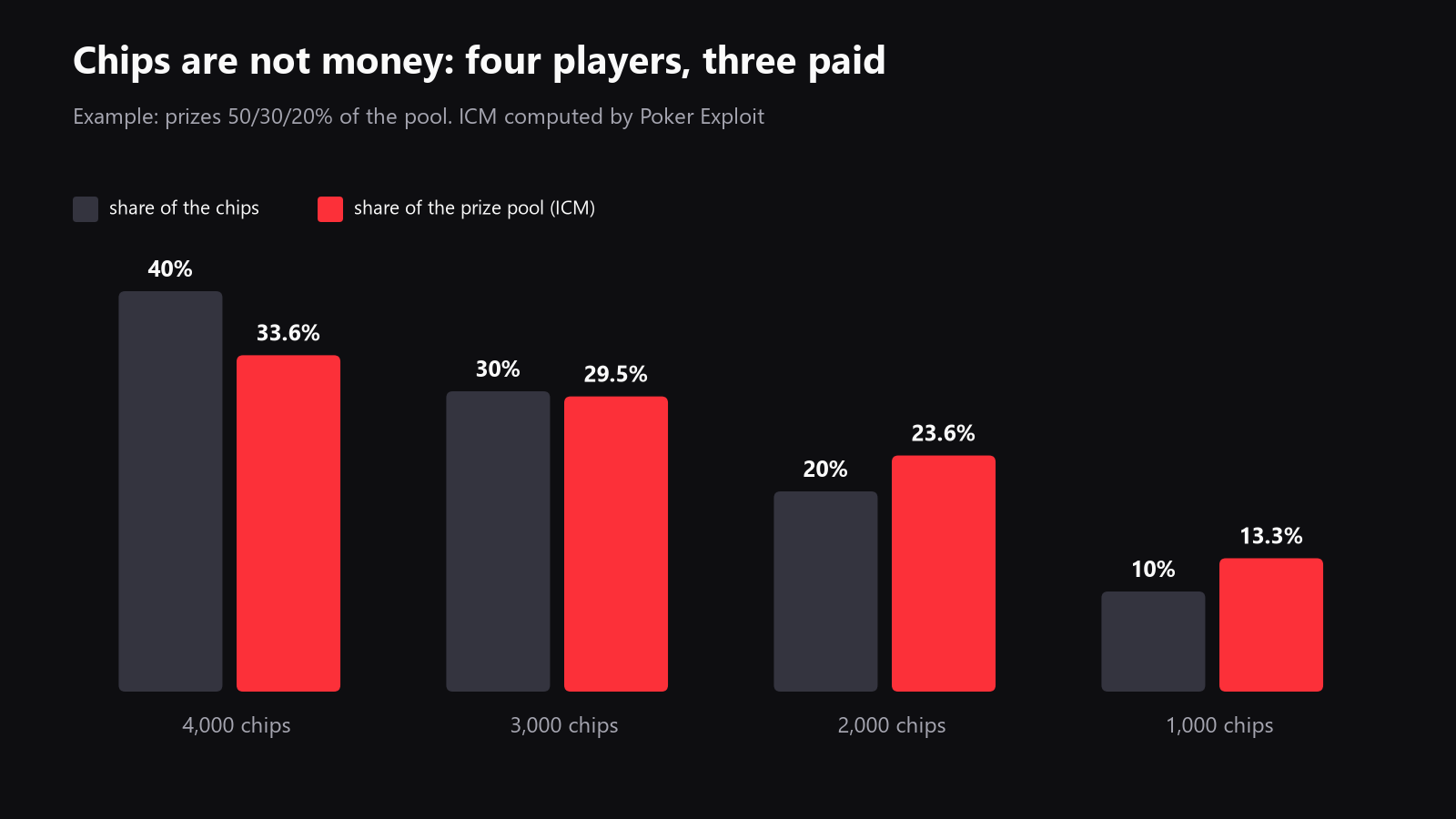
Why? Because chips have diminishing and changing monetary value. The first few chips you gain can increase your chance to survive and win the event, but later chips do not scale linearly into cash. At the same time, losing chips can hurt more than gaining the same amount helps, especially near the bubble and the final table.
That is the basic idea behind ICM, the Independent Chip Model. ICM estimates each stack’s share of the prize pool from chip stacks alone. It ignores skill, position, and blinds, and asks a simple question: if the tournament ended now, how much money equity does each stack have?
That is why a spot can be profitable in chips but not in money.
A simple example helps.
Imagine three players remain and the payout structure is top-heavy enough that the money jumps matter. If one stack wins a few chips from another, the winner gains some equity, but the loser gives up more equity than the winner gains. With only two players left, ICM is exactly proportional to chips, so that asymmetry does not appear.
This is why tournament players must ask a different question from cash-game players:
- not just, "Am I ahead in chips?"
- but, "What does this do to my chance to finish in the paid spots?"
That is also why a call can be correct in chips but wrong in money near the bubble, and why a shove can be right even when several players still have a chance to wake up with a hand, because the value of the shove depends on how much fold equity you have against the players behind you.
3. The real compass: stack depth in big blinds
In tournaments, the most useful way to measure your stack is in big blinds.
A stack of 2,000 chips means nothing by itself. It could be huge or tiny depending on the blinds. But 20 big blinds means the same thing in every event: you have about 13 orbits without antes, fewer once antes are in play.
This is why serious tournament players think in big blinds first.
Example:
- 1,500 chips at 25/50 = 30 big blinds
- 1,500 chips at 100/200 with a 25 ante = 7.5 big blinds
Same chip stack. Completely different situation.
That is the tournament compass:
- chips tell you your tournament life
- big blinds tell you your practical depth
- ICM tells you what those chips are worth in money at that stage
If you only look at raw chips, you miss the real picture.
4. How your strategy changes through the event
Tournament strategy is not one strategy. It changes with stack depth, blind pressure, and payout pressure.
Early levels
At the start, stacks are deeper in big blind terms, and the field is far from the money. That usually means:
- more room to play postflop
- more value in position
- more room for small mistakes to be recovered
- less immediate pressure from ICM
Early on, you can often play a more patient game. You still want to avoid fancy spots for no reason. Deep-stack tournament poker rewards hands that can win big pots when they connect, but it punishes overplaying one-pair hands out of position.
A common mistake is to treat early tournament poker like a cash game and ignore future blind pressure. Even deep stacks are not the whole story, because the blinds will not stay put.
Middle levels and antes
Once antes are in play, stealing blinds becomes more important. Every orbit costs more. This is usually where tournament strategy starts to feel aggressive:
- open-raises win more often
- blind defense matters more
- small sizing becomes attractive in many spots
- resteals and reshoves appear more often
Antes make dead money bigger. That means pots are worth fighting for, especially in late position.
This is also the stage where stack management matters most. If you let your stack slip from 25 big blinds to 12 big blinds, your options narrow fast.
The bubble
The bubble changes everything.
When the field is one or a few eliminations away from the money, ICM pressure spikes. Players with medium stacks become especially careful, because a bustout hurts far more than a small chip gain helps.
That creates classic bubble dynamics:
- big stacks can attack more often
- medium stacks fear collision
- short stacks need clear shove spots
- calling ranges tighten sharply
This is why a call that looks fine in chip EV can become a fold, even with a hand that would be easy in a cash game.
The key is not to become scared of every pot. The key is to understand who can afford risk and who cannot.
The final table
At the final table, ICM is strongest. Pay jumps are large, stacks are visible, and every elimination changes the prize structure.
Typical final-table adjustments include:
- big stacks applying pressure on medium stacks
- medium stacks avoiding thin calls against big stacks
- short stacks looking for first-in shove spots
- close attention to who covers whom
The most important word here is cover. If you cover another stack, you can hurt them more than they can hurt you, because busting has immediate payout consequences for them.
That does not mean you should become passive. It means you should choose your battles according to payout pressure, not only card strength.
5. Short-stack poker: where push/fold begins
When stacks get short, postflop poker shrinks and preflop decisions become central.
At around 10 to 20 big blinds, many situations become close to push/fold or raise-fold. At the shortest depths, the main question is often whether to shove first in, call a shove, or fold.
This is where many players get lost because they use cash-game instincts. In tournaments, a small chip edge is not always worth risking your whole stack. Conversely, a good shove can win blinds, antes, and fold equity without a showdown.
A useful rule is:
- the shorter you are, the more valuable fold equity becomes
- the deeper you are, the more valuable postflop skill becomes
- near the bubble, the same hand can shift value because of ICM
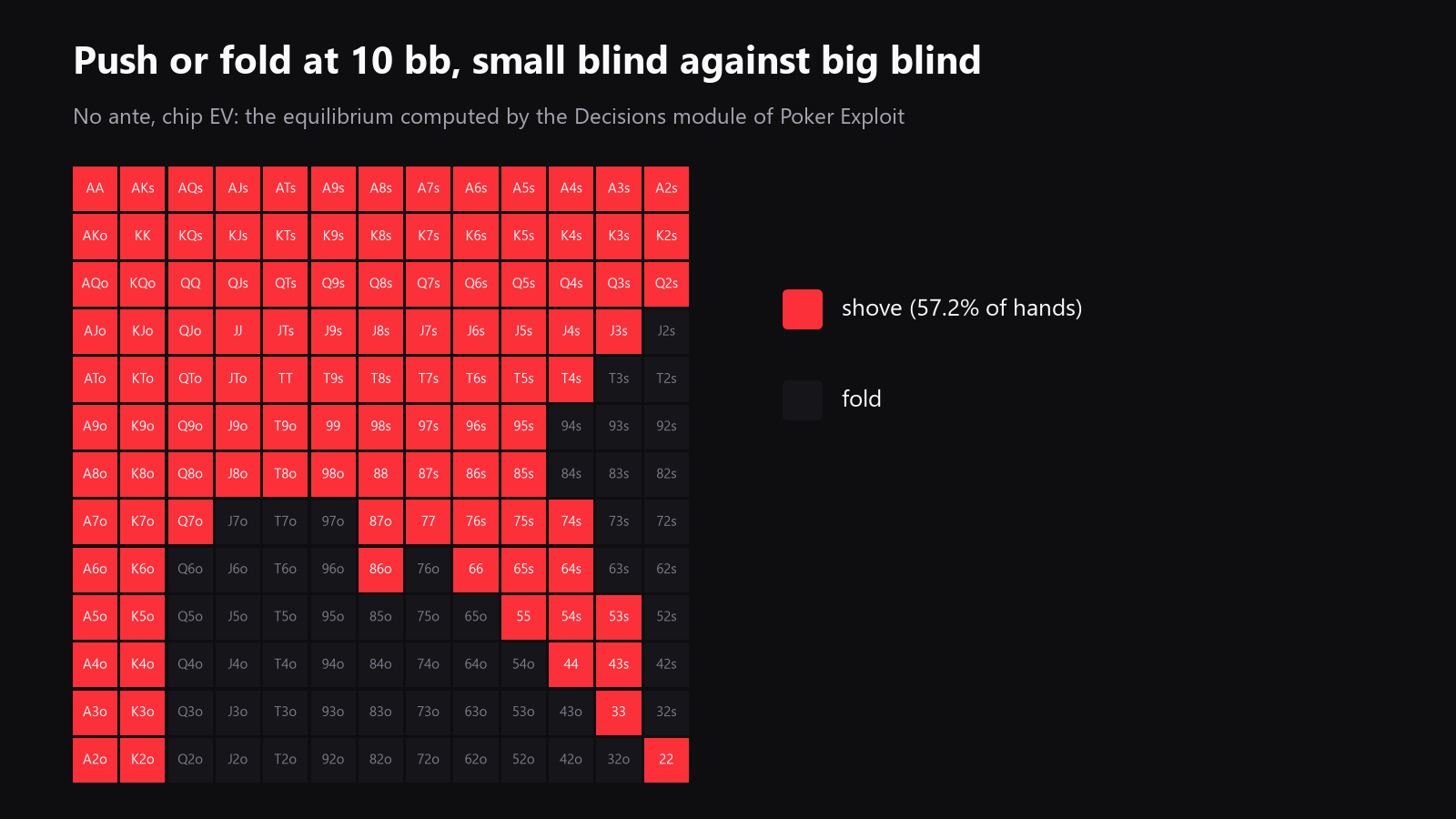
If you ever want to study these spots away from the table, the Decisions module in Poker Exploit gives push, fold, and call charts for short stacks. That kind of work belongs in review, not during play.
6. How to measure results in tournaments
Tournament results are noisy. Very noisy.
You can play well for weeks and still have a bad score line. You can also run hot for a small sample and think your strategy is better than it really is. That is normal.
This is why tournament players measure results over many events, not a handful.
The two most useful metrics are:
- ROI: return on investment
- ITM: in the money rate
ROI is:
(prizes won − everything paid to enter, fee included) / everything paid to enter
If you enter $1,000 worth of tournaments and cash $1,200, your ROI is 20%.
ITM is simply the share of tournaments you cash in. If you play 100 tournaments and cash 18 times, your ITM is 18%.
But neither number should be read too fast.
A player can have a decent ITM and a poor ROI if they min-cash too much and do not make enough deep runs. Another player can have a lower ITM and a strong ROI if their cashes are deeper and more valuable.
That is why you should not judge your tournament game by one session, or even by one week. You need a long enough sample for the payout structure to show its real shape.
If you want to track this properly, the Results screen in Poker Exploit shows ROI and ITM for tournaments. That makes it easier to separate real progress from short-term variance.

7. What to remember when you play MTTs
If you remember only a few things, make them these:
- An MTT is not a cash game. Chips do not have fixed cash value.
- Stack size should be thought of in big blinds, not raw chips.
- Antes change the game by increasing dead money and steal value.
- The bubble and final table are ruled by ICM pressure.
- Good tournament results require a large sample.
A strong MTT player does not just know hand rankings. They know when chips are worth more or less, when pressure matters more than card strength, and when survival has real equity.
That is the real base of tournament poker.
And if you want to study your own tournament hands with the same logic, that is exactly the kind of work Poker Exploit is built for: review the hands, track ROI and ITM, study short-stack spots, and use the tournament tools away from the table, never during a hand in progress.
Do it on your own hands.