
Guide
How to read a hand history
Every room writes one; few players open one. A plain text file, fully readable, holding more than the replay you remember.
2026-09-28
What is in the file
A header: room, hand number, game, stakes, date.
A table line: name, size, button seat. Then one line per seat: player and stack.
The action, street by street: blinds, raises (by how much, to how much), calls, folds.
A summary: who won what, and the cards anyone showed.
Most rooms write many hands into one file, one block after another; a file usually covers one table for one session.
A hand, line by line
The date in the header is when the hand started, sometimes written twice, in two time zones.
A tracker has to pick one and keep to it, or a session splits in two at midnight.
The button seat fixes every position at the table: count from it and you know who opened under the gun and who sat in the blinds.
The seat lines give each stack before the hand. Divide by the big blind and you have each player's depth, the first fact of any decision.
'Dealt to' is the only line with your own cards. Nobody else's appear unless they reach showdown or choose to show.
Each street opens with its cards: three for the flop, then one for the turn and one for the river.
The summary closes the hand: the total pot, the rake taken from it, the board, and one line per seat saying how that player left the hand.
Each room has its dialect
PokerStars writes 'raises 2 to 6'; Winamax 'raises 1.50EUR to 2.50EUR'; iPoker writes XML with action codes.
Currencies, decimal marks, the words for all-in or for a player sitting out: each one differs from one room to the next.
Some clients even write in the language of their interface, so the same action has several names in the same room.
A tracker's first job: read every dialect into one shape, so that a raise is a raise wherever it was made.
What a tracker sees that you do not
The pot at every point, which the file never states: it is rebuilt from the actions.
The trap is 'raises to': the figure that counts is the amount raised to, not the raise.
Position, the flop (paired, connected, high), how many players saw it: columns the tracker derives.
Who was the aggressor on the street before, which changes what a bet on this one means.
The rake as a share of each pot, then added up by room and stake: the room's cut only shows once it is summed.
Across thousands of files: how often a player did something in a spot, and how many times it was seen.
That count separates a figure worth acting on from noise. Without it, a coin flip reads as a fact.
Tournament files
A tournament hand reads like a cash hand, with chips instead of money and the level in the header.
Blinds and antes change from one level to the next, so the stack in big blinds is what the file lets you compare.
Most rooms also write a summary for each tournament: your finish and your prize, but not a single hand.
A tracker needs both: the hands for how you played, the summary for what it paid.
When a room changes its format
Rooms change their files without warning: a new currency sign, an action renamed, a line moved.
A tracker with each room's grammar built into the program needs a new version for every change, and reads nothing from that room until it has one.
Poker Exploit keeps each room's grammar in a file it updates on its own: when a room changes its format, the fix reaches you without a new version.
A refused file names the line it could not read. Send us that line: the fix arrives without a new version.
The file stays the source
Poker Exploit keeps every hand exactly as the room wrote it, compressed, and builds everything else from that original.
A new statistic, or a hand read better tomorrow, is recomputed from the originals: nothing to import again.
Old hands are packed down to about a fifth of the space the room's own files took.
Reading one yourself
Open the file in any text editor: it is plain text, and nothing in it is hidden.
Find a hand by its number, which most clients show in the table's own history window.
Rebuild the pot street by street once. It is the quickest way to see why 'raises to' is the figure that counts.
One hand is worth reading by eye. Ten thousand are what a tracker is for.
From the file to your game
The Replayer plays a hand back street by street, with the pot, the stacks and the equity at each step.
Its decisions mode opens each hand just before your first decision and jumps from one of yours to the next.
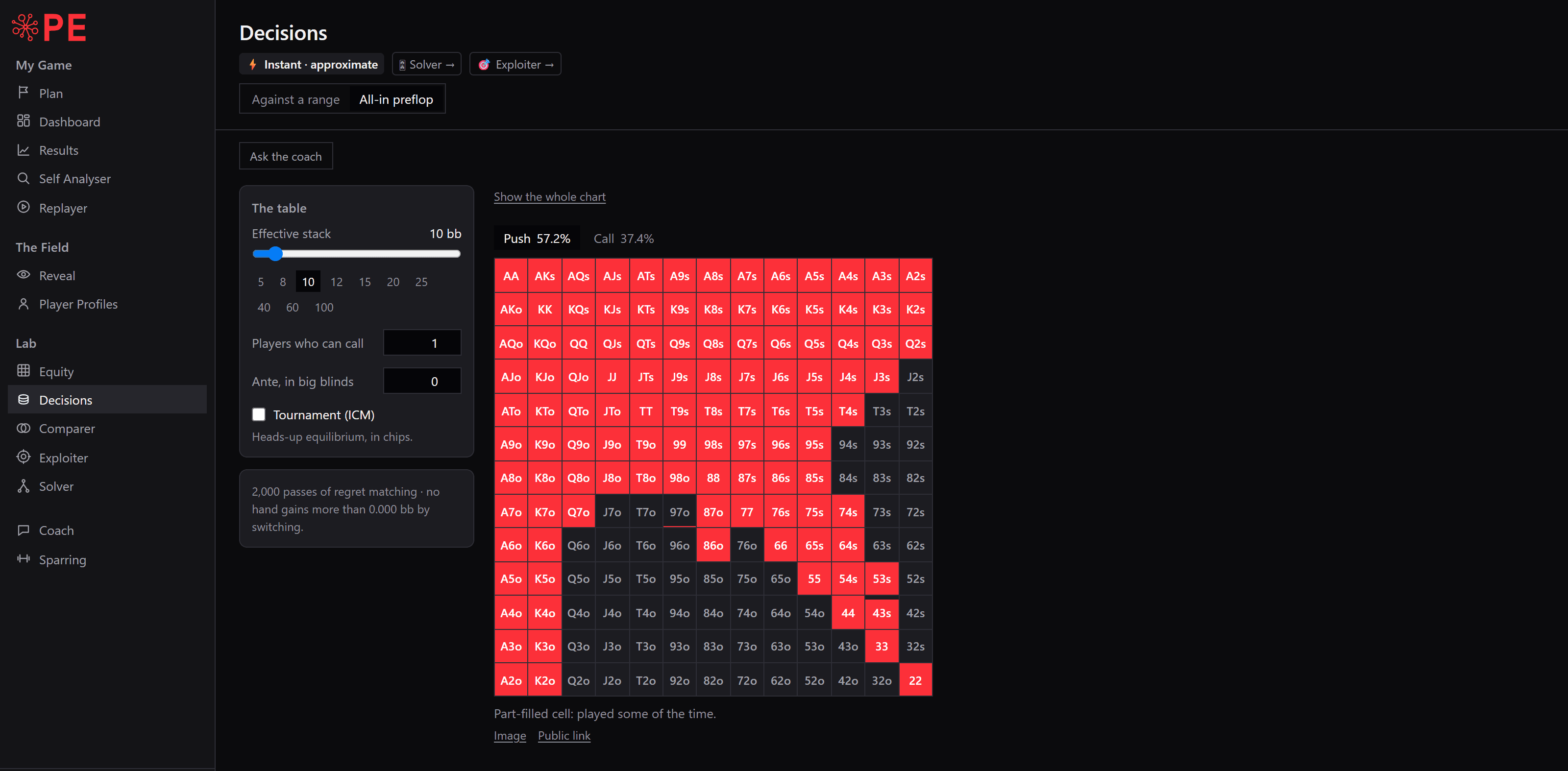
Decisions takes one spot, the board, your cards, the pot and the price, and shows the hands that answer it.
Results adds the hands up: your win rate with its interval, and the rake beside it, by room and stake.
Where the files are
Each room keeps them in its own folder, and each room has a page on this site saying where. The application looks there itself.
Point it at the wrong folder and it says so, and offers the right one.
The files and the database stay on your disk. No hand leaves it unless you send it yourself.
Try it on your own hands.
Download for free